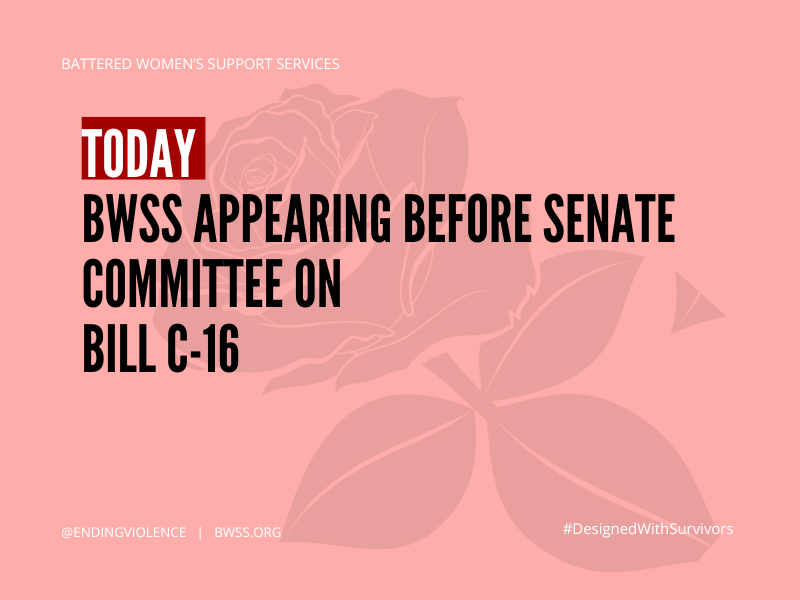
Today, Battered Women’s Support Services (BWSS) is appearing before the Standing Senate Committee on Legal and Constitutional Affairs as part of its study of Bill C-16, An Act to amend certain Acts in relation to criminal and correctional matters (child protection, gender-based violence, delays and other measures).
For more than 45 years, BWSS has worked alongside women and gender-diverse people experiencing intimate partner violence. Through crisis support, legal advocacy, counselling, prevention education, and systems advocacy, we have seen both the strengths and limitations of Canada’s responses to violence.
This frontline experience informs our participation in the Senate’s review of Bill C-16.
What is Bill C-16?
Bill C-16 proposes significant reforms intended to strengthen Canada’s response to violence, particularly intimate partner violence. The legislation includes measures related to:
Coercive control: Recognizing patterns of behaviour that dominate, isolate, intimidate, and entrap an intimate partner, even where physical violence may not be present.
Femicide: Acknowledging the gendered nature of lethal violence against women and girls.
Criminal harassment: Amending legal responses to stalking and harassment.
Mandatory minimum sentencing: Introducing or expanding certain sentencing provisions.
Child protection and related criminal justice measures: Addressing the impacts of violence on children and families.
BWSS supports the intent of Bill C-16 and welcomes efforts to improve legal recognition of coercive control and femicide. Survivors have long told us that the non-physical forms of abuse that shape their daily lives, including intimidation, isolation, surveillance, and economic control, are often misunderstood or minimized.
Why is BWSS speaking to Bill C-16?
While legal reform is important, our frontline experience demonstrates that legislation alone cannot improve safety.
Survivors have taught us two things simultaneously: they want violence to stop, and they want police and legal systems that help rather than harm.
BWSS is appearing before the Senate to ensure that survivors’ experiences inform the laws intended to protect them. Our submission emphasizes that intimate partner violence is often misunderstood as a series of isolated incidents when, in reality, coercive control operates as a pattern of domination and entrapment that escalates over time.
As we have stated in our submission:
The question is not simply, “What happened?” The question is, “What has been happening over time?”
This distinction is critical to ensuring that systems identify escalating risk and respond appropriately.
Key Issues Raised by BWSS
Protection Must Never Become Punishment
One of BWSS’s primary concerns is that laws intended to protect survivors may inadvertently criminalize them.
Frontline evidence demonstrates that survivors are sometimes misidentified as primary aggressors, particularly when systems rely on incident-based approaches that fail to recognize coercive control. Survivors acting in self-defence, protecting their children, or responding to trauma may themselves become entangled in the criminal legal system.
BWSS is calling for clear safeguards to ensure that survivors are not criminalized for actions taken to preserve their safety and wellbeing.
Femicide Is Preventable
Femicide rarely occurs without warning signs.
Escalating coercive control, separation, stalking, prior threats, and previous system contact often precede lethal violence. BWSS believes that Bill C-16 presents an opportunity to move Canada from reacting to violence after it occurs toward preventing it before it becomes lethal.
As our submission notes:
The tragedy is that too often, it was known then ignored, dismissed or downplayed.
Our intention is to continue advancing effective prevention that are grounded in coordinated responses, risk assessment, and police and legaly systems that act on known lethality risk factors before violence escalates.
Implementation Matters
Experience from other jurisdictions demonstrates that legal recognition alone does not improve safety.
Without appropriate safeguards, training, public education, and investment in community-based supports, reforms risk reinforcing existing gaps and harms. BWSS is calling for mandatory training, standardized approaches to risk assessment, public legal education, and sustained funding for community-based anti-violence services.
Community-based organizations are not ancillary to public safety, they are part of public safety infrastructure.
Survivors’ Experiences Must Inform Law Reform
Bill C-16 represents an important opportunity to strengthen Canada’s response to intimate partner violence. However, the effectiveness of these reforms will ultimately depend on whether they improve safety for survivors and their children.
BWSS is urging Parliament to ensure that legal reforms are accompanied by the safeguards, investments, and coordinated implementation necessary to prevent unintended harm and enhance survivor safety.
Ultimately, we will measure Bill C-16 not by what it recognizes, but by whether survivors and their children are safer because of it.
Read BWSS’s full submission on Bill C-16 and learn more about today’s Senate proceedings below.
https://sencanada.ca/en/committees/LCJC/meetingschedule/45-1
Safety changes everything.