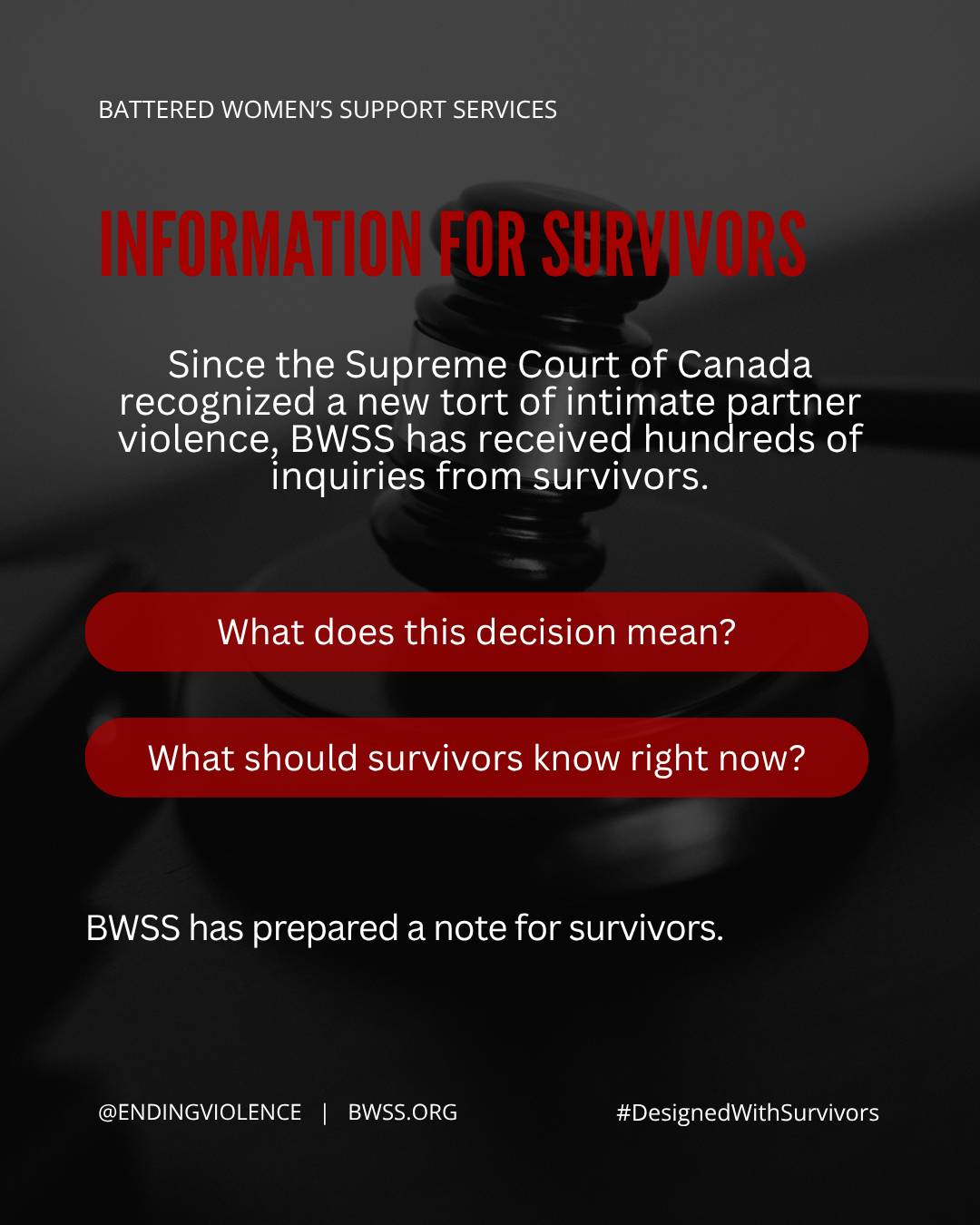
You may have heard about the landmark ruling by the Supreme Court of Canada (SCC) in Ahluwalia v. Ahluwalia recognizing a new tort of intimate partner violence.
A tort is a type of legal claim that allows someone to seek compensation for harms they have experienced. Unlike criminal or family law proceedings, tort claims are civil actions for damages. Many women accessing BWSS are navigating family law, immigration, criminal law, and child protection matters. This new tort exists within the civil legal system.
Last year, Battered Women’s Support Services intervened in the Ahluwalia case and asked the Supreme Court of Canada to:
- Recognize intimate partner violence as a standalone legal harm;
- Address systemic barriers experienced by survivors, including Black, Indigenous, and racialized women;
- Provide a clearer and more accessible pathway to legal redress for survivors of intimate partner violence.
On May 15, 2026, Supreme Court of Canada released its decision in the Ahluwalia case, recognizing a new tort of intimate partner violence grounded in coercive control. This marks an important moment in access to justice for victims and survivors.
What survivors should know:
Unlike family law, there are generally very limited low-income legal representation options for civil claims, including claims under this new tort of intimate partner violence.
In addition, successful civil claims often depend on whether both parties have financial means and resources. To pursue a civil claim, a survivor must usually either:
• pay legal fees directly; or
• find a lawyer willing to work on a contingency fee basis.
A contingency fee arrangement means the lawyer is only paid if the case is successful, usually through a percentage of a settlement or damages award.
For compensation to be recovered, the perpetrator of abuse must also have assets, income, insurance coverage, or financial resources available to satisfy any damages awarded by the court.
At this time, BWSS does not provide civil litigation representation or legal advocacy related to tort claims for intimate partner violence. We are actively exploring what supports and information may be possible in the future as we continue to assess the implications of this decision.
At the same time, this ruling will benefit survivors beyond civil lawsuits themselves. The Supreme Court of Canada directly addressed many of the issues raised by BWSS and other interveners, including coercive control, patterns of abuse, autonomy, entrapment, and systemic barriers survivors face. Survivors and their lawyers may draw on this language in other legal contexts moving forward.
We are grateful to Kuldeep Kaur Ahluwalia for bravely taking on this challenge, including for a period of time as an unrepresented litigant. This new tort of intimate partner violence represents an important moment for all who care about victims and survivors of intimate partner violence.
Yours sincerely,
BWSS Battered Women’s Support Services Association
Angela Marie MacDougall
Executive Director