
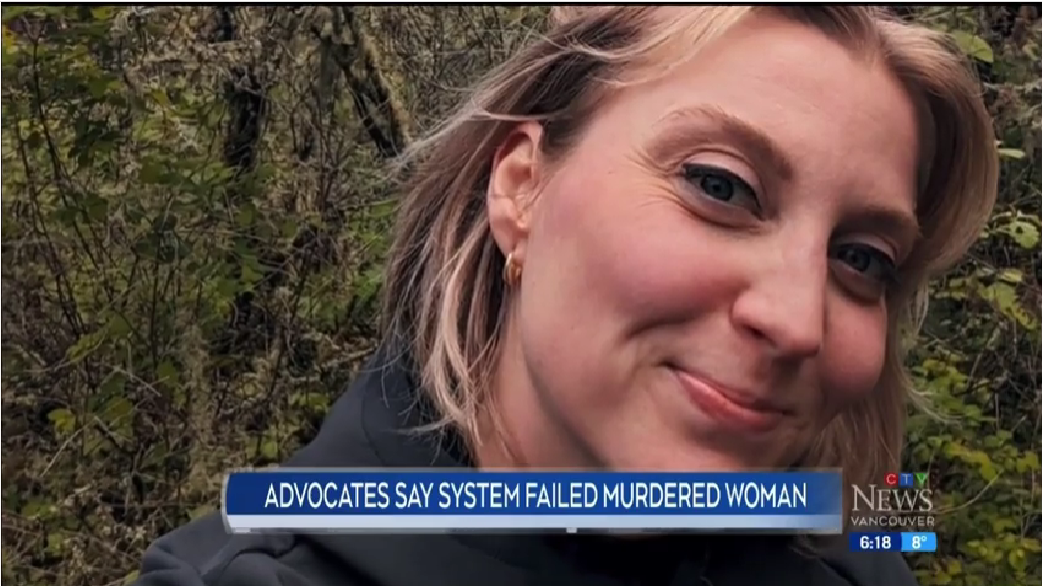
A breach was a warning. The system treated it as paperwork.
A woman in Saanich, British Columbia, Laura Gover, had a Family Law Act protection order. She had a detailed safety plan. She took extra precautions in her home, including a doorbell camera and extra locks. Friends described her as exhausted from living in a constant, heightened state of fear. On the day the accused was scheduled to appear in court for breaching that protection order, she was killed.
These facts are not abstract details. They are evidence of compliance with the very actions the system tells women to take when their lives are at risk. Women are told to seek protection orders, to plan for safety, and to rely on the justice system when a partner threatens violence. In this case, she did all those things. Violence still happened.
The video below features a longtime friend speaking about her efforts to stay safe. Her testimony should not be dismissed as emotion. The choices she made were not optional precautions. They were responses to known danger. Fear, in this context, was information, not hyperbole. The system knew risk existed. The system did not act as one.
A Breach Was a Moment for Action
A protection order granted legal constraints on contact. Reports indicate that this order was breached. A breach is not a technical process issue. A breach is a clear signal that danger has escalated. Surgeons respond to bleeding. Engineers respond to structural stress. When someone breaches a protection order, the justice system should respond with urgency.
Police, Crown counsel, and judges are all actors in that response. The way a protection order is enforced or escalated can mean the difference between safety and harm. Multiple detachments may hold information in separate files, as media reporting has suggested in this case. Fragmented information can lead to fragmented responses. Fragmented responses leave survivors exposed.
A response that treats breaches as routine paperwork or discretionary enforcement is not a response at all. A response that fails to integrate risk information across systems allows danger to continue.
Patterns We Have Documented
In 2024, BWSS released Justice or “Just a Piece of Paper?” because we were already seeing the same failure pathway repeat in cases across the province. Women complied with protective measures. Orders were breached. Risk escalated. Enforcement was inconsistent. Decision-makers in the justice system did not act in coordinated, preventive ways. The losses continued.
That report was not a collection of isolated stories. It was a call to acknowledge systemic failure. It named specific interventions that would create a justice response aligned with the lived realities of survivors. The recommendations that follow reflect the patterns we identified and the institutional responses needed to interrupt violence before it becomes fatal.
What Must Change
Mandatory Inquests When Protection Fails
When a woman is killed after seeking or holding a protection order or peace bond, a coroner’s inquest must follow immediately. This process is not intended to blame individuals. It is intended to examine the circumstances that allowed danger to continue. An inquest should determine what happened, why it happened, and how future deaths can be prevented. When protection is granted and still fails, the justice system must examine itself publicly and honestly. With each inquest, patterns become visible. Accountability becomes unavoidable.
Align Protection with Risk Duration
Decades of research and frontline practice show that the first two years following separation are the most dangerous. Protection orders and Section 810 peace bonds frequently expire long before the risk does. Requiring a two-year minimum for these orders aligns legal protection with actual risk. Survivors should not be forced to repeatedly engage with the court system just to maintain continuous protection. Frequent renewals expose survivors to additional stress and potential contact with the person who has harmed them.
Full-Length Orders on Without-Notice Applications
A without-notice protection order is granted because notifying the opposing party can increase danger. When judges issue short, interim orders that require a hearing within days, survivors are returned to court unnecessarily. This procedural requirement creates opportunities for coercion, intimidation, and re-engagement. Full-length orders in the first instance stop that loophole. They give survivors the uninterrupted time and stability they need to build safety, not fear repeated court contact as a condition of staying protected.
Centre Child Safety
The Family Law Act recognizes that exposure to intimate partner violence is itself a serious risk to children. In practice, however, courts still too often default to maximizing shared parenting time even when violence is present. Safety for children should always take precedence. When children are exposed to violence, the consequences are lifelong. Courts must require comprehensive risk assessments and ensure protection orders explicitly safeguard children from exposure to harm.
Universal, Cross-Jurisdictional Police Response to Breaches
Inconsistent police responses to breaches of protection orders and peace bonds are a persistent problem. A breach in one jurisdiction can be deprioritized, while in another it triggers immediate action. Survivors should receive equal protection regardless of where a breach occurs. Police forces across regions must adopt universal standards that include mandatory arrest for breaches, integrated databases that allow officers to see the full history of risk, and training that reflects the dynamics of intimate partner violence. Consistent enforcement sends a clear message that breaches will be taken seriously and that legal protections mean something.
Why This Matters Now
These recommendations were not abstract ideas. They were grounded in patterns already visible before this death. Inaction on these recommendations is not neutral. It means the same failure pathways will continue to produce the same outcomes.
This is not a personal tragedy. It is a systemic one. When a protection order is breached and the justice system does not respond as a unified, risk-informed mechanism, the protections become paperwork. That is not prevention. That is abandonment packaged as process.
Women should not have to manage danger alone while systems debate process. Women should not be told to do “everything right” and still be killed. The responsibility for preventing violence cannot be shifted onto those at risk. Justice must act when danger is known. Lives depend on it.



This is so frustrating, to keep seeing ladies dying.
I have said forever safety plans and protection orders are just pieces of paper and will not stop the killers.
This has been going on for so long. My husband wasn’t charged as the RCMP said it was up to them even when he broke my neck and back ribs. When he was banging on my door to get in and I called the RCMP they told me they couldn’t do anything until he actually got in. I told them I wouldn’t be able to call if he got in and I had a protection order. This was many years ago and it is devastating to hear that it is still going on.