Public Statement | January 11, 2026
When Silence Follows Women’s Deaths: Why We Are Naming Possible Femicides in BC
In the first week of 2026, two women have died in separate incidents in British Columbia. Based on publicly available information, both deaths show indicators consistent with femicide and must be understood within the broader context of gender-based violence and intimate partner violence in this province.
In Delta, two people were found dead in a private residence following a welfare check. Police have released no information about the relationship between the deceased, the cause of death, or the circumstances, beyond describing the incident as “isolated” and stating there is no public safety risk. When deaths occur in private homes and are treated as closed to public understanding, particularly where murder-suicide is a known pattern of femicide involving older women, silence itself becomes part of the problem.
In Saanich, a person has been charged with murder following a suspicious death in a home. Public court records show the accused was already before the courts in an intimate partner violence (K-file) matter for disobeying a court order, with a scheduled appearance on the same day the killing occurred. Police have acknowledged that “measures were taken” to manage risk while the accused was in the community, yet have provided no information about the victim, the relationship, or the nature of the risk that was known. The case is now formally designated as intimate partner violence.
In cases of lethal violence where risk was already known to police and the justice system, public communications often shift quickly to praising investigative process and inter-agency coordination, while withholding basic information about the victim, the relationship, and the nature of the risk that existed before the death. This kind of messaging narrows public understanding and deflects attention away from unanswered questions about why enforcement failed, how risk was assessed, and whether intervention opportunities were missed. In intimate partner violence cases, this pattern actively undermines prevention by treating lethal outcomes as procedural successes rather than system failures.
These two cases differ in circumstance, but they share troubling features: violence occurring in private spaces, prior system involvement, acknowledged risk, and a public narrative that withholds critical information while offering reassurance. This pattern makes it difficult for the public to recognize femicide, understand how risk escalates, or hold systems accountable for prevention.
Consistent with the approach of the Canadian Femicide Observatory for Justice and Accountability, BWSS names femicide based on indicators and public records, not final legal determinations. Waiting for perfect information has too often meant waiting until patterns are no longer preventable.
We recognize that investigations are ongoing and that details may evolve. Naming these deaths as possible femicides is not about assigning legal guilt. It is about refusing to allow women’s deaths to be rendered invisible through silence, minimization, system narrative control, or the language of isolation.
Preventing femicide requires more than investigation after the fact. It requires transparency when risk is known, enforcement when court orders are breached, and public systems that respond to violence before it becomes lethal.
We are not asserting motive or legal findings rather we are identifying risk indicators and systemic failures
As we begin 2026, we will continue to track, name, and speak about femicide in British Columbia because safety is not a private matter, and women’s lives depend on systems that act before it is too late.
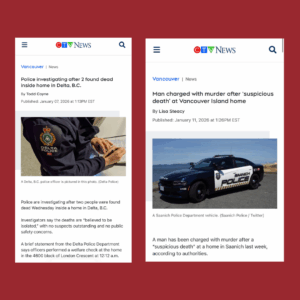
How 2026 Began: Two Deaths and a Familiar Pattern
For more information: Neighbours shocked over deaths of elderly couple inside Delta, B.C., home
Man charged with murder after ‘suspicious death’ at Vancouver Island home