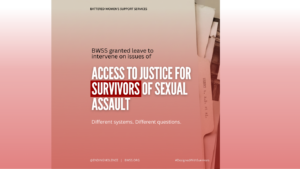
During Victims and Survivors of Crime Week 2026, BWSS was granted leave to intervene in a BC Court of Appeal case raising important questions about whether survivors can continue pursuing civil claims after criminal proceedings.
Case Summary and BWSS Intervention Context
The appeal in Henry v. A.B. et al. arises from one of the most well-known wrongful conviction cases in Canadian history and now sits at the centre of a separate legal dispute involving civil liability and sexual assault claims.
In 1983, Ivan William Mervin Henry was convicted of multiple sexual offences involving eight women in Vancouver and was declared a dangerous offender. He spent nearly 27 years in prison. In 2010, the British Columbia Court of Appeal overturned the convictions and entered acquittals after finding significant problems with the original prosecution, including failures related to disclosure, identification evidence, and trial fairness.
The acquittals did not determine who committed the assaults instead they determined that the criminal convictions could not stand.
Years later, five women who had been complainants in the criminal proceedings brought a civil lawsuit against Henry. In the civil case, the Court considered a different legal question under a different standard of proof. The issue before the civil court was whether, on a balance of probabilities, Henry was responsible for the assaults alleged by the plaintiffs. In January 2025, the BC Supreme Court found Henry civilly liable for the sexual assaults and awarded damages to the plaintiffs.
The current appeal now before the BC Court of Appeal arises from that civil decision.
One of the central issues in the appeal concerns how courts should treat overlapping criminal and civil proceedings, particularly in sexual assault cases. The appeal raises questions about the doctrine of abuse of process and whether civil claims should proceed after criminal proceedings have already taken place.
Courts use abuse of process doctrine to prevent proceedings considered unfair, duplicative, or harmful to the integrity of the justice system. Application of the doctrine can result in claims being limited or dismissed before a full hearing occurs.
Those issues have direct implications for survivors of sexual violence navigating the justice system.
Survivors often move through criminal and civil processes at different times and for different reasons. Criminal proceedings are initiated by the state and require proof beyond a reasonable doubt. Civil proceedings are initiated by individuals and proceed on a balance of probabilities. Criminal court focuses on guilt and punishment. Civil court addresses harm, accountability, and damages.
Many survivors experience criminal proceedings that do not result in charges or convictions. Others proceed through criminal court and still pursue civil claims because criminal proceedings do not address the full scope of harm experienced. Some survivors move forward with civil litigation years after criminal proceedings have concluded. Others spend years deciding whether continuing with legal action is emotionally, financially, or practically survivable.
The legal issues raised in this appeal affect whether those civil pathways remain accessible.
BWSS sought leave to intervene because the appeal raises broader public interest questions extending beyond the parties themselves and directly affecting survivors navigating overlapping legal systems after sexual violence.
On Thursday, May 7, 2026, the Court granted BWSS leave to intervene in the appeal.
BWSS is not a party to the litigation and does not take a position on the ultimate outcome of the appeal. The intervention focuses narrowly on the relationship between abuse of process doctrine and access to justice for survivors of sexual assault. BWSS brings more than four decades of frontline experience supporting women navigating criminal court, family court, and civil legal processes following violence.
Daily work at BWSS includes conversations with survivors trying to understand whether one legal process affects another, whether a civil claim remains possible after criminal proceedings conclude, and whether continuing with litigation is emotionally, financially, or practically survivable. Survivors regularly describe confusion about how different court processes connect, uncertainty about what legal options remain available, and exhaustion from repeated engagement with legal systems over many years.
BWSS sought intervention to ensure the Court hears from an organization with extensive frontline experience supporting survivors navigating these realities in practice.
BWSS is deeply grateful for to be represented in this appeal by Caitlin Ohama-Darcus, Partner at Lawson Lundell LLP, with support from Nicole Welsh and Pahul Gupta.
The appeal places questions about access to civil justice near the centre of the legal discussion. Court decisions about process shape whether survivors can continue with civil claims at all. Legal rulings developed in this appeal will influence how future courts interpret overlapping criminal and civil proceedings in sexual assault cases across British Columbia and beyond.