April 28, 2026
FOR IMMEDIATE RELEASE
“We’ve Been Saying This for Years”
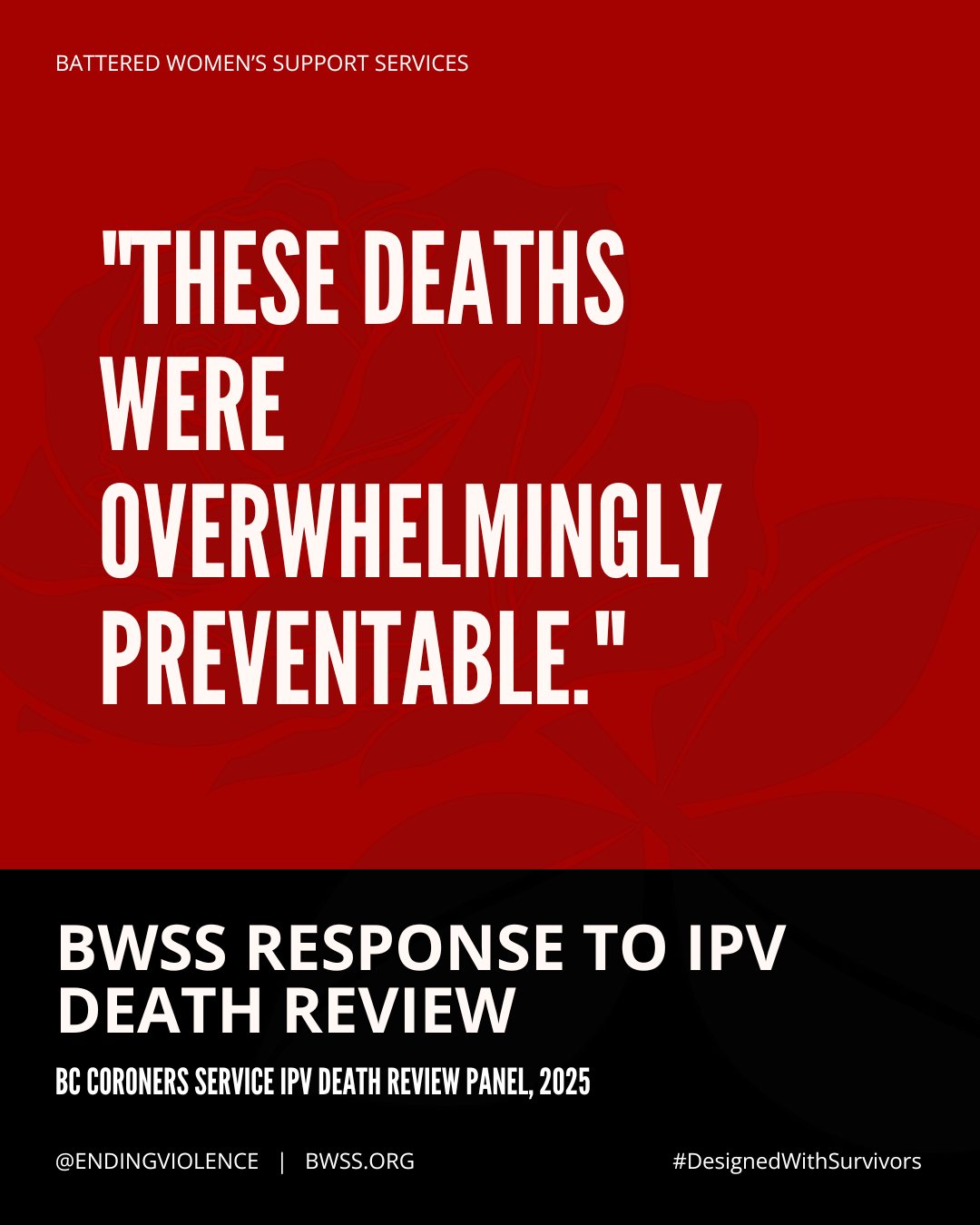
New Death Review Confirms Intimate Partner Violence Deaths Are Overwhelmingly Preventable
Vancouver, BC – The latest death review panel report, Our Time to Act, confirms what Battered Women’s Support Services has been documenting and raising publicly for decades, that intimate partner violence deaths in British Columbia follow a known pattern and are overwhelmingly preventable.
An earlier review covering 2010-2015 described the same sequence: prior violence, escalating risk, repeated contact with police and courts, and missed points of intervention. The current report shows that the sequence is continuing. Women who were killed were already known to systems, reports had been made, and in some cases, protection orders were in place.
The findings align with an independent review of British Columbia’s legal system led by Kim Stanton, which examined how police, Crown, and courts handle intimate partner violence cases and found many do not move forward. Taken together, the reports show a continuous path from system contact to escalation.
Economic conditions are also shaping that path. Current housing costs and financial instability limit the options available to women trying to leave. BWSS’s analysis of the 60 barriers to leaving shows how housing, income, legal processes, and safety concerns are managed at the same time. Provincial budget decisions influence whether safe options are available at the moment someone tries to leave.
British Columbia continues to have one of the highest rates of women killed by partners in Canada.
“For decades, survivors have been telling us what is happening, and we have been bringing that forward. This report confirms that intimate partner violence deaths follow a known pattern and are overwhelmingly preventable,” said Angela Marie MacDougall, Executive Director of Battered Women’s Support Services. “Women were already in contact with police, courts, and services before they were killed. The system response did not change the outcome.”
The recommendations in the report, coordination, training, information sharing, and earlier intervention, reflect actions BWSS has been advancing through its Five Asks:
- Municipal gender-based violence task forces to coordinate local responses
• Stabilization and expansion of frontline services
• Standardized risk assessment across police, courts, and related systems
• A province-wide prevention approach grounded in public safety
• Dedicated leadership on gender-based violence within public safety structures
“These actions are not new. They reflect what frontline work has been showing for years. Survivors are navigating housing, safety, and legal risk at the same time, while systems respond in pieces. When that response does not line up with the level of risk, the outcome is already visible.”