Jun 16, 2026 | Battered Women's Support Services
Battered Women’s Support Services (BWSS) is proud to be among 34 organizations selected to receive a National Capacity Building Grant administered by the Canadian Women’s Foundation and funded by Women and Gender Equality Canada (WAGE) through a process informed by national women’s rights organizations.
This investment comes at a critical time for organizations working to advance gender equality. Across Canada, women’s rights and gender justice organizations are responding to increasing demand, evolving public policy landscapes, and growing expectations for collaboration and systems leadership, often within funding environments that remain project-based and unpredictable.
For nearly 50 years, BWSS has worked alongside survivors in Vancouver and across British Columbia. Through crisis support, legal advocacy, prevention education, and systems advocacy, we have witnessed firsthand how gender-based violence is shaped by broader social, legal, and economic conditions. The expertise developed through this community-based feminist anti-violence work increasingly informs efforts to advance justice reform, public safety, and gender equality across Canada.
While BWSS remains deeply rooted in community-based anti-violence work in Vancouver and British Columbia, this investment recognizes and strengthens our growing role in national collaboration. Over the coming year, BWSS will enhance the governance, evaluation, strategic planning, and organizational systems that support cross-country partnerships, knowledge exchange, and survivor-informed contributions to efforts advancing justice, public safety, and gender equality across Canada. By strengthening the infrastructure that supports this work, BWSS will be better positioned to contribute to collective learning, foster collaboration across regions, and ensure that insights developed alongside survivors continue to inform systems change at local, provincial, and national levels.
At its heart, this investment is about strengthening feminist infrastructure. Strong movements require strong organizations. Community-based organizations working alongside survivors bring essential expertise to conversations about safety, justice, and equality. Sustaining that expertise requires investment not only in programs and services, but also in the organizational capacity that enables long-term leadership, partnership, and impact.
We are grateful to the Canadian Women’s Foundation for stewarding this process and acknowledge the investment of Women and Gender Equality Canada in strengthening organizations advancing gender equality. We also recognize the organizations that helped shape these investments through the Reference Group, reflecting the importance of collective leadership in building strong feminist movements across Canada.
BWSS is proud to stand alongside communities and organizations across the country working to advance justice, safety, and gender equality. Rooted in community and informed by the experiences of survivors, we remain committed to contributing to the collective work of creating a future where safety, dignity, and equality are realities for everyone.
Safety changes everything.
For more information on the Canadian Women’s Foundation website:
Jun 8, 2026 | Battered Women's Support Services
FOR IMMEDIATE RELEASE
Community Organizations Launch Coordinated Gender Safety Response for FIFA World Cup 2026
BWSS Expands Crisis-Line Services, Launches FIFA Safety Card Initiative, and Premieres New Public Service Announcement as Good Night Out Vancouver Expands Community Safety Outreach
VANCOUVER, BC, June 8, 2026 – As Vancouver prepares to welcome hundreds of thousands of visitorsduring FIFA World Cup 2026, community organizations are coming together to ensure gender safety is part of thepublic safety conversation.
Today, BWSS and Good Night Out Vancouver announced a coordinated, community-based response to gender-based violence during the six-week tournament period, highlighting the need to consider safety not only in stadiums and public gathering spaces, but also in homes, workplaces, nightlife venues, andcommunities.
While much of the planning surrounding FIFA World Cup 2026 has focused on transportation, tourism, crowds, hospitality, and public celebrations, today’s announcement focused on a different question:
What would it look like if safer streets, safer nightlife, and safer homes were all part of the same public safety conversation?
Together, BWSS and Good Night Out Vancouver represent two critical components of a comprehensive safety response during FIFA World Cup 2026: prevention in public spaces and support behind closed doors.
As part of today’s announcement, BWSS confirmed it will temporarily expand its specialized crisis-line services to 24hours a day, seven days a week throughout the six-week tournament period. The enhanced service will ensure survivors have access to information, emotional support, safety planning, risk assessment, crisis intervention, and referrals whenever they need support.
BWSS also launched its FIFA Safety Card Initiative, a practical resource designed to increase awareness of available supports and provide accessible safety information to individuals who may be experiencing violence, coercive control, stalking, harassment, or other forms of abuse.
The event also marked the premiere of The Space Between, a new public service announcement developed by BWSS to raise awareness about coercive control and the realities manysurvivors experience behind closed doors.
Set during a World Cup match, the film explores coercive control through the eyes of a survivor. Rather than depicting physical violence, The Space Between focuses on fear, monitoring, isolation, tension, and survival behaviours that often precede escalation. The film asks viewers to recognize abuse before violence escalates and challenges the tendency to dismiss warning signs that are often hidden in plain sight.
Good Night Out Vancouver announced a series of FIFA-related outreach initiatives designed to support safer nightlife and public environments throughout the tournament period. The organization will work directly within nightlife and hospitality settings to support safer venues, strengthen bystander awareness, provide community outreach, and help create safer experiences for residents, workers, and visitors.
“Everyone deserves to enjoy summer events in Vancouver safely, and creating safer environments is a shared responsibility. We appreciate that the City of Vancouver recognises this and the role Good Night Out’s outreach team plays in supporting the safety of women and other marginalized genders in our city,” said Stacey Forrester, Education Director, Good Night Out Vancouver.
“During FIFA World Cup 2026, the Good Night Out Street Team will be offering support, care, and a friendly,visible presence to anyone in the public realm, including patrons, workers and people sheltering in the street. We know that large events bring increased crowds, alcohol consumption, and social activity. We also know that while most people will have a positive experience, having additional support available helps people accessassistance if needed, which contributes to a safer and more enjoyable experience for everyone. Look for our friendly team in pink.”
International research has identified increases in reports of intimate partner violence during some major football tournaments. Sport does not cause violence against women. However, periods associated with heightened emotional intensity, alcohol consumption, gambling stress, nightlife activity, and social gatherings can intensify existing patterns of coercive control and abuse.
For many survivors, the risks associated with major sporting events are not experienced in stadiums. They are experienced at home.
Today’s announcement included a joint call for gender safety and violence prevention to be recognized as essential components of public safety planning during major international events.
Both organizations emphasized that meaningful public safety requires prevention, early intervention, survivor support, and community awareness working together.
As Vancouver prepares to welcome the world, we have a responsibility to ensure that gender safety is part ofour public safety response. Through our collaboration with Good Night Out Vancouver, we are strengthening both prevention and intervention efforts related to gender-based violence and intimate partner violence. Good Night Out is helping to create safer community and nightlife spaces, while BWSS is expanding crisis response and support for survivors. Through The Space Between and our temporary expansion to 24/7 crisis-line services, we are reminding our community that not all abuse is visible, coercive control is abuse, and survivors deserve safety. Safety changes everything.” said Angela Marie MacDougall, Executive Director, Battered Women’s Support Services.
Battered Women’s Support Services (BWSS) A feminist voice against violence and oppression, BWSS is a strong, dynamic organization that provides support and advocacy for women who have experienced abuse, as well as community education and training about violence against women. Part of a global feminist anti-violence movement, ourlong-term goal is the elimination of all violence against women and girls. www.bwss.org
Good Night Out Vancouver
Good Night Out Vancouver works to prevent sexual harassment and sexual violence in nightlife, hospitality, festival, and community spaces through education, outreach, bystander intervention, safer-space programming, and community engagement. https://www.goodnightoutvancouver.com/
May 31, 2026 | Battered Women's Support Services
FOR IMMEDIATE RELEASE
May 31, 2026
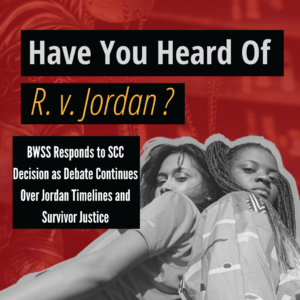
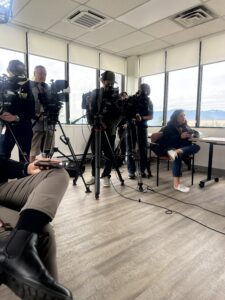
Anti-Violence Organization Responds to SCC Decision as Debate Continues Over Jordan Timelines and Survivor Justice
Vancouver, BC: On Friday, the Supreme Court of Canada released its decision in R. v. Vrbanic, a case examining the Jordan framework and constitutional timelines related to criminal court delay under section 11(b) of the Charter.
Battered Women’s Support Services (BWSS) intervened in this case to raise concerns about the impact rigid delay timelines can have on victims and survivors of intimate partner violence and sexual violence.
The Jordan framework establishes presumptive timelines for criminal prosecutions. When those timelines are exceeded, charges may be stayed and prosecutions halted. BWSS argued that intimate partner violence and sexual assault cases present unique complexities — including trauma-informed protections, vulnerable complainants, extensive evidentiary processes, publication bans, digital evidence, and coordination across multiple systems and services — which can extend the time required to prepare prosecutions.
BWSS intervened in R. v. Vrbanic after raising concerns since 2018 about the impact the Jordan framework can have on victims and survivors of intimate partner violence and sexual violence, particularly as these cases have become increasingly procedurally complex.
“While the Court did not make major changes to the Jordan framework, the decision provides important clarification regarding the complex case exception,” said Caitlin Ohama-Darcus, counsel for BWSS. “The separate reasons from Justice Rowe are also significant in recognizing concerns about the impact of stays on victims and broader public confidence in the administration of justice. These are issues BWSS and other interveners have been highlighting for years.”
BWSS intervened to ensure that the realities facing victims and survivors of gender-based violence were before the Court and reflected in the national legal conversation around access to justice, procedural fairness, and public safety.
“The Supreme Court of Canada’s decision reflects the growing tension inside the criminal legal system itself,” said Angela Marie MacDougall, Executive Director of BWSS. “Cases involving intimate partner violence and sexual violence are increasingly complex because survivors require protections, accommodations, and trauma-informed processes. When the system is not adequately resourced to support that complexity, victims and survivors can experience delay, retraumatization, and, in some cases, the loss of any opportunity for accountability or legal recognition.”
BWSS will continue advocating for survivor-centred justice system reforms, coordinated risk assessment, trauma- and violence-informed responses, and meaningful access to justice for victims and survivors of gender-based violence.
About BWSS
Battered Women’s Support Services (BWSS) works to end violence against women and gender-based violence through crisis support, advocacy, counselling, legal advocacy, violence prevention, training, and systemic change initiatives across British Columbia.