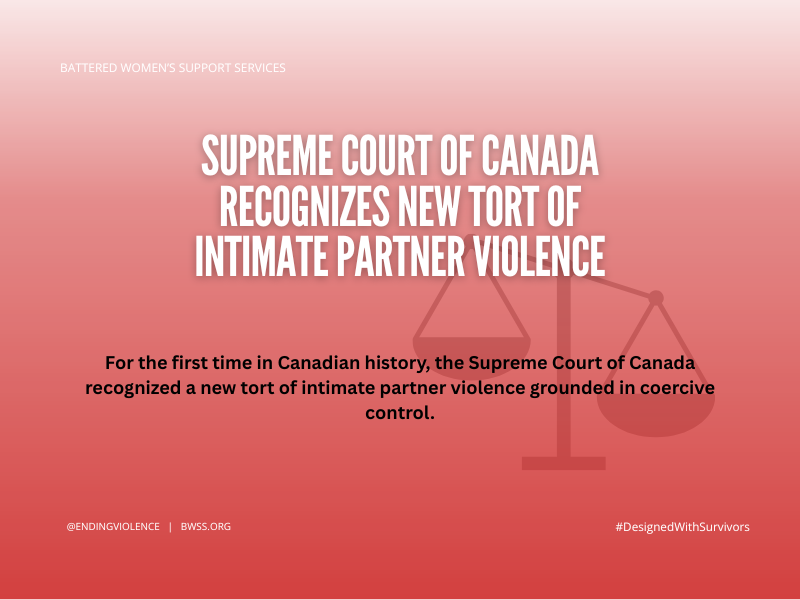
Today, the Supreme Court of Canada released a landmark decision recognizing, for the first time in Canadian history, a new tort of intimate partner violence grounded in coercive control, a historic legal development that fundamentally changes how Canadian law understands intimate partner violence, coercion, autonomy, dignity, and equality within intimate relationships.
Today is also a testament to the extraordinary courage and determination of Kuldeep Ahluwalia, who stood in her power and used her voice to pursue justice through years of litigation beginning during the COVID lockdown period, much of it while self-represented. Today’s decision is the result of her persistence, courage, and refusal to allow her experiences to be minimized or erased. Today is her victory.
For decades, survivors and anti-violence organizations have tried to explain that intimate partner violence is not simply a series of isolated assaults or incidents, but an ongoing pattern of domination, surveillance, intimidation, humiliation, financial control, fear, and entrapment that strips away autonomy and freedom.
In its majority decision in Ahluwalia v. Ahluwalia, the Court recognized that intimate partner violence can constitute “coercive and controlling conduct that undermines autonomy” through “tactics of isolation, manipulation, humiliation, surveillance, economic abuse, sexual coercion, and intimidation that can control and entrap intimate partners.”
The Court further recognized that intimate partner violence is often “greater than the sum of its parts,” rejecting narrow incident-based understandings of violence that fail to account for cumulative patterns of coercion and domination over time.
Writing for the majority, Justice Kasirer stated:
“The new tort is tied to the intimate partnership and is distinct from existing torts in that it seeks to compensate a qualitatively different wrong of coercive control, and a qualitatively different harm of the loss of autonomy.”
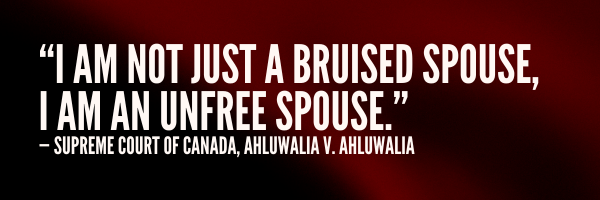
In one of the most powerful passages of the decision, Justice Kasirer wrote:
“I am not just a bruised spouse, I am an unfree spouse.”
“This decision represents a profound shift in how Canadian law understands intimate partner violence,” said Angela Marie MacDougall, Executive Director of Battered Women’s Support Services Association.
“For decades, survivors have tried to explain that intimate partner violence is not merely episodic violence, but a condition of coercion and control that shapes daily life. Survivors adapt their behaviour to survive. They live under surveillance, intimidation, isolation, economic control, fear, and threats that are often minimized as relationship conflict or private dysfunction. Today, the highest court in the country recognized that reality in law.”
The Court found that existing torts failed to fully account for the distinct harms caused by coercive control and often left survivors trying to fit cumulative experiences of domination and abuse into fragmented legal categories.
Importantly, the Court explicitly recognized that intimate partner violence is profoundly gendered and acknowledged the heightened vulnerability experienced by Indigenous, racialized, disabled, and marginalized women.
BWSS intervened before the Supreme Court of Canada alongside counsel from Lawson Lundell LLP, with a focus on the experiences of Indigenous, Black, racialized, disabled, and marginalized women experiencing intimate partner violence and coercive control, realities specifically recognized by the Court in its reasons.
“The significance of this development in Canadian law for the appellant, Kuldeep Ahluwalia, and for organizations like Battered Women’s Support Services and the women they help cannot be understated,” said Caitlin Ohama-Darcus, Lawson Lundell LLP, counsel for BWSS.
“In a judgment released this morning, the Supreme Court of Canada has recognized a new tort of intimate partner violence. As stated by the majority (per Kasirer J.), ‘The new tort is designed to recognize that gap in the law and to equip judges with resources in the private law toolbox to respond to the distinctive wrong of intimate partner coercive control and the distinctive injury to victims’ autonomy that goes beyond the physical and psychological losses it brings in the intimate partner setting. This is a matter of access to justice[.].’”
“This is a momentous day for victims and survivors of intimate partner violence, to have the specific form of harms they experience clearly recognized by the Supreme Court of Canada is a huge victory. Access to justice means access to meaningful remedies. The Supreme Court of Canada’s recognition of new tort of intimate partner violence is a significant step in the direction towards addressing and ultimately ending domestic violence in Canada.”
The Court also explicitly recognized forms of coercive control including financial control, litigation abuse, surveillance, intimidation, social isolation, threats involving children, and post-separation coercion and control.
Importantly, the Court distinguished intimate partner violence from “mere grievances” or “high-conflict disputes,” recognizing that coercive domination cannot be reduced to mutual dysfunction or ordinary relationship conflict.
“This decision matters far beyond civil damages,” said MacDougall. “It reshapes how coercive control, cumulative harm, post-separation abuse, and inequality within intimate relationships may be understood across legal systems and public institutions. It challenges systems that continue to interpret coercive domination as mutual conflict, communication problems, or isolated incidents.”
While BWSS recognizes today’s decision as historic, the organization cautions that legal recognition alone will not end violence against women.
Survivors still face enormous barriers to safety, housing, financial security, immigration stability, child custody, and meaningful access to legal representation. Many survivors continue to encounter systems that minimize coercive control, misunderstand cumulative harm, or fail to recognize the realities of post-separation abuse.
“Today’s ruling changes the legal landscape,” said MacDougall. “But survivors still need systems that believe them, protect them, and respond to the full reality of coercive control. Legal recognition alone does not guarantee safety, accountability, or justice. This decision must become part of broader structural change.”
For decades, survivors and anti-violence movements have tried to explain that intimate partner violence is not simply a collection of incidents, but a pattern of coercion and control that deprives women of autonomy, equality, dignity, and freedom.
Today, the Supreme Court of Canada recognized that reality in law.