Five Actions BC Can Take Right Now to Prevent Femicide 16 Days. One Emergency. Millions of Survivors.

British Columbia is experiencing a devastating rise in femicide and intimate partner violence. Women are being killed in their homes, communities, and relationships at a rate that is both predictable and preventable.

At BWSS, we hear every day from survivors navigating 60 barriers to leaving abusive partners, barriers rooted in housing, poverty, legal inaction, social isolation, policing failures, immigration precarity, and systemic misogyny.

Femicide is not inevitable.

It is the result of policy choices, underinvestment, and systems designed without survivors in mind.

Drawing from decades of frontline experience, survivor expertise, and the urgent findings across multiple inquiries and reviews, including the Renfrew County Inquest, the Mass Casualty Commission, and BC’s own independent systemic review by Dr. Kim Stanton, BWSS has identified five essential actions the Province of British Columbia can take right now to save lives.

These actions do not require new discoveries.

They require the political will to implement what survivors have been calling for, for generations.

1. Establish Municipal Gender-Based Violence Task Forces

Femicide does not occur in isolation. It occurs in communities, across municipalities, and through predictable system failures, policing, housing, mental health, income security, child welfare, and the courts.

A municipal GBV Task Force brings together:

  • survivors and survivor-serving organizations
  • mayors and councils
  • police leadership
  • housing providers
  • health and mental health systems
  • Indigenous governance
  • immigrant and refugee organizations
  • education
  • local businesses and community safety officials
  • This is the model used globally to prevent femicide.

It is recommended by every major inquiry, including:

Renfrew County Inquest
Mass Casualty Commission
Kim Stanton’s BC systemic review
UN Special Rapporteurs

Municipalities are where social safety breaks down and where safety can be rebuilt.

A BC-wide commitment to municipal GBV Task Forces would create coordinated, accountable, community-rooted solutions that directly prevent violence and save lives.

2. Emergency Increase Funding for Frontline Services by 15%

Frontline anti-violence services in BC are critically underfunded.

BWSS alone has experienced a 25% increase in service requests over the past year.

Without adequate stabilization funding:

survivors wait longer for crisis support
high-risk cases go unmonitored
safety planning becomes reactive instead of preventative
staff burnout and turnover increase
smaller and rural organizations cannot keep their doors open

A 15% stabilization increase would immediately strengthen the safety net survivors rely on:

  • crisis lines
  • safety planning
  • legal advocacy
  • counselling
  • transition housing
  • outreach
  • Indigenous-led programs
  • Immigrant/refugee/newcomer programs

This is not “extra.”

This is the minimum necessary to keep women and children alive.

3. Implement Province-Wide, Standardized IPV Risk Assessment

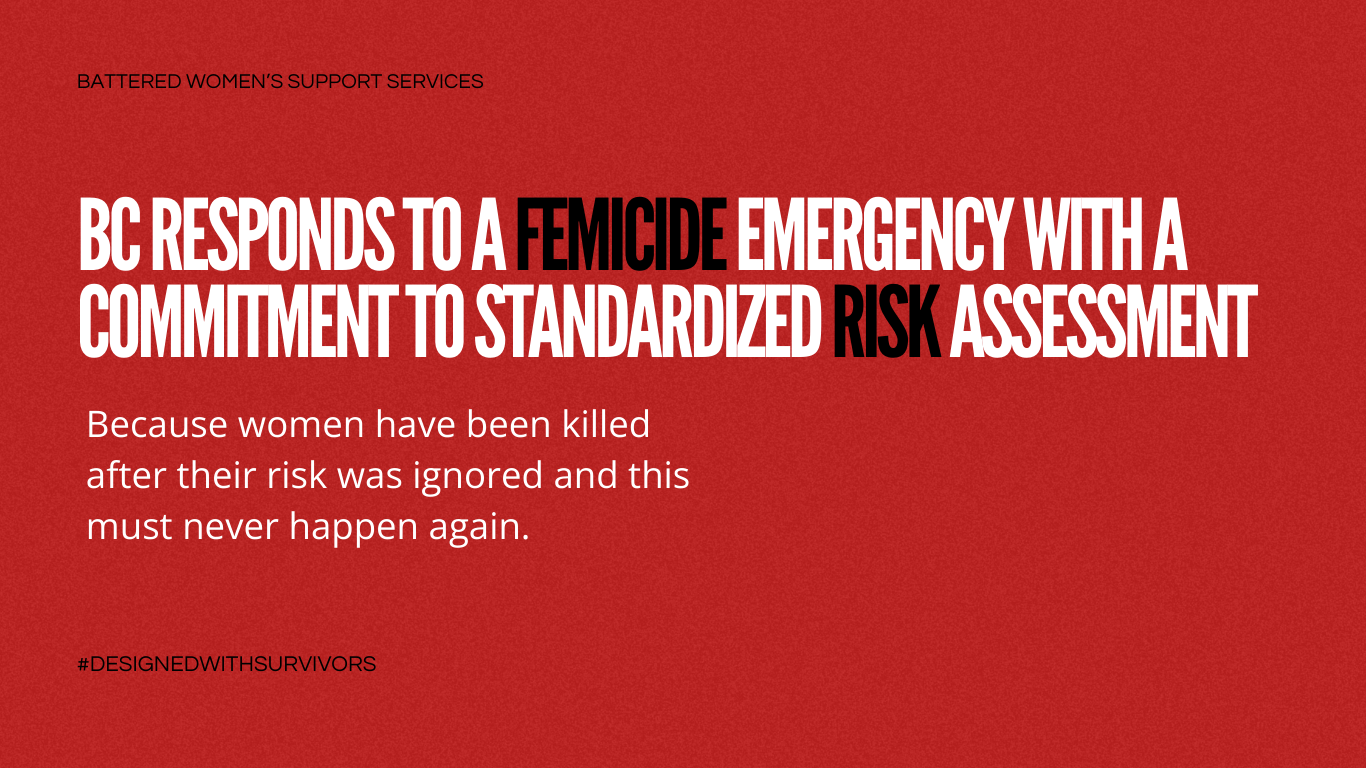
Risk assessment is one of the most powerful tools in preventing femicide.

But in BC:

police use inconsistent approaches
Crown counsel lacks mandatory standards
community workers use multiple tools
information-sharing is uneven
high-risk cases fall between systems

The result: preventable tragedies, missed warning signs, and survivors left unprotected.

A province-wide standard, implemented across policing, Justice, community organizations, and child welfare would:

  • identify high-risk situations earlier
  • improve coordinated safety planning
  • close gaps between agencies
  • prevent escalation
  • save lives

This is a core Renfrew County Inquest recommendation.

It is a key pillar in every modern femicide-prevention framework.

4. Launch a Province-Wide Public Awareness and Prevention Campaign

BC has no coordinated provincial campaign addressing:

  • coercive control
  • risk and lethality
  • economic abuse
  • immigration-related abuse
  • strangulation
  • firearm risks
  • safety planning – how to access help
  • how to help a friend or neighbour
  • Awareness saves lives.

Campaigns like this have been implemented in Scotland, New Zealand, Australia, and the UK with measurable impact.

BC needs a prevention campaign designed with:

  • survivors
  • Indigenous communities
  • grassroots anti-violence organizations
  • immigrant and refugee leaders
  • LGBTQ2S+ communities
  • Prevention is not optional, it is a core component of public and social safety.
5. Appoint a Provincial GBV Lead Within Public Safety/Attorney General

Right now, no one in the provincial government is responsible for ensuring:

  • GBV recommendations are implemented
  • risk assessment standards are enforced
  • coordination happens across ministries
  • municipal task forces are supported
  • inquiries translate into action
  • survivors are not relying on luck or geography for safety

Every major inquiry has called for one senior lead with authority, mandate, and accountability to drive action.

This role must be located within Public Safety/Attorney General, not siloed in social services or gender equity portfolios.

This is how we move from reaction to prevention.

Conclusion: These Five Actions Are Not Aspirational.

They Are Necessary.

And They Are Doable and Right Now.

Femicide is only the result of individual behaviour.

It is the result of systemic failures.

These five actions are evidence-based, survivor-informed, and ready for implementation.

BC can prevent femicide.

BC must prevent femicide.

And survivors cannot wait.

#DesignedWithSurvivors
#16Days


What Happened After B.C. Declared Gender-Based Violence an Epidemic?

A look at the missed opportunities, the rising risks, and the five urgent actions B.C. needs today.

In January 2025, the Government of British Columbia declared gender-based violence (GBV) a national epidemic. That moment carried weight. It signaled overdue recognition of what survivors, Indigenous women and girls, gender-diverse people, frontline advocates, and community-based organizations have been saying for decades: that gender-based violence is not a private tragedy, it is a social and safety emergency.

It acknowledged something essential. The violence that devastates families, fractures communities, and takes lives is not inevitable. It is the result of structural failures of housing systems, court systems, child protection systems, police practices, social policies that fail to act, fail to intervene, or fail to protect.

But recognition, on its own, changes little.

Since that declaration, British Columbia has lost at least  37 women to violence many killed by men they knew. In some regions, police calls related to intimate partner violence have surged by over 25%. Transition houses remain at or over capacity. Courts continue to delay, defer, and deny justice. Victim services and anti-violence organizations are stretched beyond their limits. Survivors are still navigating 60 well-documented barriers to safety, barriers shaped by poverty, racism, housing precarity, colonialism, and inconsistent institutional responses.

Across Canada, over 100 municipalities, counties, and regional governments have declared GBV or IPV an epidemic since 2020. These declarations have helped raise awareness, but they have not, in most cases, delivered real change. They have not been followed by legislation or created accountability mechanisms, they have not secured stable core funding for frontline services and they have not mandated universal risk assessment. They have not prevented the next killing.

British Columbia cannot become the latest jurisdiction where symbolic recognition stands without structural response.

A Map for Action Already Exists

There is no shortage of evidence or expertise. In 2024, BC Attorney General Niki Sharma commissioned an independent systemic review of how the province’s legal system responds to GBV, led by lawyer and human rights expert Dr. Kim Stanton. The findings were damning: one in three police-reported cases never makes it to Crown counsel; charges are withdrawn or stayed at rates that leave survivors retraumatized and unprotected; risk assessment is uneven, child protection, law enforcement, and family court practices vary dramatically from one region to another, and responses are often siloed, underfunded, and unaccountable.

The core problem is not lack of will on the frontlines. It is a lack of coordinated, survivor-centred investment in social and safety infrastructure, a system designed to hold the line when others fail.

These findings echo those of the Mass Casualty Commission, which investigated the 2020 mass shooting in Nova Scotia. That tragedy, which took place during COVID lockdowns while “epidemic” language dominated public discourse, was rooted in gender-based and intimate partner violence. The Commission’s final report called GBV an “epidemic” in Canada and issued 130 recommendations, including:

  • The creation of a national GBV commissioner
  • Stronger police accountability
  • Reformed public alerting systems
  • Cross-sector coordination of services, with clear government responsibility

Both Stanton’s BC report and the national Mass Casualty Commission point to the same truth: epidemic language alone will not shift systems. Only coordinated, legislated, and resourced action will.

Now Is the Time for Structural Response

As we approach the International Day for the Elimination of Violence against Women and the 16 Days of Activism, British Columbia faces a choice. Will it remain a province of declarations or become a province of delivery?

The context is urgent because narly half of Canadians now say that inflation and housing costs are making day-to-day life unaffordable. Arguably, confidence in institutions is falling as rising hate, deepening economic precarity, and growing mental health crises are compounding risk factors for gender-based violence. The need for structural prevention and rapid intervention has never been greater.

Over five decades, frontline organizations and survivors have shown what works-intentional, coordinated, well-funded, and accountable systems of response. With that knowledge in hand, five immediate actions can be taken now to prevent the next femicide in British Columbia.

Five Immediate Actions to Prevent the Next Femicide in BC

  1. Mandate Municipal GBV Task Forces
    Require every city in British Columbia to establish a gender-based violence task force that coordinates housing, policing, justice, and survivor services rooted in lived expertise and backed by authority.
  2. Stabilize Frontline Services
    Deliver a 15% emergency funding increase to community-based programs, STV outreach, transition houses, Indigenous-led services, and victim supports, before capacity collapses.
  3. Standardize Risk Assessment
    Make risk assessment tools mandatory across all key systems: police, Crown counsel, family court, child protection, housing, and health. Enforce their use with training, data integration, and oversight.
  4. Launch a Province-Wide Prevention Campaign
    Use the communications power of government to shift public understanding, reach men, de-normalize coercive control, and challenge the misogyny, racism, and colonial legacies that drive violence.
  5. Appoint a Provincial GBV Lead
    Create a dedicated leadership position within Public Safety or the Attorney General’s office to coordinate inter-ministerial action, track implementation, and hold the system accountable.

These are not aspirational goals, they are urgent, evidence-based actions aligned with national and provincial recommendations, decades of frontline experience, and what survivors themselves say they need.

One year after BC’s declaration, what’s required now is action. These five steps could save lives if implemented now. The time for symbolic language has passed and the time for structural response is here.


16 Days. One Emergency. One Province Rising

Every November 25th: The World Rises

International Day for the Elimination of Violence Against Women Launch of the 16 Days of Activism Against Gender-Based Violence
In British Columbia, 48% of women and girls have experienced intimate partner violence.
Reports have risen 17% to 25% in just the last year.

When nearly half the population faces harm, safety cannot be optional. It must be built by design, with survivors at the centre.

This Year, BC Rises

Because here at home, gender-based violence is not a private matter or personal tragedy — it is a public-safety emergency.

It is shaped by systems: housing, income security, policing, health, immigration, justice, and community supports. And when those systems fail, survivors pay the price.

But across this province, people are building safety together.

Voices Across BC

For 16 days, BWSS will share voices from across BC: survivors, Elders, Indigenous leaders, youth, frontline workers, legal advocates, and community organizers.

Voices that carry truth. Voices that demand action. Voices building a future where safety is not luck or bravery but infrastructure and justice.

🎥 Watch the Broadcast
Daily Videos: youtube.com/user/BWSSendingviolence

One message each day.
One province rising for safety.

Why We Rise
  • To end violence against women, girls, and gender-diverse people
  • To honour the leadership, courage, and wisdom of survivors
  • To demand systems built with and for survivors
  • To define safety as a shared public responsibility and a public investment

We rise because safety is not a feeling… safety is infrastructure.

Join the Collective Action
  • Watch each day
  • Share the voices
  • Stand with survivors
  • Call for system-level change across BC
Filming Recommendations and Practical Tips
  • Duration: 60 seconds
  • Format: landscape/horizontal
  • Quality: 1080p or 4K if available
  • Language: any (English subtitles if possible)
  • Film at eye level, in a well-lit and quiet space
  • Use a mic if available
  • Review for clarity before sending
Submission and Sharing

Please send your video or link by November 14, 2025 to
endingviolence@bwss.org.
We will feature these voices across the 16 Days as well as in a BC broadcast moment, joining global actions.

48% of women and girls. Reports up 17–25%.
We cannot say we didn’t know.
But together, we can say we rose.

BWSS Addresses Vancouver City Council on Gender Equity and Violence Prevention

On November 5, 2025, Battered Women’s Support Services Executive Director Angela Marie MacDougall addressed Vancouver City Council on two critical motions:

Ensuring Continuity of the Women’s Equity Strategy Following the Closure of the Equity Office https://council.vancouver.ca/20251105/documents/cfscmotion2.pdf

Advancing a Gender-Based Violence Prevention Strategy https://council.vancouver.ca/20251105/documents/cfscmotion3.pdf

These motions came forward at a time when violence against women and gender-diverse people is rising in Vancouver, across British Columbia, and across Canada.

Fourteen women have been killed in Vancouver since November 2024 and more women have been killed in BC this past year than in previous years. At the same time, we are witnessing a dangerous erosion of women’s equality, rights, and safety infrastructure, locally and nationally.

Gender-based violence most often happens in private spaces, in homes, between people who know each other, where systems are least visible and where survivors are most vulnerable. Yet the consequences are public, intergenerational, and deeply felt across our communities.

This moment is not simply about two motions.

It is about whether our city chooses to:

  • treat women’s safety as core public-safety infrastructure
  • honour longstanding commitments to gender equity
  • prevent femicide rather than grieve it
  • build systems of support rather than rely on survivor endurance
  • defend hard-won progress rather than allow it to slip away

BWSS’s remarks were delivered not only to Council, but to survivors, girls in our city watching the world form around them, and to history. They reflect the urgency of this time and a clear truth:

Progress is not guaranteed. It is defended, or it disappears.

Below are the full statements delivered to Council.

Ensuring Continuity of the Women’s Equity Strategy Following the Closure of the Equity Office

Advancing a Gender-Based Violence Prevention Strategy

Safety Isn’t a Feeling, It’s Infrastructure: BWSS 2024–2025 Impact Report

The most dangerous moment for a survivor is not when violence begins — it’s when she tries to leave.
Not because she lacks courage, but because our systems too often fail to hold her.

At BWSS, we know survivors don’t face one barrier — they face many. Leaving violence doesn’t happen alone. It happens through housing systems, legal systems, income systems, immigration systems, and community systems — or not at all.

That’s why our work is grounded in the 60 Barriers to Leaving and why we focus on transforming the six systems that shape safety: crisis response, housing, justice, healing, economic futures, and community.

This year, we didn’t just respond to violence — we tracked where systems held, where they broke, and where they began to change.

We witnessed thousands of moments where coordinated support meant the difference between danger and safety, isolation and possibility, fear, and a future.

This report shows what safety looks like when it isn’t left to chance or bravery, but built with coordination, intention, evidence, and community power.

Safety isn’t a feeling, it’s infrastructure.
And together, we are building it.

See where safety is shifting — and where we must go next.

In Pursuit of Justice 2025

Advancing Feminist Litigation and Survivor-Centred Legal Reform

The Justice Centre at BWSS invites you to our national feminist legal-justice gathering during the 16 Days of Activism Against Gender-Based Violence. Building on the momentum of last year’s conference, this year’s event brings together legal experts, policymakers, advocates, and survivors to advance bold reforms that centre survivor experience and transform justice systems in Canada. 

Event Details

  • Date: Monday, December 8, 2025
  • Time: 9:30 AM to 4:00 PM
  • Location: My Sister’s Closet – 3958 Main Street, Vancouver
  • Format: Hybrid (In-Person and Livestream)
  • In-Person Registration: $75 (includes lunch)
  • Online Registration: $30
  • Email endingviolence@bwss.org for sliding scale or fee waiver.

Program Highlights

Opening keynote on landmark feminist litigation and precedent-setting case law.

Four expert panels exploring:

  • Immigration, Gender-Based Violence and TRPs
  • Post-Separation Abuse and Vexatious Litigation
  • Femicide and Canadian Law: Where Legal Responsibility Fails
  • #DesignedWithSurvivors: Building Public Safety Around Survivors

Deep dive into issues including bail reform, R. v. Jordan, risk assessment, family-violence torts and red-flag laws

Justice is not automatic. It is built.

Too often in Canada, justice has been built without survivors at the centre.

It is time to redesign what justice looks like, from the courtroom to community safety systems.