The following blog will highlight how little action has been undertaken to date despite 58 reports and 700 recommendations tabled so far.
A Canadian National Roundtable on Missing and Murdered Indigenous Girls and Women was held on February 27, 2015 in Ottawa, Ontario with 12 representatives from British Columbia, in attendance.
The Canadian Federal Government has consistently rejected the call for a national inquiry examining the epidemic of violence against Indigenous girls and women, despite the urging from thousands of family members, individuals, women’s groups, communities, First Nations, municipal, provincial and territorial governments, the international community, and human rights organizations.
The Federal Government’s rejection has been largely positioned as a “choice” between taking “action” or a national inquiry.
The consistent levels of indifference combined with a lack of political will to address violence against women, in general and specifically, with respect to Indigenous girls and women is jarring for those of us on the front-line of the war on women including victims, survivors, activist, and advocates.
Review of reports and recommendations – Executive Summary
Prepared by Pippa Feinstein and Megan Pearce
February 26, 2015
INTRODUCTION
Indigenous women and girls in Canada are assaulted, abducted and murdered at appallingly high rates. Against the backdrop of this tragic reality, Indigenous leaders, national Indigenous organizations, provincial and territorial governments, non-government organizations, international human rights bodies and individual activists, have repeatedly called for a national inquiry to examine the disproportionately high rates of violence against Indigenous women. The federal government has rejected these calls, justifying its position on the basis that: (a) violence against Indigenous women and girls is not a sociological phenomenon, but should viewed instead as a series of crimes, and (b) that the problem of violence against Indigenous women and girls in Canada has already been adequately studied.
We have reviewed 58 studies, reports and inquiries which have examined the causes of this violence and made hundreds of recommendations about how best to respond. These reports have been prepared by a diverse set of
authors, including national Indigenous organizations, such as the Assembly of First Nations and the Native Women’s Association of Canada; international organizations such as Amnesty International; Canadian parliamentary committees and provincial and federal Ministries; independent academics; and grassroots organizations. Most recently, the Inter-American Commission issued a report on murders and disappearances of Indigenous women in British Columbia, which was requested by the Native Women’s Association of Canada and the Canadian Feminist Alliance for International Action. The IACHR report describes the severity of this issue and recommends specific action.
The existing literature does not support the government’s stance. First, despite diverse authors, the reports reviewed show strong consensus about the root causes of this violence; it is a sociological issue. Second, the recommendations that are repeated time and again in so many of the reports highlight exactly why an inquiry is needed: to ascertain the extent to which these recommendations have been implemented, and to identify and address obstacles to implementation. Such an inquiry could also provide the basis for future informed and coordinated inter-jurisdictional action on this issue, which is based on credible evidence.
CONSIDERABLE AGREEMENT ON THE CAUSES OF VIOLENCE AGAINST INDIGENOUS
WOMEN
Our research revealed that there is consistent consensus with respect to the causes of violence against
Indigenous women, and that this issue is a sociological one.
There is considerable agreement between the reports about the root causes of violence against Indigenous women. Many reports stress that the economic and social marginalization of Indigenous women makes them more susceptible to violence and less able to escape violent circumstances.
Contributing to this marginalization is a set of complex and overlapping factors. In particular, a lack of access to education and employment opportunities results in high levels of poverty amongst Indigenous women. In addition, according to some reports, Indigenous women experience disproportionately high rates of food insecurity, overcrowded housing, and homelessness. High instances of family breakdown, and the intervention of the child welfare system further contribute to the vulnerabilities of Indigenous women and girls. Finally, chronic underfunding of services to help Indigenous women cope with these circumstances also contributes to their susceptibility to violence and limited ability to leave violent situations.
According to many of the reports reviewed, the poverty and discrimination experienced by Indigenous women is a product of continuing racism and sexism in Canada that excludes and devalues Indigenous women. The historical context of this violence, and in particular the legacies of colonialism, the residential school system, and discriminatory Canadian laws such as the Indian Act, continue to adversely impact the wellbeing of Indigenous women and girls. And yet, police and health care professionals fail to adequately prioritize the health and safety of Indigenous women, and a lack of culturally sensitive programs prevent the services that already exist from addressing challenges specific to Indigenous women’s experiences. These issues are compounded by an unresponsive justice system that is often unable to accommodate the needs of those most at risk.
Despite the federal government’s contrary assertions, the reports reviewed make plain: violence against Indigenous women in Canada is a sociological phenomenon.
RECOMMENDATIONS FOR ACTION TO ADDRESS THE VIOLENCE
Our research has also revealed that there is considerable agreement in the literature with respect to the
recommendations for future action to prevent and end violence against Indigenous women in Canada.
The 58 reports we reviewed contained over 700 recommendations. Most of these recommendations concerned preventative action, highlighting the need to address the causes of violence against Indigenous women in holistic
ways. Within the large number of recommendations, sixteen overarching ‘themes’ were identified. Below is a
brief summary of each theme and an assessment of the extent to which the associated recommendations have
been implemented:
1. 4 reports published between 2012 and 2015 recommend the establishment of a national commission of inquiry into this issue. Another report prepared in 2012 contains detailed recommendations for how to ensure any future inquiry will be fair and inclusive. The federal government refuses to implement this recommendation.
2. 12 reports, published between 2002 and 2015, recommend the establishment of a national action plan, and call for governments and service providers to ensure that action is coordinated. The federal government’s current ‘action plan’ falls far short of providing the preventative measures or coordination of inter-agency or inter-jurisdictional efforts necessary for a proper response. Moreover, funding for the ‘action plan’ pales next to the funding cut to Indigenous organizations, many of which offered services that addressed the root causes for the disproportionate violence against Indigenous women.
3. 4 reports, published between 2004 and 2012, recommend greater public acknowledgement of the extent of violence against Indigenous women, and priority afforded to the issue. The only action on this recommendation has occurred at a provincial level. In particular, the government of British Columbia has signed a memorandum of understanding with First Nations and Métis leaders that explicitly acknowledged the extent of this issue and declares it a priority.
4. 28 reports, published between 1996 and 2015, stress the importance of properly resourced, Indigenous-specific programs to address both the causes of violence against Indigenous women and to provide support and services to women and girls who have experienced violence, and their families. Our research has shown that the federal government has dramatically cut funding to Indigenous-led organizations providing services to Indigenous communities, and Indigenous women in particular. These organizations delivered preventative programs, aimed at alleviating poverty and minimizing the social and economic marginalization of Indigenous women, as well as services designed to protect, heal and support women and girls who had experienced violence. By cutting funding to these organizations, the federal government has failed to implement this recommendation.
5. 12 reports, published between 1996 and 2015, stress the importance of greater involvement of Indigenous peoples in program development and delivery. At least on the federal level, the involvement of Indigenous peoples in the development and delivery of programs directly affecting them has steadily decreased. Federal budget cuts have effectively subsumed Indigenous-specific programs into mainstream government services, decreasing Indigenous people’s involvement in program development and delivery.
6. 14 reports, published between 1994 and 2015, recommended improved data gathering and publication. Over the past few years, the federal government has defunded some of the most significant Indigenous-specific data gathering initiatives, and prevented the continued gathering and publication of information about violence against Indigenous women. Further, inter-jurisdictional police information sharing initiatives still require urgent attention.
7. 15 reports, published between 2005 and 2014, recommend further awareness raising and public education efforts. It is unclear what education or awareness raising initiatives are currently supported financially by the federal government. There is some action at a provincial level, with the most promising programs being designed and delivered by independent or non-government groups.
8. 12 reports, published between 2002 and 2013, recommend improvements to transport services and physical access to accommodation, including safe housing and shelters. Our research has shown that there has been little improvement in this area and that inadequate shelter and transportation continue to put economically marginalized Indigenous women at risk.
9. 5 reports, published between 2002 and 2012, recommend additional support for community-based first response and search and rescue. Our research was not able to identify any positive developments or changes in this area.
10. 4 reports, published between 2004 and 2012, recommend greater protection of Indigenous women working in the sex industry. New legislation on this topic has recently been passed by the federal government, and has received mixed reactions. However, there is very little to suggest the implementation of recommendations aimed at preventing Indigenous women from having to engage in survival sex work, or protecting those who are forced to do this work.
11. 21 reports, published between 2001 and 2015, recommend measures to improve the relationships between police and Indigenous communities. Despite some limited initiatives in recent years, our research failed to find evidence that such developments have significantly improved the relationships between police departments and Indigenous communities.
12. 15 reports, published between 2004 and 2015, recommend improvements to investigations into and prosecutions over missing and murdered Indigenous women. A small number of initiatives have been developed at a provincial level, in particular in British Columbia. None of these initiatives is specific to Indigenous women. Moreover, our research suggests the programs that are in place have not been effective.
13. 6 reports, published between 2001 and 2015, concern the importance of support for community based and restorative justice. Some provinces have programs that include community justice initiatives, such as sentencing circles. However, recent federal legislation involving mandatory minimum sentences, may frustrate the growth of these initiatives.
14. 5 reports, between 1996 and 2013, have recommended that Canada endorse international declarations and ratify international conventions concerned with promoting the safety of women, and Indigenous peoples’ rights. The federal government has not implemented these recommendations, refusing to endorse or ratify applicable international instruments such as the United Nations Declaration on the Rights of Indigenous Peoples.
15. 5 reports, published between 1996 and 2009, recommend several specific areas of domestic law reform. While some limited reforms have been made, significant discrimination still exists in the Canadian legal system and further law reform is required.
16. 4 reports, published between 2006 and 2012, recommend a compensation and/or healing fund for the victims of this violence and their families. This has not been implemented by the federal government.
The recommendations summarized above cover a range of responses – from preventative actions to address the systemic discrimination and economic marginalization of Indigenous women, through to recommendations aimed at improving the way Indigenous women are treated by the police and in the justice system. The recommendations illustrate the importance of addressing the outcomes and the root causes of violence. In fact, the Inter-American Commission on Human Rights has recently confirmed, in a detailed and ground-breaking report, that Canada is legally obliged, in accordance with established principles of international law, to prevent violence against Indigenous women by addressing the “institutional and structural inequalities confront[ing] indigenous women in Canada”, including by measures to reduce poverty, guarantee proper housing and improve education and employment opportunities.1 According to the Inter-American Commission, the Canadian government’s legal obligation also extends to ensuring that, when violence occurs, it is promptly investigated, punished and that reparations are made to the victims.
THE NEED FOR A NATIONAL COMMISSION OF INQUIRY
It is clear from our research that despite wide agreement about the causes of violence against Indigenous women, and the response required, very few recommendations have been implemented by federal or provincial governments. Moreover, determining which recommendations have been implemented at either federal or provincial levels is made considerably difficult by the very limited information available publicly. When information is available publicly, it rarely, if ever, extends to an assessment of how well various initiatives or programs are performing. Finally, our research shows that there is little in the way of formal government commitments to implement existing these recommendations, and that inter-agency and or inter-jurisdictional coordination of existing implementation efforts is sorely lacking.
In light of these challenges, a properly mandated and well-run national commission of inquiry offers an efficient and effective information gathering tool, with robust powers to compel the production of information and witnesses, and to conduct coordinated and comprehensive research with the support of experts where necessary. An inquiry can therefore consolidate and update existing knowledge about the causes of violence against Indigenous women, comprehensively evaluate the adequacy of existing initiatives and programs, and help Canadians and policy-makers understand why there has been so much resistance to action to address this issue. This would help to ensure that any recommendations it makes are based on a solid understanding of what is being done already. Finally, a national public inquiry can be an important way to make the Canadian governments accountable for failing to undertake coordinated and informed action in response to violence against Indigenous women and girls.
Our goal with this research is to help inform existing and future advocacy initiatives related to the establishment of a national commission of inquiry into violence against Indigenous women and girls.
RESEARCH BRIEF AND FORMAT OF REPORT
A. This review was conducted on behalf of the Legal Strategy Coalition on Violence Against Indigenous Women (LSC). We were originally briefed to complete three main tasks:
1) To review 40 reports that examine issue of violence against Aboriginal women, and to list the recommendations made therein (if any). This list of 40 reports was provided by the Department of Justice to justify the federal government’s stance that there is no need for a national public inquiry into this issue,
2) To find additional reports the federal government may be relying on to support their refusal to hold a national public inquiry. (The LSC had been notified that the federal government is relying on the existence of at least 49 reports, to support their position.), and
3) To research and analyze the extent to which the recommendations contained in these reports (if any) have been implemented to date.
B. Organization of research outcomes
We have organized our research into three parts:
1) a spreadsheet containing the details of the 58 reports we have reviewed. This document contains a brief summary of each report’s contents, including a list of causes for violence identified in each report, and a summary of the recommendations in each report;
2) a memorandum dividing all reports’ recommendations into 16 themes, and assessing the extent to which federal and provincial governments have taken action under each of the recommendation themes; and
3) An appendix containing a list of all reports’ recommendations in their original wording, also organized by theme.
Federal Government’s record of refusal: An act of violence against Indigenous women
On November 12, 1971 Helen Betty Osborne was sexually assaulted and brutally murdered in the Pas, Northern Manitoba. On August 2014, we learned about the brutal murder of 15 year old Tina Fontaine in Winnipeg, Manitoba. Within the 43 year time span between the two murders, hundreds of Indigenous women have continued to go missing or have been murdered in every region across Canada.
Here’s a list of some of the most recent reports calling for the Canadian public to address the issue.
1. SUMA backs inquiry into MMIW, pushes to keep revenue sharing stable, Feb. 3, 2015:
The Saskatchewan Urban Municipalities Association, SUMA joined their voices in support of an inquiry into missing and murdered Indigenous women.
2. The Inter-American Commission on Human Rights (IACHR) Issues Report on missing and murdered women, December 21, 2014:
The IACHR report focuses on British Columbia and recommends movement to address violence against women and support for the creation of a national-level action plan or nation-wide inquiry into the issue of missing and murdered Indigenous women.
3. The Women’s Legal Education and Action Fund (LEAF) makes new research available, December 6, 2014:
Following the murder of Inuit university student Loretta Saunders, LEAF published two documents which list and synthesize 40 reports for MMIW advocates.
4. The Special Committee on Violence Against Indigenous Women issue report, March 2014:
The Special Committee on Violence Against Indigenous Women issues a report called ‘Invisible women: A Call to Action — ACAT Canada’, concludes by saying “the families will have to wait until the government changes to get the National Public Enquiry and National Action Plan”
5. UN Special Rapporteur James Anaya visits Canada and issues report on situation of Indigenous in Canada, July 2014:
United Nations Report — Crisis in Canada following a visit to Canada from October 7-11, 2013 by James Anaya, Special Rapporteur on the rights of Indigenous peoples in Canada. The document highlights least 29 official inquires with 500 recommendations for action have been put forward since 1996.
6. Ontario Federation of Indigenous Friendship Centres respond to Royal Canadian Mounted Police, May 2014:
Ontario Federation of Indigenous Friendship Centres (OFIFC) response to Royal Canadian Mounted Police (RCMP) Operations Report slams the November 2013 document. The OFIFC outlines inconsistencies and calls on the RCMP to provide concrete actions to address the high rates of missing and murdered Aboriginal women in Canada.
7. RCMP issue report Missing and Murdered Aboriginal Women: A National Operational Overview, November 2013:
Over ten years after Stolen sisters was issued, the RCMP responds to missing and murdered Indigenous women. Brought us to a shocking total of 1100+ cases. Presently, the document is the most cited report used by media.
8. Coordinating Committee of Senior Officials (Criminal): Missing Women Working Group issues report and recommendations, January 2012:
Coordinating Committee of Senior Officials (Criminal): Missing Women Working Group established in February 2006. Focuses between 2006 and 2010 confirming factors under which Aboriginal women became victims of violence and issues recommendations to reduce these factors.
9. Missing Women Commission of Inquiry issues a report in response to Robert Pickton case, November 2012:
The Missing Women Commission of Inquiry issues a report entitled ‘Forsaken: The Report of the Missing Women Commission of Inquiry Executive Summary’ a four volume response to British Columbia’s Missing and Murdered women in the wake of the Robert Pickton case.
10. Amnesty International report documents stories of missing and murdered Indigenous Women, October 2004:
Amnesty International Report entitled ‘Stolen sisters — A human rights response to Discrimination and Violence against Aboriginal women in Canada’ documents the stories of missing and murdered women over 30 years. The culmination of many inquiries (starting as far back as 1971), the report called for “Canadian officials to ensure the rights and safety of Aboriginal people are respected and upheld by police and courts.”
The list of reports originally appeared on MUSKRAT Magazine.
February 27, 2015
A coalition of advocacy groups, Indigenous organizations, and family members continue to demand that the federal government hold a national public inquiry into murdered and missing Indigenous women and girls. In its January 2015 report, the Inter-American Commission on Human Rights strongly supported a national inquiry because there is “much still to be understood and much to be acknowledged.” In a report of his visit to Canada in 2014, the United Nations Special Rapporteur on Indigenous Rights and Freedoms, Dr. James Anaya, also supported the need for a national inquiry, as have Indigenous women and communities, human rights groups, opposition parties and Premiers.
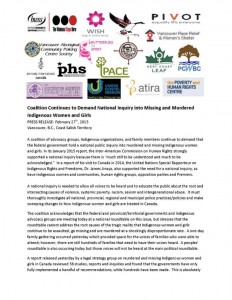
A national inquiry is needed to allow all voices to be heard and to educate the public about the root and intersecting causes of violence, systemic poverty, racism, sexism and intergenerational abuse. It must thoroughly investigate all national, provincial, regional and municipal police practices/policies and make sweeping changes to how Indigenous women and girls are treated in Canada.
The coalition acknowledges that the federal and provincial/territorial governments and Indigenous advocacy groups are meeting today at a national roundtable on this issue, but stresses that the roundtable cannot address the root causes of the tragic reality that Indigenous women and girls continue to be assaulted, go missing and are murdered at a shockingly disproportionate rate. A one-day family gathering occurred yesterday which provided space for the voices of families who were able to attend; however, there are still hundreds of families that need to have their voices heard. A peoples’ roundtable is also occurring today but those voices will not be heard at the main political roundtable.
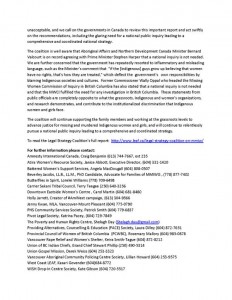
A report released yesterday by a legal strategy group on murdered and missing Indigenous women and girls in Canada reviewed 58 studies, reports and inquiries and found that the governments have only fully implemented a handful of recommendations, while hundreds have been made. This is absolutely unacceptable, and we call on the governments in Canada to review this important report and act swiftly on the recommendations, including the glaring need for a national public inquiry leading to a comprehensive and coordinated national strategy.
The coalition is well aware that Aboriginal Affairs and Northern Development Canada Minister Bernard Valcourt is on record agreeing with Prime Minister Stephen Harper that a national inquiry is not needed. We are further concerned that the government has repeatedly resorted to inflammatory and misleading language, such as the Minister’s comment that “if the [Indigenous] guys grow up believing that women have no rights, that’s how they are treated,” which deflect the government’s own responsibilities by blaming Indigenous societies and cultures. Former Commissioner Wally Oppal who headed the Missing Women Commission of Inquiry in British Columbia has also stated that a national inquiry is not needed and that the MWCI fulfilled the need for any investigation in British Columbia. These statements from public officials are completely opposite to what the grassroots, Indigenous and women’s organizations, and research demonstrates, and contribute to the institutionalized discrimination that Indigenous women and girls face.
The coalition will continue supporting the family members and working at the grassroots levels to advance justice for missing and murdered Indigenous women and girls, and will continue to relentlessly pursue a national public inquiry leading to a comprehensive and coordinated strategy.
For further information please contact:
Amnesty International Canada, Craig Benjamin (613) 744-7667, ext 235
Atira Women’s Resource Society, Janice Abbott, Executive Director, (604) 331-1420
Battered Women’s Support Services, Angela Marie MacDougall
Beverley Jacobs, LL.B., LL.M., PhD Candidate, Advocate for Families of MMIWG , (778) 877-7402
Butterflies in Spirit, Lorelei Williams (778) 709-6498
Carrier Sekani Tribal Council, Terry Teegee (250) 640-3256
Downtown Eastside Women’s Centre , Carol Martin (604) 681-8480
Holly Jarrett, Creator of #AmINext campaign, (613) 304-9566
Jenny Kwan, MLA, Vancouver-Mount Pleasant (604) 775-0790
PHS Community Services Society, Patrick Smith (604) 779-6837
Pivot Legal Society, Katrina Pacey, (604) 729-7849
The Poverty and Human Rights Centre, Shelagh Day (Shelagh.day@gmail.com)
Providing Alternatives, Counselling & Education (PACE) Society, Laura Dilley (604) 872-7651
Provincial Council of Women of British Columbia (PCWBC), Rosemary Mallory (604) 985-0878
Vancouver Rape Relief and Women’s Shelter, Keira Smith-Tague (604) 872-8212
Union of BC Indian Chiefs, Grand Chief Stewart Phillip (250) 490-5314
Union Gospel Mission, Derek Weiss (604) 253-3323
Vancouver Aboriginal Community Policing Centre Society, Lillian Howard (604) 253-9575
West Coast LEAF, Kasari Govender (604)684-8772
WISH Drop-In Centre Society, Kate Gibson (604) 720-5517
If you could do something to end violence against girls and women, wouldn’t you?