Canada must act to prevent violence: Inter-American Commission on Human Rights
PRESS RELEASE – FOR IMMEDIATE RELEASE
Murders and disappearances of Indigenous women caused by inequality, marginalization – Canada must act to prevent violence: Inter-American Commission on Human Rights
(January 12, 2015) (OTTAWA and VANCOUVER) A groundbreaking investigation by the leading human rights body for the Americas points to Canada’s history of colonization, long-standing inequality, and economic and social marginalization as the root causes of violence against Indigenous women. It says national co-ordinated action is required by Canadian governments.
The Inter-American Commission on Human Rights, which is an arm of the Organization of American States, launched an investigation into the murders and disappearances of Indigenous women and girls in British Columbia in 2012, and released its report today. It finds Canada is obligated under international human rights law to prevent the violence by taking measures to deal with poverty, access to housing and employment, and disproportionate criminalization. The report also strongly supports a nation-wide inquiry into the crisis of missing and murdered Indigenous women.
The investigation was initiated at the request of the Native Women’s Association of Canada (NWAC) and the Canadian Feminist Alliance for International Action (FAFIA). “This report is ground-breaking,” says NWAC Vice-President Dawn Harvard. “It is the first in-depth examination by an expert human rights body of the murders and disappearances of Indigenous women in Canada.”
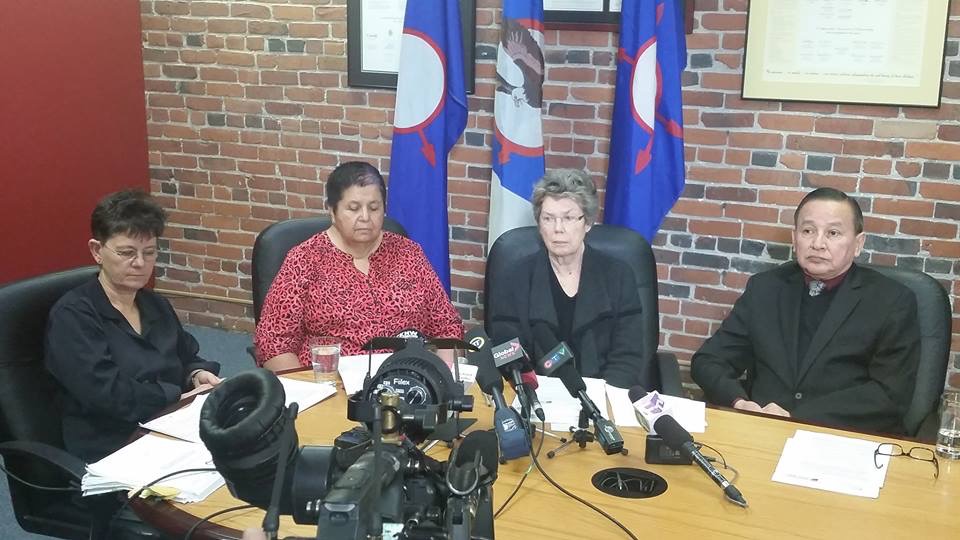 Press Conference: Report on Missing and Murdered Indigenous Women in BC by Inter- American Commission on Human Rights. Native Women’s Association of Canada counsel Gwen Brodsky, Feminist Alliance for International Action chair Shelagh Day, and Sharon McIvor, and UBCIC Grand Chief Stewart Philip. (Photo credit:Andrea Glickman, UBCIC)
Four key conclusions apply in all parts of Canada. “First, Canada is legally required to address the violence against Indigenous women fully and effectively,” says Harvard. “This is not a matter of choice. Our obligations under international human rights law require us to eliminate the discrimination which causes the violence and to ensure that Canada’s institutions—including the police and the justice system—respond effectively when Indigenous women disappear or are murdered.”
“Second,” says Mavis Erickson, Women’s Advocate for the Carrier Sekani Tribal Council which represents Indigenous peoples in northern British Columbia, “the Commission made a key finding of fact. The Commission concluded that the root causes of the high levels of violence against Indigenous women lie in a history of discrimination beginning with colonization and continuing through laws and policies such as the Indian Act and residential schools.”
“The Commission says this history laid the foundations for pervasive violence and created the risks Indigenous women face today, through economic marginalization, social dislocation and psychological trauma,. In this way,” says Sharon McIvor of FAFIA, the Commission’s report directly refutes the Prime Minister’s claim that this is a matter of individual crimes, not a social phenomenon. The Commission says clearly that there is a broad and known pattern of heightened risk and vulnerability, and the risk factors must be addressed.”
Leilani Farha, Executive Director of Canada Without Poverty and the United Nations Special Rapporteur on the Right to Adequate Housing noted the Commission’s clarity on the relationship between Indigenous women’s experiences of violence and their disadvantaged social and economic conditions. “The Commission has told Canada, unequivocally, that it must take effective measures to address risk factors, and specifically that Canada must combat the poverty of Indigenous women, improve education and employment, guarantee adequate housing and address the disproportionate application of the criminal law against them.”
“This broad understanding of the scope of Canada’s obligations explains why the report says implementing the Oppal Inquiry’s recommendations in British Columbia is necessary, but just a starting point for reforms in one area,” says Shelagh Day of FAFIA.
“The third key point,” said Claudette Dumont-Smith, Executive Director of NWAC, “is that both federal and provincial governments have responsibility for the legal status and conditions of Indigenous women and their communities. This is not only a provincial matter, nor should it be a political football tossed back and forth between levels of government.”
“The Inter-American Commission is clear. Canada must provide a co-ordinated, national response to the violence. This is what we have been working for and what we do not yet have.”
“Finally, the Inter-American Commission strongly supports a nation-wide inquiry,” said Holly Johnson, Chair of FAFIA. “Despite this report and others, the Commission says there is much more to understand and to acknowledge if we are to effectively address the crisis of missing and murdered Indigenous women in Canada.”
“This is a crucial conclusion. The message of the Inter-American Commission is that Canada has a lot of work to do, and it must be done by all levels of government, with the full participation of Indigenous women, and with effective nation-wide co-ordination.”
Media Contacts:
Claudette Dumont-Smith, Executive Director, NWAC, 613-722-3033 X 223
Sharon McIvor, Human Rights Committee, FAFIA, 250-378-7479
Shelagh Day, Human Rights Committee, FAFIA, 604-872-0750
Holly Johnson, Chair, FAFIA, 613-355-5582
Leilani Farha, Executive Director, Canada Without Poverty, United Nations Special Rapporteur on the Right to Adequate Housing, 613-302-7769
Mavis Erickson, Carrier Sekani Tribal Council Women’s Advocate, 250-649-6858 (Prince George)
Additional Contact:
Gwen Brodsky, counsel to NWAC at the Oppal Inquiry and counsel to NWAC and FAFIA for the IACHR investigation, 604-874-9211
Elizabeth Sheehy, Vice-Dean, Professor of Law, University of Ottawa, 613-562-5800 X 3317
The IACHR report can be found at www.fafia-afai.org and at www.oas.org/en/iachr/reports/pdfs/Indigenous-Women-BC-Canada-en.pdf
KEY FINDINGS, CONCLUSIONS AND RECOMMENDATIONS
- Canada must provide a national coordinated response to address the social and economic factors that prevent indigenous women from enjoying their social, economic, cultural, civil and political rights, the violation of which constitute a root cause of their exposure to higher risks of violence.
In order to move forward to meet its obligations the IACHR recommends that:
- Canada design and implement better co‑ordination among the different levels and sectors of government;
- Canada establish strengthened accountability mechanisms – preferably through independent bodies – for officials handling investigations and prosecutions;
- Canada provide access to legal aid and support services for families of missing or murdered indigenous women, with families able to freely choose their own representatives;
- Canada ensure active participation of indigenous women in the design and implementation of initiatives, programs and policies at all levels of government;
- Canada develop data collection systems that collect accurate statistics on missing and murdered indigenous women, by consistently capturing the race of the victim or missing person;
- The Oppal Commission does not provide the full solution to violence against indigenous women and girls in British Columbia. Commission says: “The findings in the Oppal report regarding the irregularities in the handling of the investigations can serve as a starting point for reforms to the investigative function. [It] could help prevent irregularities in investigations of future disappearances or murders of indigenous women.” In other words, the Oppal report addresses only one aspect of the obligations, and, at that, is a starting point only;
- Canada is obliged to continue the investigation of unsolved cases of missing indigenous women. There are many cases in which investigations have remained pending, or the authorities have decided not to proceed with prosecution. The IACHR stresses the importance of the right of families and relatives to know what happened to their loved ones. The authorities cannot justify the failure to complete an investigation or prosecution on insufficient proof if the reason for the insufficiency is deficiencies or irregularities in the investigation;
- Canada must improve its consultation mechanisms with the different parties involved, including indigenous women, indigenous women’s groups, civil society organizations and families and relatives of missing and murdered indigenous women, in order for those mechanisms to be successful;
- IACHR strongly supports the creation of a national level action plan or nation‑wide inquiry because “there is much more to understand and to acknowledge…” “This initiative must be organized in consultation with ….indigenous women, at all stages from conception to establishing terms of reference, implementation and evaluation”;
- IACHR recommends that B.C. appoint a new Chair of its Advisory Committee on the safety and Security of Vulnerable Women as soon as possible. In light of more comprehensive recommendations about consultation, it would be appropriate for BC to rethink its consultation processes from the ground up;
- The IACHR recommends that police officers, including both RCMP and Vancouver Police, and public sector functionaries, such as prosecutors, judges and court personnel, receive mandatory and ongoing training in the causes and consequences of gender-based violence in general and violence against indigenous women in particular. This includes training on the police duty to protect indigenous women from violence.
- Specifically regarding Prince George, the IACHR urges the Canadian State to immediately provide a safe public transport option along Highway 16.
FINDINGS ON THE INDIAN ACT (paras. 67 – 72.)
- The IACHR has done an analysis of the Indian Act and finds that the ongoing sex discrimination in the Indian Act is a contributing factor to the violence against indigenous women. This is extremely important, since indigenous women have been told over and over again, and as recently as 2011, that all significant sex discrimination has been removed from the Indian Act.
The IACHR takes note of Bill C‑3 and the Gender Equiaty Registration Act, but goes on to say this:
- On the basis of the information received and analyzed, the IACHR considers that under the current state of the law, however, some provisions that have a discriminatory effect for indigenous women remain. In particular, Bill C-3’s amendment adds a new category to the first, more privileged status group, but it hinges in part on whether a woman has children or not. In addressing only particular subsets of indigenous women who faced this discrimination, the Indian Act as amended fails to fully address remaining concerns about gender equality.
- Indigenous women face multiple challenges with respect to securing status for themselves and their children, and in some cases the presence of a second, intermediate status classification can rise to the level of cultural and spiritual violence against indigenous women, since it creates a perception that certain subsets of indigenous women are less purely indigenous than those with “full” status. This can have severe negative social and psychological effects on the women in question, even aside from the consequences for a woman’s descendants.
- Additionally, in order for the children of an indigenous woman to be recognized as having full status, the administrative policy is that the identity of the father must be declared and the signatures of both parents must be presented, otherwise it will automatically be assumed that the father is non-Indian.
- According to the information reviewed, between 1876 and 1985 approximately 25,000 indigenous women lost status and had to leave their communities. It is important to keep in mind that for every woman who lost status and had to leave her community, all of her descendants also lost status. When Bill C-31 was passed in 1985 there were only 350,000 status Indians left in Canada. Because Bill C-31 allowed individuals who had lost status to regain it, and also allowed their children to regain status, approximately 100,000 individuals had regained their status by 1995. However: the damage caused, demographically and culturally, by the loss of status of so many Native women for a century prior to 1985, whose grandchildren and great-grandchildren are now no longer recognized –and in many cases no longer identify – as Indian, remain[s] incalculable.95
- The IACHR has been informed that many women and their children who have recovered Indian status as a result of the 1985 amendments have been nevertheless unable to secure band membership. This is because those same amendments gave bands the power to control their own membership criteria, meaning that some bands can create obstacles for women attempting to reestablish membership after marrying outside of the community.96 A lack of funds for band administration in particular may make bands reluctant to grant membership to increasing numbers of people as they gain or regain status.
For Inter-American Commission on Human Rights’ full report “Missing and Murdered Indigenous Women in British Columbia, Canada”, please visit here.
If you could do something to end violence against girls and women, wouldn’t you?



 Gender persecution is typically related to family or domestic violence, acts of sexual violence, punishment for transgression of social mores, forced marriage, coerced family planning, and female genital mutilation. At BWSS, we understand that women are not fleeing from a single form of violence but they experience a spectrum of violence from the moment they are born.. Violence against women in Mexico is highly prevalent and the perpetrators are left unpunished. Legislation to prevent and punish violence has not been enforced effectively and officials are not adequately monitored to ensure that gender-based crimes are dealt with appropriately. Inadequate state protection, coupled with the lack of programs for prevention, do not allow women to feel safe in Mexico. To make matters worse, state actors are often involved in violence against women. Given the level of ineffective state protection, public confidence and trust on state officials are lacking. In these circumstances, BWSS believes that a community-based women’s organization would be best to connect women, who are in a similar situation as Ms. Vega Jimenez, to community-based organizations in their countries of origin.