Justice for Noelle, Chelsea, and Tatyanna: A March for the Lives They Were Denied
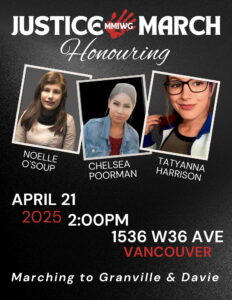
On April 21, 2025, families, advocates, and communities will gather in Vancouver to march in memory and in rage. We are marching for Noelle O’Soup, Chelsea Poorman, and Tatyanna Harrison—three Indigenous girls and young women whose disappearances and deaths were not only preventable but foreseeable, rooted in colonial systems that continue to treat Indigenous lives as disposable.
The Justice for Noelle, Chelsea, and Tatyanna March begins at 2:00 PM at 1536 West 36th Avenue—the Shaughnessy mansion where Chelsea’s body was found—and proceeds to Granville and Davie Streets. The march is an urgent public demand: for justice, for answers, and for the transformation of the systems that failed them.
The March is occurring during Prevention of Violence Against Women Week 2025 – a week dedicated to highlighting ways to end violence against women and gender-based violence.
They Should Still Be With Us
Noelle O’Soup(14 years old)
Noelle was a 14-year-old Nēhiyaw girl who went missing from a Port Coquitlam group home in May 2021. Over a year later, her body was found in a locked room of a single-room occupancy (SRO) building in Vancouver’s Downtown Eastside—alongside another deceased woman and a third person found alive. The apartment was rented by Anh-Tuan Pham, a man with a lengthy criminal history, including weapons and drug charges, and who was wanted on a Canada-wide warrant at the time.
The Vancouver Police Department (VPD) was aware of Pham’s criminal record and had received multiple complaints about his suite. Yet no action was taken until after his death. As Global News reported, a VPD officer was under investigation for neglect of duty in Noelle’s case. And as CBC revealed, Pham was known to offer drugs to young girls, and his unit had been flagged repeatedly—but there was no coordinated response, no intervention, and no urgency.
Why did VPD not act sooner to enter that suite?
Why wasn’t Noelle found earlier—when she might have still been alive?
Why was a child under state care living and dying in such horrific conditions?
The Ministry of Children and Family Development (MCFD), responsible for Noelle’s care, has offered no accountability. How many more Indigenous children must die before this ministry is overhauled?
And where are the consequences for those who were supposed to protect her?
Chelsea Poorman (24 years old)
Chelsea, a 24-year-old Cree woman from Kawacatoose First Nation, went missing in September 2020. Her body was found in April 2022, in the backyard of a mansion in Vancouver’s wealthy Shaughnessy neighbourhood—just steps away from the starting point of this march. Her body was so decomposed that police could not determine a cause of death. They declared the case not suspicious and closed it within days, to the shock of her family and community.
A 2023 CBC investigation revealed that the VPD did not canvas neighbours, did not identify or interview the property owner until a year after her body was discovered, and did not search the home until prompted by media inquiries. Key evidence was overlooked or ignored. Chelsea’s sister described her as a vulnerable person, still healing from a traumatic brain injury. But she was treated as just another missing person—not as a young Indigenous woman at elevated risk.
Why did police conclude so quickly that there was no foul play—despite her remains being incomplete and the home being unoccupied?
Why was her death deprioritized?
How many other cases have been dismissed this way?
This is a textbook example of what Indigenous families have long described: a justice system that neither investigates nor protects our people with the seriousness and dignity we deserve.
Tatyanna Harrison(20 years old)
Tatyanna was a Métis woman who had been reaching out for help in the weeks before her disappearance in April 2022. Her body was found in a Richmond boatyard in May—but it took authorities more than a month to identify her, even though her mother had been actively searching. It was only after public pressure that the VPD acknowledged the delays and mishandling of her case.
She had sought help from hospitals, housing providers, and crisis services, but like so many Indigenous girls and women, she was treated as a problem to be managed—not a person to be protected. Her death, like Noelle’s and Chelsea’s, is not isolated—it is systemic.
Most MMIWG Are Not Women—They Are Girls in State Care
It is essential to understand that many of those who make up the crisis of Missing and Murdered Indigenous Women and Girls are not adults—they are teenagers and children, often in the care of provincial ministries like MCFD. These girls are vulnerable not by accident but by design. The so-called “child welfare system” is a pipeline to homelessness, exploitation, overdose, and death.
Why is there no public inquiry into the role of MCFD in the deaths of Indigenous girls like Noelle?
Where is the accountability for social workers, group home operators, and ministry officials who disappear behind bureaucratic silence?
A March That Demands More Than Grief
This march is more than an act of mourning—it is a movement for justice. It demands:
Transparent investigations into the deaths of Noelle, Chelsea, and Tatyanna
Accountability for police, social workers, and ministry staff who failed them
Immediate transformation of child protection and policing in BC
Join the March: April 21, 2025
📍 Start: 2:00 PM at 1536 West 36th Avenue 📍 End: Granville and Davie Streets
Bring your signs, your voices, your drums, and your love for our stolen sisters.
We march because they mattered.
We march because they were failed.
We march because this must never happen again.
Curtis Sagmoen Is Dead: But the System Was Never Designed to Stop Him
On April 8, 2025, the RCMP announced the death of Curtis Sagmoen—a man long associated with violence against women, particularly sex workers and Indigenous women in the North Okanagan region. His death will not bring closure for the women he harmed or for the families still searching for answers. And while some will view this as the end of a chapter, the truth is more complex: the system that failed to stop him is still very much intact.
At BWSS, we’ve followed this case closely, documenting each development in our Curtis Sagmoen timeline. It reveals a troubling pattern—not just of individual violence, but of institutional limitations in addressing a known, serially violent man whose actions targeted some of the most marginalized women in this country.
Curtis Sagmoen was convicted of threatening a woman with a firearm in 2020. He had previous charges for violent offences against women he lured to the family property. The remains of Traci Genereaux were found nearby, yet no charges were laid in relation to her death or other missing women.
These are not just failures—they are symptoms of a system never built to deal with gendered, patterned violence like this. Police and courts rely on reactive, incident-based responses. But serial offenders like Sagmoen operate over time, targeting vulnerability and exploiting the gaps between jurisdictions, the mistrust between survivors and law enforcement, and the invisibility of women pushed to the margins.
The criminal legal system in Canada struggles to respond effectively to violence that is coercive, cumulative, and often silences its victims. Survivors are expected to navigate a complex and retraumatizing system, often without support or safety. And when they do come forward, they’re frequently met with disbelief, delays, or dismissal.
This is the reality. The system, as it stands, is not equipped to stop men like Curtis Sagmoen—until it’s far too late.
At BWSS, we continue to push for systemic transformation—not tweaks or reforms, but a fundamental shift in how we understand and respond to gender-based violence. We believe in centring survivors, investing in prevention, resourcing community-based responses, and building systems rooted in safety and justice—not surveillance and control.
Curtis Sagmoen is dead. But the women who lived in fear of him—and those still targeted by violence like his—deserve more than an obituary for a man who was never truly held to account.
Relaunch April 25 during Prevention of Violence against Women Week 2025
After six years of silence, And Still We Rise returns on April 25, 2025, with weekly episodes on gender justice, economic power, and the politics of survival.
This isn’t commentary from the sidelines—it’s insight from the frontlines
Each episode connects the dots between gender justice, racial and economic equity, and global power—through analysis, storytelling, and the voices of those doing the work on the ground.
What Kind of Economy Ends Violence? Rethinking Safety, Care, and Public Policy in Canada
By Angela Marie MacDougall
As Canada approaches a federal election in the midst of growing uncertainty—from a worsening affordability crisis to escalating trade tensions with the United States—there is an urgent need to interrogate the economic assumptions shaping public policy. While debates focus on jobs, budgets, and competitiveness, there is far less conversation about the underlying ideology guiding these conversations. The general, the ideology guiding economic policy, is rooted in market supremacy, privatization, deregulation, and reduced public spending, continues to dominate policy across party lines and levels of government.
Even as its promises remain unfulfilled, notions of the economy persists through a set of widely accepted myths. These myths are presented as common sense, yet they obscure the real costs to individuals and communities, particularly to women, gender-diverse people, and those already navigating marginalization and violence. Understanding these myths, and how they directly connect to the realities of gender-based violence and violence against women, is essential in shaping a just economic and social future for Canada.
The first myth is that lower taxes help everyone. In practice, tax cuts primarily benefit corporations and high-income earners, while eroding the public services that everyday people rely on. When governments reduce their fiscal capacity through tax cuts, survivors of violence pay the price in the form of fewer shelters, longer wait times for counselling, inaccessible legal aid, and a diminished safety net.
The second myth is that privatization leads to efficiency. In truth, privatized services are often more expensive, less accessible, and less accountable. This is especially harmful in sectors tied to safety and survival. When long-term care, mental health services, or housing are left to the private market, care becomes conditional on profit—leaving those in crisis with few or no options.
Austerity and balanced budgets are often framed as responsible governance. Yet history shows us that austerity disproportionately harms the very populations most in need of public investment. When services are cut in the name of fiscal discipline, women, and gender-diverse people—especially those fleeing violence—are left with impossible choices. Balancing budgets by underfunding women’s shelters, legal aid, or income supports is not responsible. It is abandonment.
Another myth is that free trade benefits everyone. In reality, trade agreements often empower multinational corporations while displacing local industries, weakening labour protections, and making it harder for governments to enforce environmental and human rights standards. In the current context, as Canada faces real tariffs and economic threats from the U.S., these dynamics are only intensifying. The impacts are not just economic; they are personal. When wages fall and communities lose good jobs, stress and insecurity rise. Violence often follows. Economic instability is a risk factor for GBV, and economic disempowerment is a barrier to leaving it.
We are also told that the market will solve the housing crisis. But the housing market is not designed to provide homes—it is designed to generate profit. That profit model has made safe, affordable housing increasingly inaccessible, especially for women, racialized communities, and survivors of violence. Without stable housing, fleeing abuse becomes nearly impossible. Market-based solutions have failed. The evidence is in the overcrowded shelters, the rising homelessness among women, and the impossible waitlists for second-stage housing.
Finally, this ideology aka neoliberalism tells us that success is a matter of personal responsibility. But structural violence cannot be outworked or out planned. Gender-based violence is not the result of poor choices; it is the result of a society that normalizes inequality, disinvestment, and harm. The myth of personal responsibility serves to silence survivors, erase structural causes, and justify inaction.
These myths not only mask the failures of the current economic policy—they deepen and normalize the conditions that allow gender-based violence to persist. They discredit public care while valorizing private profit. They frame survival as a matter of choice while making real safety unaffordable or unavailable.
In the Canadian context, this means we must recognize five clear links between economic policy and violence. First, underfunding social services directly limits options for those fleeing violence. Second, the precarity of work created by deregulated labour markets traps people in unsafe conditions. Third, housing policy rooted in market speculation denies survivors the stability they need to rebuild. Fourth myth, carceral responses are funded while prevention, healing, and community-led supports are starved. Fifth, colonial and racialized economic structures continue to deny Indigenous women and communities the resources and sovereignty required for safety.
As Canadians cast their votes in a time of rising uncertainty—faced with international threats, internal instability, and a cost-of-living crisis—it is essential to ask whose version of economic security we are defending. What does “Canada first” mean when our policies prioritize markets over people, and capital over care? Gender-based violence does not exist in isolation. It is shaped and sustained by the same policies that are now being repackaged as solutions.
The choice before us is not only about leadership. It is about the kind of economy we believe is possible. One that rewards extraction, privatization, and inequality—or one that invests in care, housing, healing, and collective safety.
That choice is not rhetorical. It is structural. And it matters more than ever.
This guide explores the complex effects of social media on young people, particularly young women and girls, highlighting the challenges they face. It also discusses actionable steps we can take as a society and as parents and guardians to support youth in navigating this complex online world safely and confidently.
In a world where technology and online spaces are evolving at an alarmingly fast pace, young women and girls find themselves navigating an increasingly challenging social life.
Unfortunately, this space is filled with unwanted sexual images, harassment, and cyberstalking. Despite the dangers, the fear of missing out (FOMO) keeps many young people on social media platforms like TikTok, Instagram, and Snapchat.For youth, staying connected online is essential for social interaction and community building. Social media platforms provide a space for self-expression, creativity, and connection with peers, which can be crucial for their development and sense of belonging.
FOMO drives young people to remain active on these platforms, as they fear missing out on important events, trends, and social experiences that their peers engage in.
There is constant pressure to be present and engaged, but it does create a cycle of anxiety that traps them in an online world that can feel overwhelming and makes it difficult to navigate relationships and their futures.
Findings from a Girlguiding survey reveal alarming statistics: one in five young women and girls reports experiencing online stalking, and over a third have encountered sexual images they did not wish to see. Yet, more than half of 11- to 21-year-olds feel compelled to remain active on social media, driven by the anxiety of missing out on social connections and experiences.
A staggering 85% of survey respondents acknowledged experiencing sexism in their daily lives.
It is crucial to recognize that the challenges young women and girls face online are not their fault, but rather a result of a system that perpetuates sexism and misogyny.
“In my daily life, I see how the constant pressure to meet unrealistic beauty standards and the normalization of sexism leaves girls feeling vulnerable and unsupported. Being online all the time amplifies this.” – As 17-year-old Jiya, a Girlguiding advocate
The Effects of Social Media on Young Women and Girls
While social media affects young people as a whole, its challenges are experienced in disproportionately harmful ways by young women and girls.
This exposure to judgment and comparison fosters feelings of loneliness and erodes confidence, making it even harder for young women and girls to envision a positive future for themselves.
Alarmingly, nearly half (47%) of girls aged 11 to 21 feel that sexism and misogyny diminish their sense of safety—more than double the number who felt this way a decade ago.
As the social media continues to amplify these pressures and harmful behaviours and attitudes, young women and girls are left grappling with a growing sense of insecurity and isolation, making the path to self-acceptance and empowerment all the more challenging.
It is critical that we take action against the rising levels of misogyny that threaten the well-being of young women and girls. We must start treating extreme misogyny as a form of extremism and engage in a rapid review of how to effectively address these harmful ideologies.
How We Can Take Action as a Society
As a society, we must advocate for stronger protections, better education, and accountability to create safer online spaces for everyone.
Strengthen Online Safety Policies
Advocating for stricter laws and protections against cyberstalking, harassment, and unwanted sexual content is essential in creating a safer online environment for young people. By classifying extreme misogyny as a form of extremism, society can prioritize urgent responses to these issues, ensuring that young women and girls are better protected from online threats.
Promote Comprehensive Education in Schools
Updating school curriculums to include discussions on online safety, digital literacy, and respectful relationships can empower students with the knowledge to navigate the digital world responsibly. This education is crucial for equipping young people with the skills to recognize harmful behaviour and foster a culture of respect and empathy.
Raise Awareness and Challenge Gender Stereotypes
Supporting public campaigns that highlight the harms of online sexism is vital in shifting societal attitudes toward gender-based discrimination. By encouraging respectful behaviour online, these initiatives can help dismantle harmfulstereotypes and promote a healthier, more inclusive online space for all young people.
Hold Social Media Platforms Accountable
Demanding that social media platforms improve content moderation and user safety features is critical to protecting young users from harassment and abuse. By pushing for transparency in how these platforms handle misogynistic and abusive content, society can ensure that companies take their responsibility seriously and create safer online environments for everyone.
How We Can Take Action as Parents and Guardians
As parents, we can guide young people toward safer, more empowering online interactions by modeling healthy habits, supporting their self-confidence, and encouraging open dialogue.
Foster Open Communication
Creating a safe space for young people to discuss their online experiences is essential for helping them process challenges they may encounter. By encouraging open dialogue without fear of judgment, parents and guardians can help youth feel supported and understood, making it easier for them to share their concerns about online harassment or negative interactions.
Teach Digital Resilience and Empowerment
Equipping youth with skills to set online boundaries and report harmful content empowers them to take control of their online experiences. By encouraging them to follow uplifting accounts that promote self-worth and positivity, we can help them build resilience against negative influences and cultivate a healthier online environment.
Model Healthy Social Media Habits
Demonstrating mindful social media use by balancing online engagement with offline activities is vital for promoting mental well-being. Encouraging young people to take regular breaks from social media helps them develop healthier habits and reduces the risk of anxiety and stress associated with constant online connectivity.
Build Confidence and Challenge Stereotypes
Engaging in discussions about beauty standards and gender roles reinforces to young people that they deserve respect and value beyond societal expectations. By helping them recognize and challenge sexism, we can empower youth to stand up against harmful stereotypes and foster a culture of inclusivity and respect.
Stay Informed and Support Advocacy Efforts
Staying informed about online trends and issues allows parents and guardians to better understand the online landscape young people navigate daily. Supporting advocacy initiatives aimed at promoting safer, more inclusive online spaces not only empowers youth but also contributes to broader societal change for a healthier online community.
Moving Forward
As we navigate the complexities of the digital age, it is crucial for both parents and society to take a proactive stance in supporting young people. By recognizing the unique challenges faced by youth, particularly young women and girls online, we can collectively work towards creating safer and more empowering environments.
At Battered Women’s Support Services (BWSS), we understand the importance of providing resources tailored to youth and to supporting youth, including information on internet safety and empowerment. We encourage parents, youth workers, teachers and youth to explore our website for valuable resources that can support the young people in your lives.
Together, we can challenge harmful behaviours and social media pressures, ensuring that young people can express themselves, build connections, and thrive in an online world free from harassment and discrimination. By prioritizing their well-being and empowerment, we can help them transform their online experiences into positive opportunities for growth and self-discovery.
As an organization dedicated to ending violence in all its forms, BWSS stands in solidarity with victims and survivors. For resources on safety, accessing support, and taking action against gender-based violence, visit our website.
A common assumption is that if someone is in an abusive relationship, they have the power to end the abuse simply by leaving. However, the reality is that leaving does not mean the abuse ends. In fact, after leaving is often the most dangerous time.
Violence in an intimate relationship is a systematic pattern of domination, where an abusive partner uses tactics to maintain power and control. When a survivor leaves, the abusive partner may escalate violence in an attempt to regain control. There are also many barriers that can make leaving difficult, and only the survivor knows when it is safest to do so.
The next time a survivor steps forward to disclose abuse, consider these 19 reasons why leaving is not always an immediate or safe option.
Reason #1 - Fear
Fear of retaliation; of being killed; of the abusive partner hurting loved ones; of being stalked; of not being believed; of unsupervised visits with the abusive partner putting children at risk. The reality that the most dangerous time for a survivor/victim is when she leaves the abusive partner. 77 percent of domestic violence-related homicides occur upon separation and there is a 75 percent increase of violence upon separation for at least two years.
Reason #2 - Gaslighting
Gaslighting occurs when an abusive partner minimizes what’s happening by convincing a survivor that their memories of events are incorrect. This can lead to self-doubt, making it harder to trust personal intuition about the level of danger, even when friends and family may clearly see the risks. An abusive partner may also shift blame, making the survivor feel responsible for the abuse—as if changing their behaviour could make it stop.
Reason #3 - Isolation
The abusive partner will isolate the survivor from their friends, family, community support, and resources, as abusive partners seek to cut off survivors from support networks as a control mechanism.
Reason #4 - Children
Fear for the safety of children, especially if the abusive partner has threatened harm if the survivor leaves. Custody concerns, including the risk of the abusive partner gaining custody, something that happens in more than half of cases. The risk of child abuse as a consequence of attempting to leave.
Reason #5 - Threats of suicide
The abusive partner may make threats to hurt their partner/children, other loved ones, and/or pets; threats to call Canada Border Services Agency or Immigration Canada; threats to take the children; threats to “out” their partner to family or coworkers, etc.
Reason #6 - Economic Necessity
The abusive partner may control the finances or be the sole source of finances for the family; the abusive partner may have destroyed the survivor’s credit or forced joint accounts so starting over financially is not feasible.
Reason #7 - Lack of resources/Information
Such as lack of transportation to services, lack of access to the internet to find services or lack of resources in the survivor’s language.
Reason #8 - Nowhere to go/Housing Crisis
Shelters are full, wait lists are long, and rent prices are too high, so even when survivors feel ready to leave they might not have anywhere to go.
Reason #9 - Hope
The abusive partner promises they will change, using manipulative tactics to try to keep the survivor in the relationship.
Reason #10 - A connection to the partner’s well-being
Far that the abusive partner will be arrested, imprisoned, deported etc. which may have consequences for the survivor through retaliation, finances, and children.
Reason #11 - Racism
In the criminal justice system that results in a fear of turning to resources such as the police or courts.
Reason #12 - Culture/religion/family pressures
Culture/religion/family pressures to stay together.
Reason #13 - Failure of the criminal legal system
With a very low prosecution rate, survivors are unlikely to pursue legal action when it means being revictimized in court without meaningful results. Abusive partners often use threats to pressure survivors into recanting, and even when charges are laid, consequences are often minimal. In some cases, survivors have even been wrongfully arrested, accused of perpetrating the violence they were trying to escape.
Reason #14 - Shame
The belief that the abuse is their fault, largely because of societal victim blaming. Causing many survivors feel like the abuse is somehow their fault.
Reason #15 - Immigration status
Abusive partners may threaten the survivor with deportation if she discloses abuse, which can also result in fear of separation from children, law enforcement etc.
Reason #16 - Distrust of police
If survivors have called the police in the past and had a negative experience, they are less likely to seek help again. The risks are even greater if the abusive partner is a police officer, as disclosing abuse can become even more dangerous. Abusive officers often manipulate the system, telling survivors that no one will believe them or that they can convince others the survivor is the perpetrator. Additionally, police officers retain access to firearms even after a domestic violence charge, increasing the risk of lethal violence.
Reason #17 - Victims who are from other marginalized genders face stigmas
The most common survivor of domestic violence is someone who identifies as female, but people of all gender identities can experience abuse. Escaping an abusive partner can present additional barriers, particularly for non-binary survivors, who often feel excluded from the conversation about domestic violence altogether.
Reason #18 - Elderly or having a disability
The abusive partner may be the survivor’s caretaker or vice versa, the survivor might be the abusive partner’s caretaker. The survivor might stay out of obligation or may feel like they can’t live independently without the abusive partner’s help.
Reason #19 - Pets
Many survivors are unable to escape an abusive partner due to concerns about what will happen to their pets. Domestic violence does not discriminate, it affects even beloved animals. Abusive partners often use pets as a tool for power and control, making it crucial to include them in safety planning. If possible, avoid leaving pets alone with the abusive partner. When preparing to leave, consider reaching out to friends, family, or a veterinarian for temporary care. Use our online interactive tool to create a personalized safety plan with prompts to help protect both you and your pets while in an abusive relationship, planning to leave, or after leaving.
As an organization dedicated to ending violence in all its forms, BWSS stands in solidarity with victims and survivors. For resources on safety, accessing support, and taking action against gender-based violence, visit our website.
Join us for an empowering workshop on combating financial abuse in abusive relationships.
📅 Date: Thursday, July 13
📍 Location: Commercial Drive, Vancouver BC
⏰ Time: 10 am - 4 pm PST
Register now! Spots are limited:
strategicinterventio…pic.twitter.com/mOGJ…
An Edmonton man convicted of killing his pregnant wife and dumping her body in a ditch has been granted full parole.
The Parole Board of Canada granted Michael White full parole in late May. #femicide#justice#intimacydiscountedmonton.ctvnews.ca/…
Economic Empowerment Strategies
This curriculum is designed to support women assessing and redressing the impact of economic abuse.