Apr 11, 2012 | Battered Women's Support Services, Media Advisory
![clip_image002[6]](https://www.bwss.org/wp-content/uploads/2012/04/clip_image0026_thumb2.gif "clip_image002[6]")
NEWS RELEASE
FOR IMMEDIATE RELEASE
Contact: Angela Marie MacDougall
Executive Director,
Battered Women’s Support Services
www.bwss.org
Janice Abbott
CEO, Atira Women’s Resource Society
604.813.0851 • www.atira.bc.ca
DOWNTOWN EASTSIDE VANCOUVER WOMEN’S GROUPS COLLABORATE TO TAKE ACTION ON VIOLENCE AGAINST WOMEN
Vancouver, Coast Salish Territories, BC – April 5, 2012 – Battered Women’s Support Services (BWSS) and Atira Women’s Resource Society have collaborated to deliver Downtown Eastside Vancouver Community-based Women Assault/Sexual Assault Program . The Program will deliver a dedicated Education and Awareness Outreach, Mobile Crisis Response and Follow-up to support women survivors of violence in Downtown Eastside Vancouver (DTES).
“There is no dedicated women assault/sexual assault service in the DTES. Approximately 90% of all incidences of physical and sexual violence goes unreported and according to Vancouver Police Department, reported incidents of sexual and physical violence against women in the DTES neighbourhood are almost double that of other regions of Vancouver” said Angela Marie MacDougall, Executive Director, BWSS. “Women are less likely to access and service providers are less likely to refer women to anti-violence services located outside of the DTES, due to women’s experience of being stigmatized and stereotyped.”
It is estimated that 8,000 women are in or navigating through the DTES, with 60/40 ratio of men to women. Women in the neighbourhood are diverse and include Indigenous women, Immigrant women, mothers, single women, young women, senior/elders, women of colour, refugee women, women who do sex work, women who use licit and/or illicit substances, women who are living in grinding poverty, women who are homeless or under housed.
The Program will take action to prevent violence and sexual exploitation through 1) Education and Awareness Outreach, 2) Mobile Crisis Response and 3) Follow-up to enhance DTES communities to become an effective resource in violence prevention and effective intervention for women survivors of gender violence.
“Atira Women’s Resource Society is delighted to be partnering with BWSS in filling this critical service gap in Vancouver’s Downtown Eastside. Negative experiences with the criminal justice and health systems, fear of retribution and further violence and the pervasive misconception that there must be physical violence inflicted by a stranger for a rape to be considered “genuine” have long prevented women from reporting most of the violence they experience” said Janice Abbott, CEO, Atira Women’s Resource Society. “We expect this project will provide the support that allows women the opportunity to make real choices about reporting assault and that the partnership will inspire the community to come together to eliminate the profound incidence of violence against our women.”
The Program will draw on strong collaborative relationships with Downtown Eastside Women’s Centre, WISH, Vancouver Women’s Health Collective, Lu’s, BC Women’s Hospital and Health Centre, Nurse Practitioner Outreach Clinics and Sexual Assault Services strengthening the web of support for women survivors of violence.
Community-based Women Assault/Sexual Assault Program has been funded as a pilot project by Ministry of Public Safety Solicitor General with support from Central City Foundation.
Mar 28, 2012 | Battered Women's Support Services, Media Advisory
Open letter to Premier Christy Clark on the Budget for BC’s Justice System
March 20, 2012
The Hon. Christy Clark
Premier, Government of British Columbia
PO Box 9041 STN Prov Govt
Victoria, BC V8W 9E1
Dear Premier Clark,
Re: Open letter on the budget for BC’s Justice System
We write seeking clarification of the statements you made in the Legislature on February 15, 2012, regarding the current funding allocated to BC’s justice system. You said:
“We’re putting more money in at the same time that crime is dropping, that the number of cases going to court is dropping, and the length of cases is actually staying the same. It just doesn’t add up. We are adding more money to the system, but in addition to that, we have a great responsibility to British Columbians. That is to get to the bottom of why, while there is more money and less work coming into the system, the delays are getting longer.
However, as set out below, your government’s own documents contradict your assertions. We are concerned that you may be relying on faulty or inaccurate information in your statements to the Legislature and the public on these important matters. We request your clarification as to what information you have to support your assertions that your government is “putting more money” into the justice system, and how that information squares with the Ministry of the Attorney General’s budget estimates and 2010/11 Annual Service Plan Report.
“We are adding more money to the [justice] system”
This statement is contradicted by the Ministry of the Attorney General’s budget estimates, which in fact show a significant decrease in the Attorney General’s operating budget over the past four years. The Ministry Budget Summaries show the following budget estimates (in 000s):
- 2008/9: $530,6441
- 2009/10: $465,1982
- 2010/11: $457,6393
- 2011/12: $443,2044
These documents also show that the budgetary allocation to the judiciary has decreased over the past four years, and allocations to prosecution services have remained constant; thus, accounting for inflation, both key line items in the Ministry’s budget have in fact decreased. These numbers do not reconcile with your assertion that the government is providing more money to BC’s justice system.
“The number of cases going to court is dropping”
The Ministry of the Attorney General’s 2010/11 Annual Service Plan Report directly contradicts the assertion that the demands being placed on BC courts have lessened. The Service Plan states:
- The volume of small claims cases in Provincial Court has increased by 13.7% over the past five years, to over 19,000 new cases opened in 2010/11;
- The total number of Provincial and Supreme Criminal Court cases (including adult, youth and traffic) coming into the system has increased by 7% over the last five years; “The length of cases is staying the same”
This assertion is also contradicted by the Service Plan, which states that criminal trials have “steadily become more expensive, lengthy and complicated.” Further, despite the decrease in the crime rate, the complexity of criminal cases continues to increase, and large criminal trials that consume a disproportionate amount of justice system resources are becoming more common.
“Delays are getting longer”
This is true – the delays in scheduling both civil and criminal matters in Provincial Court has increased; the courts themselves report substantial delays for obtaining civil and criminal appearance dates. For example, the median length of time it takes for a small claims case to get to trial has increased to 400 days, up from 320 days in 2008/9.
Notably, the Ministry failed to meet any of its goals with respect to timelines for civil and family matters. For example, the median time it took for an applicant in a family matter to obtain an initial order was 98 days. The Service Plan attributes this to “increased scheduling delays in Provincial Court for child protection cases and family hearings.” Such lengthy delays in these types of hearings are particularly troubling given the significant and serious interests at stake in family and child protection matters.
However, these facts must be placed in context – you say that “while there is more money and less work coming onto the system, the delays are getting longer”. In fact, as you can see from your own documentation, there is less money and more work straining the justice system, which may well explain the longer delays.
Funding for Legal Aid
Additionally, you commented in the Legislature that there is “more money for legal aid.”
The $2.1 million that will be added to the Legal Services Society’s budget in 2012/13 to support family law and child protection services will only allow LSS to maintain current levels of service, and represents the first funding increase for LSS’s family law programs since 2005.10 After the decimation of family law legal aid in 2002 and the slashing of LSS’s budget by almost 40 percent over three years, this tiny increase will do little to assist the thousands of individuals – women in particular – who need legal advice and representation to effectively access the justice system and meaningfully assert their legal rights. Numerous individuals and organizations highlighted the need for adequate legal aid funding in the government’s budget consultation last fall. As Sharon Matthews, president of the BC Branch of the Canadian Bar Association pointed out, “Without an adequately-funded legal aid program, the justice system will continue to face increased costs and stresses from unnecessary case filings, prolonged hours of trials and hearing and the attendant delays, and decreased public confidence as important cases get thrown out due to delay.”
However, the government has declined the opportunity to invest in an effective and efficient justice system in its latest budget, maintaining the status quo for the province’s legal sector. While the budget allocated an additional $237-million over the next three years to the Ministry of Justice, much of that funding is reserved for existing services: $66-million to keep 168 police officers hired in 2009 to combat gang activity; $42-million to sustain court and prosecution-services staff hired within the past year to avoid the closing of some courtrooms; and $30-million to fund RCMP cost increases, mainly salary and pension expenditures.
The underfunding of the justice system, and legal aid in particular, undermines our democracy and the rule of law. When low-income clients cannot access to legal aid, they do not have equal access to the justice system, and cannot assert their rights on par with those who have the resources to pay for legal representation. This profound inequality in access to justice erodes public trust in the fairness and integrity of our court system. We agree with the multiple statements from judges across the province in past months regarding the dysfunctional state of our justice system. Its ability to handle its caseload is “abysmal” and requires immediate action. The system is “threatened, if not imperilled,” by the lack of funding, which has contributed to “intolerable delays” that result in serious cases being thrown out of court. We can say it no better than a frustrated Justice Russell of the BC Supreme Court who, in deciding a family case involving two middle class litigants who did not qualify for the “almost non-existent legal aid available,” but who could also not afford representation for their complex legal matter, wrote: “It is shameful that in our wealthy province we no longer have resources available which would give real help to parties in this situation.”
Premier Clark, we call on you to clarify your comments in the Legislature on February 15, 2012, and to tackle the crisis in our justice system in a manner that prioritizes equality, fairness and the right to access justice. In particular, we seek your clarification regarding the information you were relying on in claiming that there is more money for the justice system, the number of cases are dropping and the length of cases is staying the same, in light of the contradictory information contained in the government documents set out above. We are pleased that you want “to get to the bottom” of the problems in the justice system, and we hope you will do so on the basis of the real facts. We look forward to your response.
Yours truly,
Kasari Govender
Stephen Portman
Jim Russell
Co-Chairs, on behalf of the Coalition for Public Legal Services, including:
Access Pro Bono Society of British Columbia
ARA Mental Health Action, Research & Advocacy Association of Greater Vancouver
Atira Women’s Resource Society
Battered Women’s Support Services
BC Coalition of People with Disabilities
BC Public Interest Advocacy Centre
Community Legal Assistance Society
Ending Violence Association of BC (EVA BC)
First United Church
Kootenai Community Centre
Okanagan Advocacy & Resource Society (OARS)
Parent Support Services Society of BC
Pivot Legal Society
The Poverty and Human Rights Centre
Together Against Poverty Society
Tri-City Transitions Society
West Coast LEAF
Vancouver & Lower Mainland Multicultural Family Support Services
CC:
Hon. Adrian Dix, Leader of the Official Opposition
Hon. Shirley Bond, Minster of Justice and Attorney General
Hon. Leonard Krog, Opposition Critic for the Attorney General
Please send return mail care of West Coast LEAF, 555 – 409 Granville Street, Vancouver BC, V6C 1T2
1 http://www.bcbudget.gov.bc.ca/2009_Sept_Update/estimates/Estimates_Sept_2009.pdf
2 http://www.bcbudget.gov.bc.ca/2010/estimates/2010_Estimates.pdf
3 http://www.bcbudget.gov.bc.ca/2011/estimates/2011_Estimates.pdf
4 http://www.bcbudget.gov.bc.ca/2012/estimates/2012_Estimates.pdf
5 http://www.bcbudget.gov.bc.ca/Annual_Reports/2010_2011/pdf/ag.pdf
6 At page 13.
7 Supra
8 See Performance Measure 4: Civil and Family Timelines, at page 20.
9 At page 21.
10 Ministry of the Attorney General Press Release, “Legal aid for children and families increased” 30 December 2011, online: http://www.newsroom.gov.bc.ca/2011/12/legal-aid-for-families-and-children-increased.html.
11 Select Standing Committee on Finance and Government Services, Report on the Budget 2012 Consultations, online: http://www.leg.bc.ca/cmt/39thparl/session-4/fgs/reports/PDF/Rpt-FGS-39-4-1stRpt-Budget2012Consultations-2011-NOV-15.pdf.
12 Sunny Dhillon, “For BC’s strained justice system, a status-quo budget” 22 February 2012, The Globe and Mail, online: http://www.theglobeandmail.com/news/national/british-columbia/bc-politics/for-bcs-strained-justice-system-a-status-quo-budget/article2345751/.
13 R. v. Blattler, 2012 BCPC 0035 at para. 57, per Justice Steinberg.
14 Jonathan Fowlie, “Lack of court funding targeted by B.C.’s chief justice,” 24 November 2011, The Vancouver Sun, online: http://www.vancouversun.com/business/chief+justice+sounds+alarm+over+lack+funding+courts/5762815/story.html.
15 DeKova v. DeKova, 2011 BCSC 1271 at paras. 14, 15.
Nov 14, 2011 | Battered Women's Support Services, Media Advisory
FOR IMMEDIATE RELEASE
PEERS VANCOUVER, THE ONLY ORGANIZATION DEDICATED TO HELPING SEX WORKERS
EXIT THE SEX TRADE FORCED TO CLOSE ITS DOORS DUE TO PROVINCIAL EMPLOYMENT
PROGRAM CHANGES IN 2012

(VANCOUVER) November 14, 2011 – Over the last 10 years, PEERS Vancouver Resource Society has helped hundreds of clients exit the sex trade and transition into healthier and safer lifestyles. Through programming, public education and peer support we have worked tirelessly to facilitate long-term life-changes for women, men, and transgender individuals involved in the sex industry.
Under the provincial government’s new Business Transformation model, our Bridging to Employment program will not be receiving any direct funding from the Ministry of Social Development. As of April 2012, PEERS Vancouver will no longer be able to provide the comprehensive programming that is necessary to ensure our client’s personal and professional success in the mainstream world.
An organization that assists individuals in a survival state cannot operate in a similar state itself. Our successes are due to the relationships of trust we have built with our clientele and with exiting being a process not an event, core funding is mandatory. We have many smaller project funders that enhance our programming by supporting our outreach, public education and prevention efforts but we cannot exist on these alone.
It is hard to ignore the unfortunate irony of the timing of this press release, during the Missing and Murdered Women’s Inquiry and shortly after the City’s release of the report "Preventing Sexual Exploitation and Protecting Vulnerable Adults & Neighbourhoods Affected by Sex Work: A Comprehensive Approach and Action Plan". The report clearly identifies the need for a coordinated approach that specifies the inclusion of investments in social services and supports, including adequate resources to assist individuals to exit sex work. There was significant press on the report, none of which covered what is being done for sex workers and the solution-based models in place for them such as PEERS.
"It is inspirational working at PEERS Vancouver. Helping sex workers realize that their value does not come in a dollar amount and not only are they able to be productive members of society but they have a right to be is incredibly rewarding." – Ty Mistry, Executive Director
It is undeniable that the closure of PEERS Vancouver will be a tremendous loss for the entire community and will create a serious gap along the continuum of support for individuals involved in the sex industry.
-30-
Contact for PEERS Vancouver
Ty Mistry, Executive Director
Office: 604 681 3017
Cell: 778 838 3017
admin@peersvancouver.org
www.peersvancouver.org
Nov 10, 2011 | Battered Women's Support Services, Media Advisory
Press release
Proposal for Conditional Permanent Residence Would Increase Violence Against Women
10 November 2011
Women’s organizations, newcomer advocacy groups and ethno-specific organizations today expressed concern over the federal government’s plan to introduce “conditional permanent residence” for some sponsored spouses.
The organizations believe that the proposal will increase the risk of spousal abuse, especially among newcomer women.
“Women will be forced to stay in violent or abusive relationships for fear of deportation,” said Angela Marie MacDougall, Executive Director of Battered Women’s Support Services in Vancouver.
According to the proposal, if a sponsored spouse leaves a relationship within two years of arrival in Canada, he or she could be stripped of status in Canada and deported.
The problems of sponsored women being abused by their partners is nothing new for those working in the settlement sector like Sarah Amies, Program Director at Lethbridge Family Services – Immigrant Services, who is frustrated that this measure will make newcomer women even more vulnerable to abuse. “We regularly serve sponsored women fleeing violent partners. If this measure passes, these women will no longer have the option to escape, and will be forced to withstand abuse in order to avoid being deported,” Ms. Amies said.
“The sponsorship system already makes sponsored spouses dependent, but this measure would open the door to situations of manipulation and control,” said Alexa Conradi, President of the Fédération des femmes du Québec.
There are already provisions in place to address misrepresentation by immigrants, including any who falsely claim to be in a relationship. “There is no evidence that this is a significant problem that needs to be addressed with further legal measures, especially one that increases the risk of violence against women. This proposal is part of an increasingly negative government discourse unfairly linking newcomers to fraudulent behaviour,” said Wanda Yamamoto, President of the Canadian Council for Refugees.
The organizations are also concerned that people from certain countries of origin may be targeted and the measure may be applied in a discriminatory manner. “The Indian community is being unfairly targeted – the claims of ‘marriage fraud’ by Indians are exaggerated. Given this stereotyping we fear that Indians will be discriminated against in the application of the proposed new measure,” stated Shalini Konanur of the South Asian Legal Clinic of Ontario.
Women’s organizations have denounced the impact of similar measures already in place in Australia, the UK and the United States. Women who have precarious status often feel forced to remain in an abusive relationship for fear of being deported, and in some cases separated from their children.
Citizenship and Immigration minister Jason Kenney has recently stated that he intends to introduce the measure before the year’s end.
Fifty organizations across Canada have signed on to a statement of opposition to the proposal.
Contacts
Canadian Council for Refugees: Colleen French, Communications Coordinator, tel. (514) 277-7223 ext. 1, 514-476-3971 (cell), email: cfrench@ccrweb.ca
Battered Women’s Support Services: Angela Marie MacDougall, Executive Director, tel. (604) 687-1613, email: director@bwss.org
South Asian Legal Clinic of Ontario: Deepa Mattoo, tel. (416) 487 – 6371 ext. 43, email: mattood@lao.on.ca
Fédération des femmes du Québec: Alexandra Pierre, tel. (514) 876-0166 ext. 1503, email : apierre@ffq.qc.ca
Background information
For the joint Statement on Proposed “Conditional Permanent Residence” for sponsored spouses:
http://ccrweb.ca/en/statement-proposed-conditional-permanent-residence-sponsored-spouses
For more information:
http://ccrweb.ca/en/conditional-permanent-residence
Nov 5, 2011 | Battered Women's Support Services, Media Advisory
FOR IMMEDIATE RELEASE
November 4, 2011
For more information contact:
Jana L. Walker
(406) 449-2006
email: jwalker@indianlaw.org
International Commission Holds Historic Hearing on Violence Against Native Women in the U.S. – U.S. Officials and Native Advocates Agree Violence Must End
WASHINGTON, D.C. — During an historic hearing dedicated to their missing and murdered Native sisters throughout the Americas, Native women and tribal advocates resorted to an international human rights body to raise global awareness on the epidemic of violence against Native women in the United States. Representatives of the United States appearing at the hearing admitted that this level of violence against Native women is “an assault on the national conscience.”
“The right to be safe and live free from violence is a fundamental human right that many take for granted—but not Native women in the United States,” said Jana Walker, Director of the Safe Women, Strong Nations project at the Indian Law Resource Center. “Through this unprecedented hearing—the first of its kind—the Inter-American Commission on Human Rights has made it clear that others in the world are now focusing on this crisis too.”
The thematic hearing before the Inter-American Commission on Human Rights, an autonomous organ of the Organization of American States (OAS) created by countries to protect human rights in the Americas, was the first ever to focus specifically on violence against Native women in the United States. The Commission, located in Washington, D.C., took testimony during an hour long hearing from representatives of the Indian Law Resource Center, National Congress of American Indians Task Force on Violence Against Women, Eastern Band of Cherokee Indians, Clan Star, Inc., and the National Indigenous Women’s Resource Center, Inc.
A Human Rights Crisis
The epidemic of violence against Native women in the United States is a human rights crisis that Indian country has been aware of for far too long. “It was imperative for this panel to make clear to the Commission how systemic legal barriers in U.S. law and chronic lack of enforcement is allowing rapists and batterers to commit crimes against Native women without fear of punishment whatsoever,” noted Juana Majel Dixon, First Vice President of the National Congress of American Indians and Co-Chair of the NCAI Task Force on Violence Against Women.
According to U.S. Department of Justice statistics, 1 out of 3 Native women will be raped in her lifetime and 3 out of 5 will be physically assaulted while their offenders escape prosecution under the color of discriminatory United States law. In this human rights crisis, Native women are murdered at rates 10 times the national average, and subjected to domestic violence and assault at staggering rates — rates 2½ times higher than any other group in the United States.
These distressing statistics are linked to systemic barriers imposed by United States law—barriers that prevent Indian nations from effectively safeguarding their citizens and adequately responding to crimes. Unlike local communities or state governments, Indian nations and Alaska Native villages are legally prohibited from prosecuting non-Indians. Furthermore, federal law has greatly restricted the sentencing authority of tribal courts for offenders committing acts of sexual and domestic violence that occur within tribal lands and communities. In effect, United States law condones violence in Indian country and Alaska Native villages, where 88% of the violent crimes against Native women are committed by non-Indian perpetrators. Very few of these Native women have access to meaningful justice and ever see their assailants prosecuted. According to a recent United States Government Accountability Office study, U.S. attorneys failed to prosecute 52% of all violent criminal cases, including 67% of sexual abuse cases and 46% of assault cases occurring on Indian lands.
“In most non-Indian communities in the United States, county or city governments have by-and-large unquestionable authority to investigate and prosecute both misdemeanor and felony crimes committed against women,” testified Dorma Sahneyah, Vice Chairperson, National Indigenous Women’s Resource Center; and Executive Director, Hopi Tewa Women’s Coalition to End Abuse. “United States law has left Tribal governments with inadequate legal authority to protect its citizens, allowing perpetrators to prey on Native women with impunity.”
Lisa Brunner, Executive Director Sacred Spirits First Nation Coalition, described the devastating impacts of Public Law 280 on the safety of Native women and tribal justice systems. “Many young Native girls and their mothers are forced to plan for a rape and how they will respond,” testified Brunner. She described one pre-rape decision by a 14-year-old girl and her mother to not report the event when it happens for fear that nothing would be done and it would cause problems for their family. “When the issue within Native communities becomes a matter of preparing your daughter to be raped, the United States has failed in its federal trust responsibilities to our tribes.”
Recommendations to Improve Safety for Native Women in the U.S.
The Native women and tribal advocates concluded by urging the Commission to issue strong recommendations to the United States with respect to its obligations to Native women under international human rights law. Terri Henry, Co-Chair, National Congress of American Indians Task Force on Violence Against Native Women, and Tribal Council Representative, Eastern Band of Cherokee Indians detailed the following recommendations targeted at the United States:
enact legislation that contains the Department of Justice’s legislative proposal to restore criminal authority of Indian Nations to prosecute non-Indian perpetrators on dating and domestic violence;
fully fund and implement the Tribal Law and Order Act, particularly as to bolstering capacity to exercise enhanced sentencing authority, ensuring federal prosecutors share information on declamations of Indian country cases, and providing training and cooperation among the tribal state and federal agencies;
launch a national initiative and consultation within Indian nations to examine and implement reforms to increase the safety of Native women living within tribal lands under concurrent tribal, state, and jurisdictional authority of Public Law 280;
increase federal technical and financial support to Indian nations to enhance their responses to violence against Native women;
create a grant program to provide sufficient federal support to non-profit government Native women’s organizations to provide effective services including shelters, transitional housing, and rape crisis centers;
incorporate tribal specific provisions in sex trafficking legislation, ensure Native women are prioritized in research on sex trafficking, and provide adequate resources and training for justice officials on how to respond to sex trafficking of Native women;
develop a national protocol and reporting system for handling and monitoring cases of murdered and missing Native women; and
create a forum for dialogue collaborating and cooperating among tribal, federal, and state courts on the issue of violence against Native women.
Henry also urged the Commission to conduct site visits to Indian nations throughout the United States to further investigate these ongoing human rights violations against Native women and its implications for U.S. international human rights obligations. Additionally, Henry asked the Commission to issue a special report or country report on how the United States, in consultation and collaboration with tribes, could better protect the human rights of Native women. The panel of advocates also urged the Commission to include information related to this hearing in its press release on the 143rd Ordinary Period of Sessions and in its Annual Report to the Organization of American States General Assembly.
Representatives of the United States appearing at the hearing acknowledged that much more needs to be done to protect Native women. Virginia Davis, U.S. Department of Justice, explained that, for many reasons, the current legal structure for prosecuting crimes of violence against women in Indian country is just not working. The Department of Justice and the Department of the Interior are recommending legislation and refinement to existing laws to better protect Native women, and both Departments support the reauthorization of the Violence Against Women Act and proposed amendments. Jodi Gillette, U.S. Department of the Interior, echoed Ms. Davis’ comments, adding that the goal is to move towards a system that will eliminate the devastating problem of violence against Native women.
Taking Action—Next Steps
The Violence Against Women Act is up for reauthorization in the U.S. Congress and, since the thematic hearing, on October 31, 2011, Chairman Daniel Akaka of the Senate Committee on Indian Affairs introduced S.1793, the “Stand Against Violence and Empower (SAVE) Native Women Act.” Given the epidemic of violence against Native women, it is crucial that the United States do something quickly to restore safety and justice for Native women and to strengthen Native nations and communities.
For more information about the Violence Against Women Act, SAVE Native Women Act, and to view or read about the thematic hearing on violence against Native women, visit www.indianlaw.org.
Partner Organizations
About the Indian Law Resource Center
Contact: Jana L. Walker
email: jwalker@indianlaw.org
The Indian Law Resource Center is a non-profit law and advocacy organization established and directed by American Indians. The Center is based in Helena, Montana and also has an office in Washington, DC. The Center provides legal assistance to Indian and Alaska Native nations who are working to protect their lands, resources, human rights, environment, and cultural heritage. The Center’s principal goal is the preservation and well-being of Indian and other Native nations and tribes. For more information, visit www.indianlaw.org.
About the National Congress of American Indians
Contact: Katy Jackman, Attorney
(202) 466-7767, email: Katy_Jackman@NCAI.org
The National Congress of American Indians (NCAI) is the oldest and largest national organization of American Indian and Alaska Native tribal governments. As the collective voice of tribal governments in the United States, NCAI is dedicated to ending the epidemic of violence against American Indian and Alaska Native women. In 2003, NCAI created the NCAI Task Force on Violence Against Women to address and coordinate an organized response to national policy issues regarding violence against Indian women. The NCAI Task Force represents a national alliance of Indian nations and tribal organizations dedicated to the mission of enhancing the safety of American Indian and Alaska Native women.
About Clan Star, Inc.
Contact: Terri Henry
(828) 497-5507
Clan Star, Inc. is a not-for-profit organization incorporated under the Eastern Band of Cherokee Indians in 2001, devoted to improving justice to strengthen the sovereignty of Indigenous women through legal, legislative, and policy initiatives, and, education and awareness. Clan Star provides technical assistance, training, and consultation throughout the United States to Indian tribes and tribal organizations in the development of public policy strategies addressing violence against women. For more information, visit www.clanstar.org.
About the National Indigenous Women’s Resource Center
Contact: Lucy Simpson, Executive Director
Email: lsimpson@niwrc.org
The National Indigenous Women’s Resource Center (NIWRC) is a nonprofit organization that provides technical assistance, policy development, training, materials, and resource information for Indian and Alaska Native women, Native Hawaiians, and Native non-profit organizations addressing safety for Native women. The NIWRC’s primary mission is to restore safety for Native women. For more information, visit www.niwrc.org.
Jul 8, 2011 | Battered Women's Support Services, Media Advisory
Don’t Be That Guy
Urging Men to Own Their Role to End Rape
Sex without consent is sexual assault, also known as, rape.
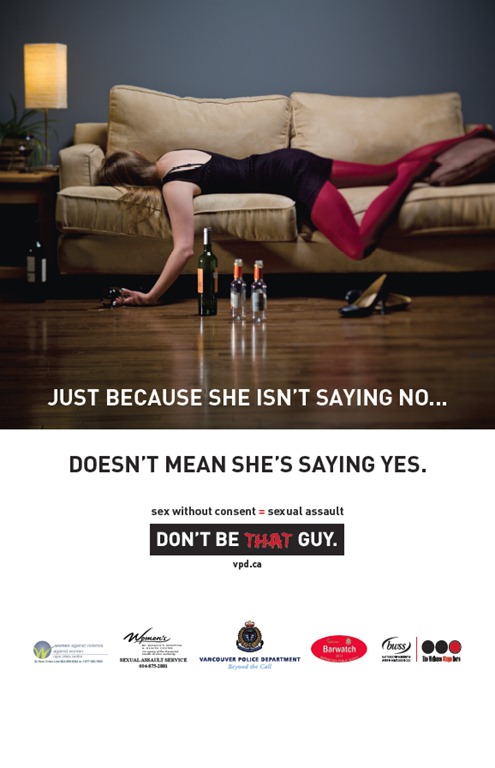
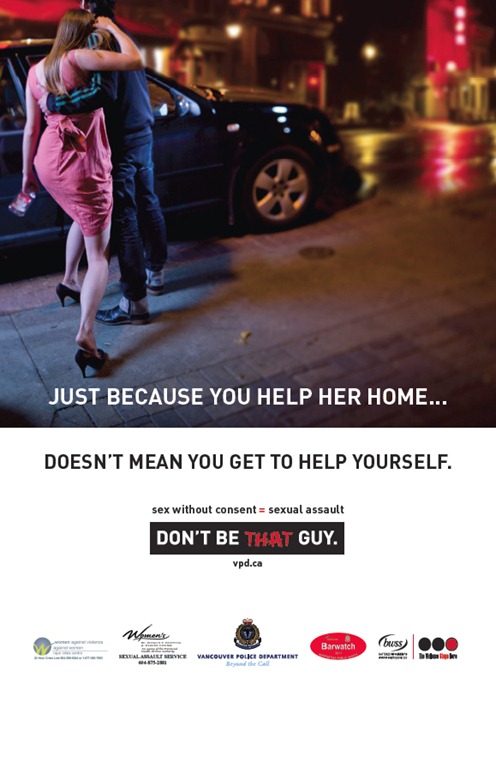
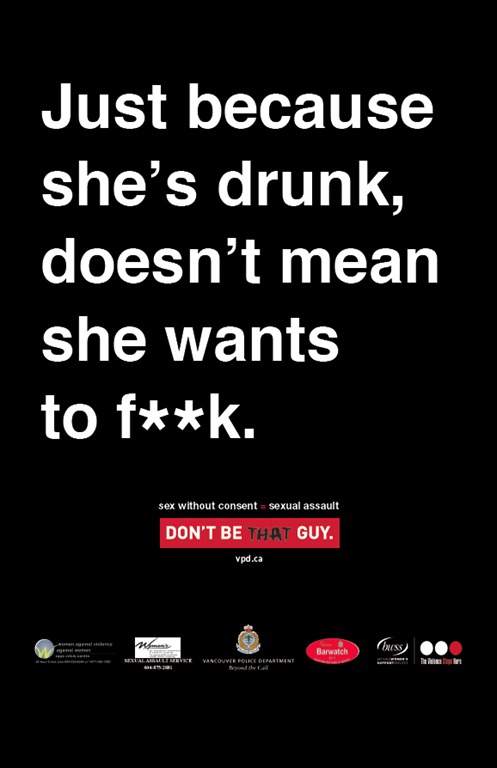
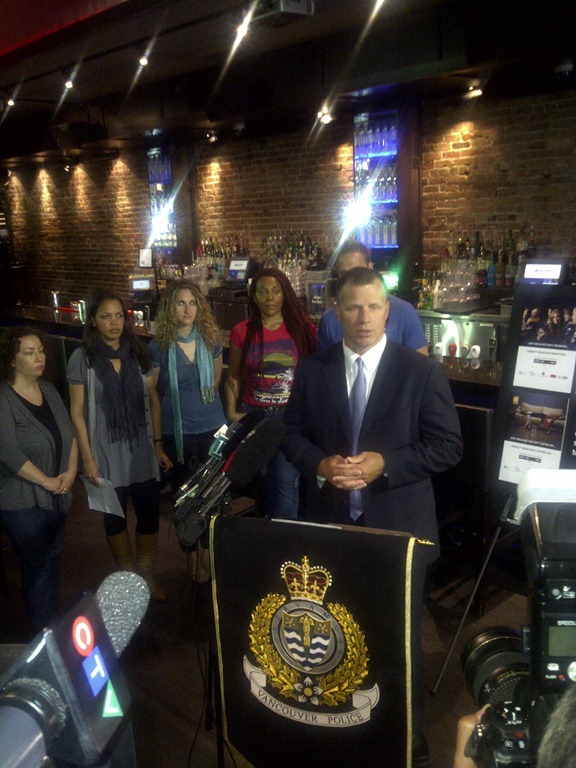
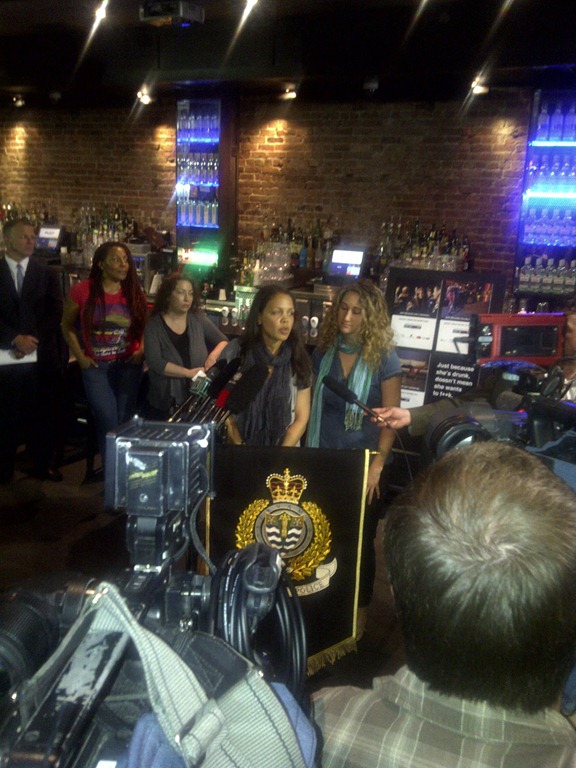
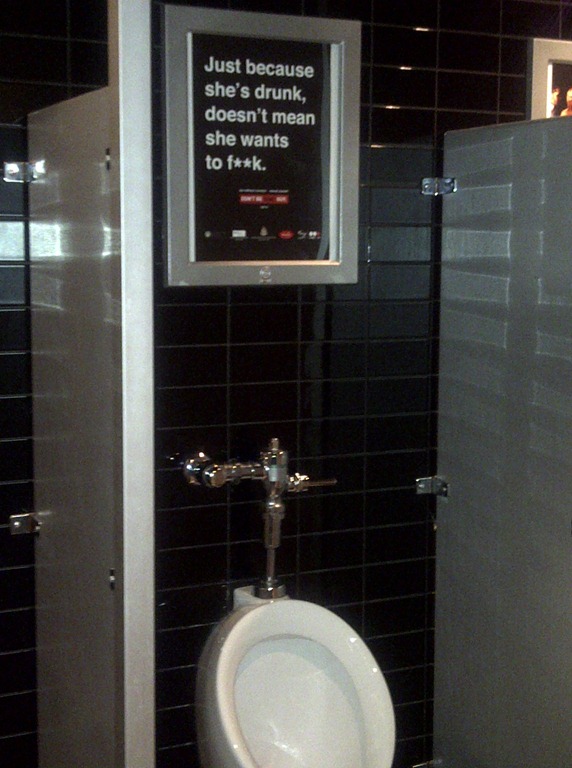
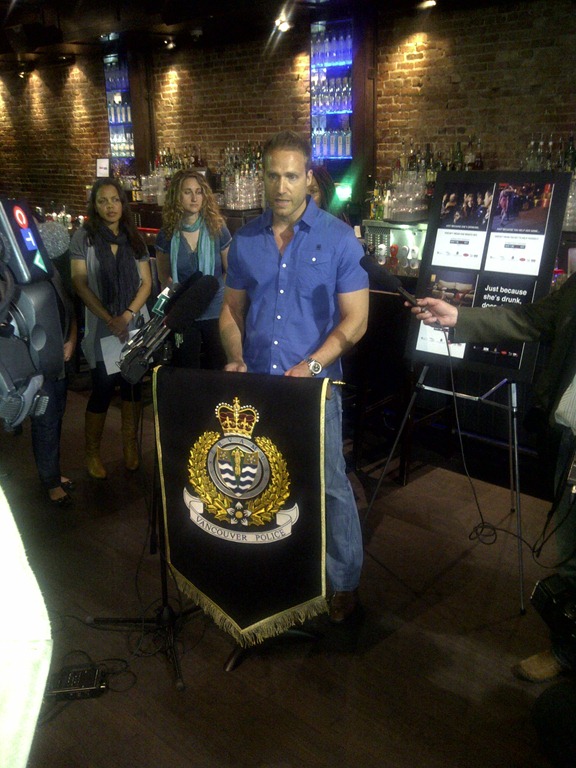
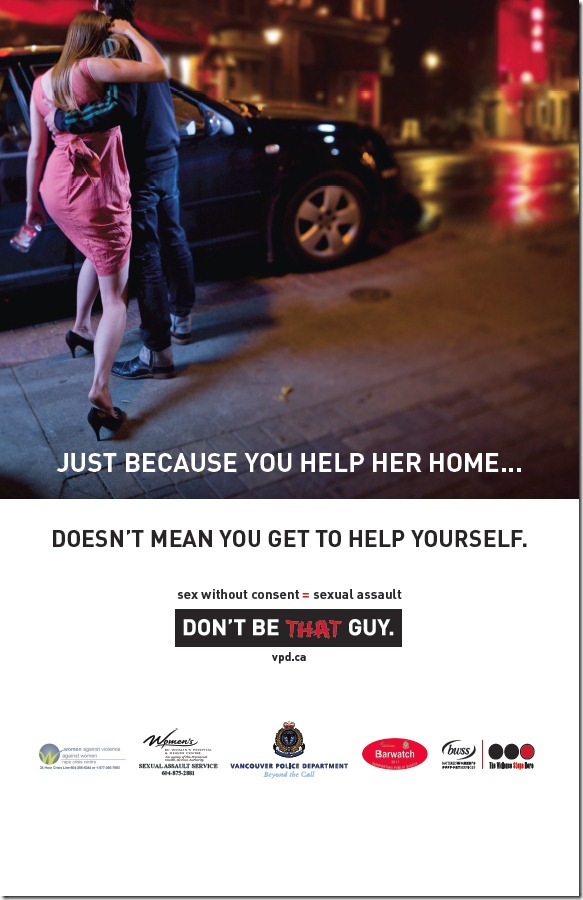
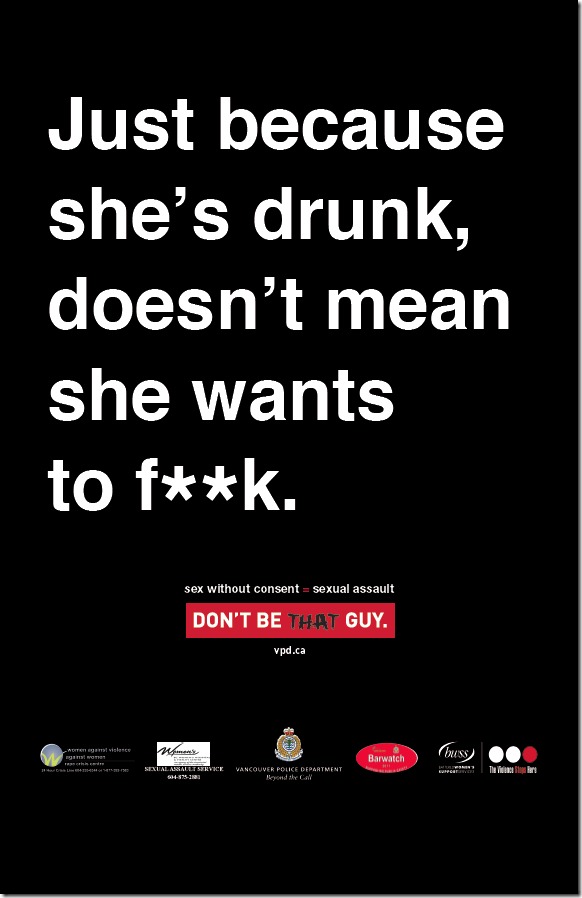
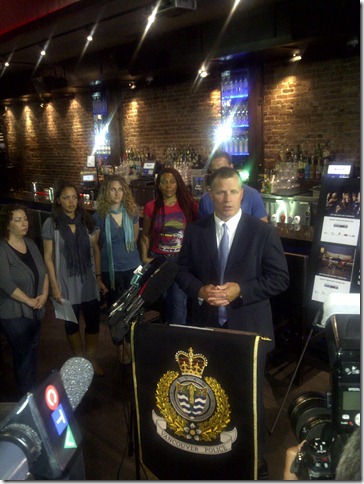
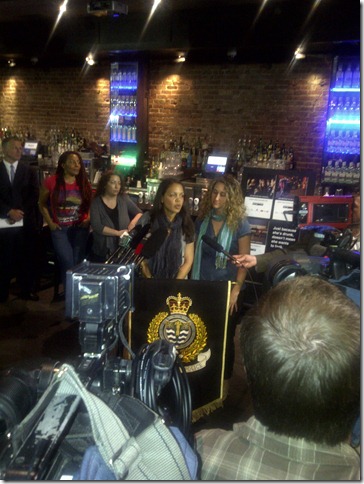
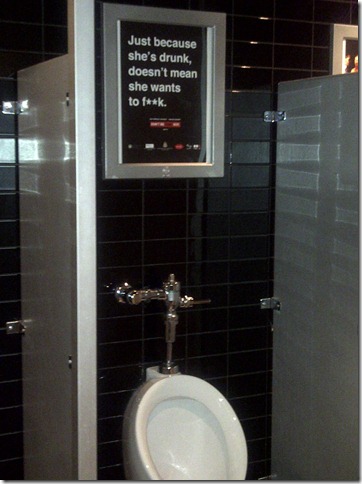
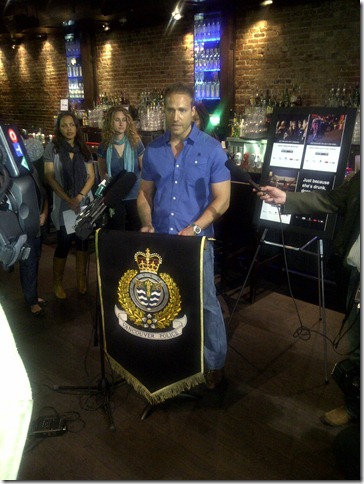
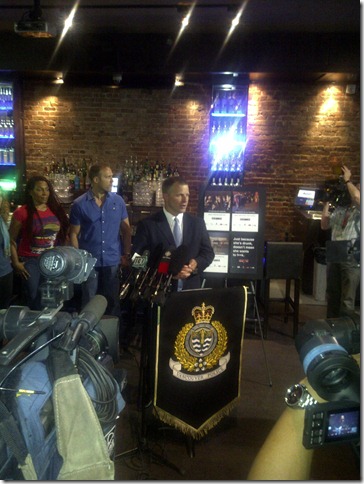
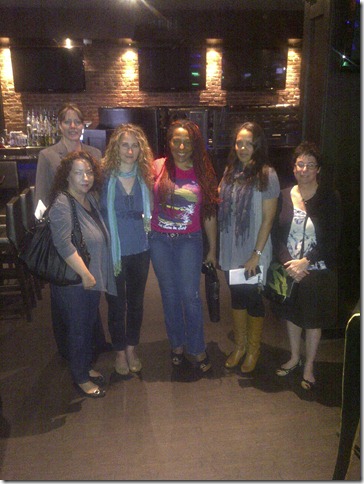
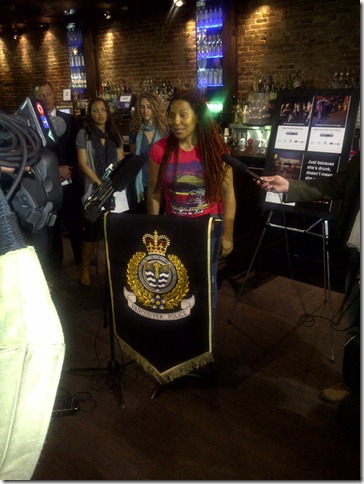
Today, Battered Women’s Support Services has partnered with Vancouver Police Department, Bar Watch, WAVAW and BC Women’s Hospital and Health Centre in Don’t Be That Guy. Don’t Be That Guy – a behavioural marketing campaign sends the message that sex without consent is sexual assault. We are sending a visual message to men between the ages of 18 – 25, graphically demonstrating their role in ending alcohol facilitated sexual assaults. Don’t Be That Guy shifts the emphasis to men to take responsibility for their behaviour. Studies involving 18-25 year old men revealed that 48 per cent of the men did not consider it rape if a woman is too drunk to know what is going on.
The original vision for Don’t Be That Guy was a community collaboration in Edmonton, Alberta in response to recognition of increased reports of alcohol facilitated sexual assaults in their city. The community collaboration called themselves SAVE (Sexual Assault Voices of Edmonton) and their major partners were Edmonton Police Service, Sexual Assault Centre of Edmonton, University of Alberta Sexual Assault Centre, Saffron Centre, Alberta Health Services – Covenant Health, Prostitution Action and Awareness Foundation of Edmonton, University of Alberta Women’s Studies Program, Red Cross (Edmonton), Responsible Hospitality Edmonton and several community advocates. Here’s more about SAVE.
Typically, sexual assault awareness campaigns target potential victims/women by urging women to restrict their behaviour. We know through our work at Battered Women’s Support Services and research confirms that women are, on a daily basis, taking remarkable steps to prevent victimization, and that targeting the behaviour of victims is not only ineffective, but also contributes to how much they, the offender and the larger public (including law enforcement and justice system) blame women after the assault. Here’s more information about Sexual Assault – Rape. The behaviour of men, including the sense of entitlement in regards to sex and access to women’s bodies is what is being challenged through this campaign. Don’t Be That Guy is urging men to end rape.
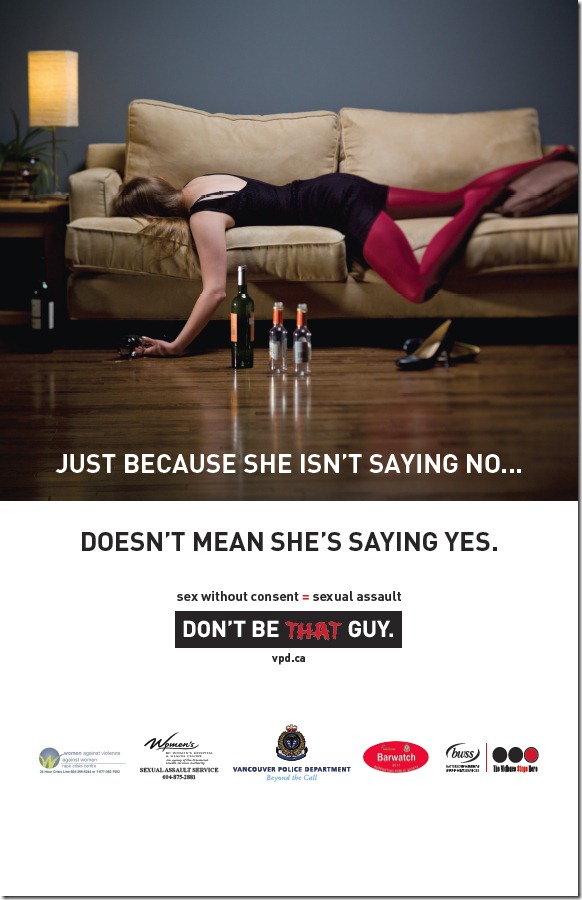
In order to effective change and end rape we must put the onus on the ones responsible for the assault to be responsible for stopping it. Don’t Be That Guy is intended to address alcohol-facilitated sexual assault without victim-blaming. These three posters are appearing in restrooms in Vancouver downtown core bar district. Bar district staff are being trained to recognize and respond to situations of risk, to hold potential offenders responsible and to ensure the safety of potential victims.
Battered Women’s Support Services has been working to prevent violence against women for 32 years. For 20 years we have delivered violence prevention and healthy relationships information to youth in middle and high schools in BC. Our Youth Engagement in Violence Prevention Program is in development with a heavy emphasis on “by-stander” intervention components, urging those who are silent and witnessing to become engaged participants to respond to instances of domestic and/or sexual violence. When we launched The Violence Stops Here in 2010, Battered Women’s Support Services urged men to own their role in ending violence against women. Last year we responded to 9,500 requests for information and support. If you have been sexually assaulted or if you are dealing with violence in an intimate relationship call us at 604-687-1867 or toll-free at 1-855-687-1868. The posters are available for download or email us at endingviolence@bwss.org
Don’t Be That Guy – Urging Men to Own Their Role to End Rape
Update! Media and Pictures from the Press Conference
The Vancouver Police Department Don’t Be That Guy press release
The Province ‘Don’t be that guy,’ say police
CBC Sexual Assaults Targeted in Poster Campaign
News 1130 Don’t Be That Guy Campaign Kicks Off
CKNW 980 AM Don’t Be That Guy Campaign Launched to Prevent Sexual Assaults
Kelvin Claveria Kelvin (KC) Claveria’s Blog
Vancouver Courier Cops Target Predatory Bar Patrons in Vancouver
India Times Quotes
Stephen Hui – The Georgia Straight
![clip_image002[6]](https://www.bwss.org/wp-content/uploads/2012/04/clip_image00262.gif "clip_image002[6]")