May 18, 2012 | Battered Women's Support Services, Media Advisory
FOR IMMEDIATE RELEASE
Contact: Angela Marie MacDougall
Executive Director,
Battered Women’s Support Services
www.bwss.org
May 17, 2012
Bill C-31 Re-Victimizing Women Refugees and their Children
(Vancouver, Coast Salish Territory) Bill C-31, “The Protecting Canada’s Immigration System Act,” seeks to implement a series of new changes to immigration policy and procedure that are going to severely impact refugees escaping from violence and persecution, particularly women, queer and trans-identified individuals, and their families.
Under Bill C-31 impossible time frames will be imposed for refugees to have their claims assessed. Within 15 days of arrival asylum-seekers will be expected to arrange legal council, interpretive services, and present their personal experiences before the Immigration and Refugee Board (IRB). “Lawyers who are willing to take aid for refugee claims are very few,” says Angela Marie MacDougall Executive Director of BWSS, “They will be incredibly overburdened.”
Designations of certain countries as “safe” will result in women being sent back to the violence they just left. “These provisions fail to recognize that women may experience systemic discrimination and unchecked gender-based violence in countries that are otherwise considered safe,” says Barbra Schlifer Clinic Executive Director, Amanda Dale. “We regularly work with women who have been abused, without state protection, in the home countries they fled, such places as Portugal, St. Vincent and Mexico, to name but a few.”
Alarmingly, there is no provision preventing the detention of children in Bill C-31. Children and youth under the age of 15 will be detained with their parents, or turned over to foster care, forcing either incarceration or the breaking apart of families.
Additionally, refugees who are arbitrarily designated as “irregular arrivals” by the Minister, will face immediate indeterminate imprisonment.
For those who manage to get through this harrowing process and somehow attain status, Bill C-31 will see to sustained impermanence. Status will remain conditional and may be revoked on any number of subjective conditions, determined by the Minister – ensuring those who actually manage to receive refugee status in Canada will not be able to trust in the stability of that status.
Also important to note, the Ministry plans to reassess successful cases after 5 years of obtaining status, to determine whether the country refugees needed asylum from, has become a so-called “safe” country, thus creating further uncertainty with the very real probability of being sent back.
Bill C-31 will ensure further traumatization of highly vulnerable women and children fleeing persecution and seeking safe asylum in Canada. Among its many issues, it will see expedited processes that will force deportation and unfair assessments of persecution, cause families to break apart, criminalize victimized persons through detention, imprisonment of youth and children, as well as undermining the nature of safety sought with threats and the added possibility of deportation should status actually be attained.
Battered Women Support Services continues in its ongoing opposition to this bill and stands in solidarity with The Barbra Schlifer Clinic, METRAC, and LEAF, who have recently issued a press release on this issue and have also presented their concerns about the Bill to Commons Committee on Bill C-31, which concluded hearings last week.
Link to The Barbra Schlifer Clinic, METRAC, and LEAF:
http://schliferclinic.com/vars/advocacy/PressReleaseBillC31.pdf
Links to BWSS articles covering related issues:
https://www.bwss.org/2011/11/proposal-for-conditional-permanent-residence-would-increase-violence-against-women/
https://www.bwss.org/paola-ortiz-was-deported-yesterday%E2%80%93refugee-women-fleeing-gender-persecution/
https://www.bwss.org/2011/05/the-role-of-men-in-ending-violence-against-women-by-angela-marie-macdougall-presentation-to-canadian-council-of-refugees/
https://www.bwss.org/2011/05/canadian-council-for-refugees-%E2%80%93-activities-on-violence-against-women/
Apr 22, 2012 | Battered Women's Support Services, Media Advisory
News Release
FOR IMMEDIATE RELEASE
Contact: Angela Marie MacDougall
Executive Director,
Battered Women’s Support Services
www.bwss.org
Rosa Elena Arteaga, Manager,
Battered Women’s Support Services, 778-996-5993• www.bwss.org
April 23, 2012
National Crime Victims Awareness Week April 22 – 28, 2012
Taking Action to End Violence Against Girls and Women
“Women are eight times more likely than men to be killed by their spouse or romantic partner,” states new report released, last Tuesday, by the BC Coroners Service.
The report looked at 120 homicides classified as Intimate Partner Violence (IPV) from 2003 to 2011. IPV is defined as “intentional harm or injury inflicted by a current or former spouse, boyfriend or girlfriend or other romantic partner of the victim.” However, the findings of this report expose the gendered implications of these crimes: women are at the highest risk.
“These statistics only scratch the surface,” said Angela Marie MacDougall, Executive Director, Battered Women’s Support Services (BWSS), “for every murdered woman represented in these statistics, there are hundreds and thousands more women and their children living in fear in British Columbia.”
During National Crime Victims Awareness Week 2012, BWSS highlights “best practices” intervention and prevention initiatives. In 2011, through BWSS interventions over 4,000 individual counselling appointments were provided, 3,600 women access specialized support groups, 1,350 women were assisted with safety planning, risk assessment, crisis intervention and court accompaniment. In the absence of legal aid over 1,000 women obtained assistance with family law cases. Our services are delivered by a dedicated team of 16 staff and 40 volunteers.
“Through our statistics we have learned that now, more than ever, women are leaving abusive relationships” said Rosa Elena Arteaga, BWSS Manager, Direct Services and Programs. “Therefore, we value every opportunity to build trust and to support every woman who accesses our services. We are a small organization and we are one strong organization committed to ending violence against girls and women”
Prevention work at BWSS includes:
- Youth Ending Violence Program, where trained young women and young men facilitate workshops with their peers in high schools and community programs. Through this initiative youth work together examining their relationships with one another, identify the possibilities and conditions for violence and emotional abuse and explore how to build healthy intimate relationships.
- Online campaigns at www.bwss.org/endingviolence How Does She Resist? Resisting Media Representations to End Violence Against Girls and Women and Women, Violence and Justice. Since April 15, 2012, over 20,000 individuals have read blogs and shared through social media, raising awareness critical to long term social change.
“Over a third of women who die in this province, die at the hands of a partner – and more often at the hands of a current partner,” said chief coroner Lisa Lapointe. “We need to really look at situations where domestic violence is happening, or we suspect it is happening, and make sure there are resources for those women.”
Thirty-three years ago, Battered Women’s Support Services (BWSS) initiated this call and remains progressive providing prevention and intervention services to help end violence against girls and women.
Apr 17, 2012 | Battered Women's Support Services, Media Advisory
How to Get your Messages Heard and Hold the Media Accountable,
with Strategies from Jennifer Pozner
by Joanna Chiu
“Hey! We’re all trying to get the same thing here!”
This statement, hollered by one camera operator to another jostling to take video footage of a small group of “scantily clad” young women at SlutWalk NYC’s march last October, demonstrates what the SlutWalk NYC Media Team was up against.
While living in New York for a year, I perhaps foolishly volunteered to help with media outreach for SlutWalk NYC. I had mixed feelings about the movement, but I thought that joining survivors and allies to collectively protest victim blaming and sexual assault sounded like a good cause. I had written previously about SlutWalk Vancouver for the Georgia Straight and had analyzed the media coverage of SlutWalk Vancouver, so I wanted to help SlutWalk NYC articulate its messages to the media and learn something about the rough-and-tumble New York media scene in the process.
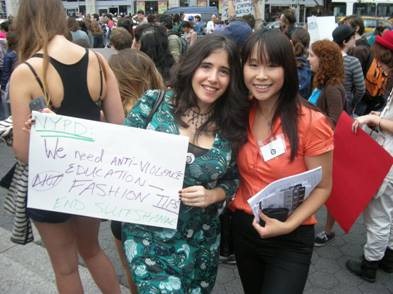
On the morning of the march, I rushed around Union Square Park frantically trying to figure out what to do with the hordes of journalists and camera crews that were literally falling over themselves in the presence of a few bras and fishnet stockings. Many media organizations had arrived at the scene looking to grab shots of the proportionally few women (mostly young, white and slim) who were wearing what some consider shocking dress, while rendering invisible the vast majority of participants (including men and people of colour) who showed up in the clothing they would normally wear to work or school.
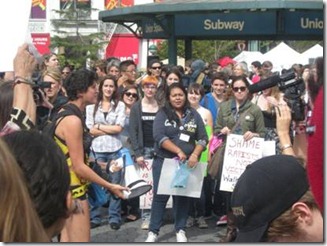
At SlutWalk NYC, note how cameras were trained on one protestor,
ignoring the casually dressed crowd.
The controversy that the SlutWalk movement had generated made it easy for SlutWalk marches to get attention from the media, but difficult for organizers to convey their messages when media organizations had preconceived ideas about the movement.
In retrospect, I thought that us organizers were pretty naïve to think that spending months in preparation, including sending out over 100 personalized press releases, could prevent the corporate media from sensationalizing a march called “SlutWalk,” or even to stop blaming victims of sexual assault in their news coverage. That night, after returning home to see that more than a dozen mice had moved into my studio apartment, I hid under the blankets on my bed and cried for a bit.

New York City mice: not so cute when they’re
eating your food and nesting in your closet.
But while SlutWalk may have been particularly prone to attracting sensational media coverage, the struggle to get events covered accurately (or covered at all) in the media is an all too familiar problem that all activists face. It was something that I certainly encountered organizing events to help end poverty, promote gender equality, and remove landmines for well-established organizations like Oxfam Canada and Amnesty International.
I turned to a valued mentor, Jennifer Pozner for some much-needed advice. Pozner is the director of Women in Media & News (WIMN), a media analysis, education and advocacy group. Pozner provides media literacy training to individuals, campuses and organizations, and is the author of Reality Bites Back: The Troubling Truth About Guilty Pleasure TV. She also appears as a frequent media commentator on outlets such as NBC, CNN, MSNBC, and the Daily Show, and like the pro she is, she kept a smile on her face while debating Bill O’Reilly, Sean Hannity and Joe Scarborough on Fox News.
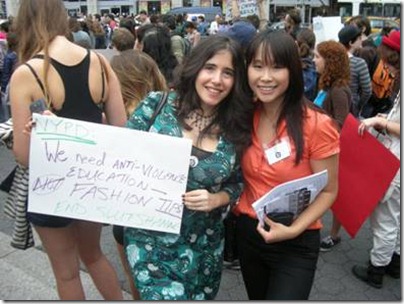
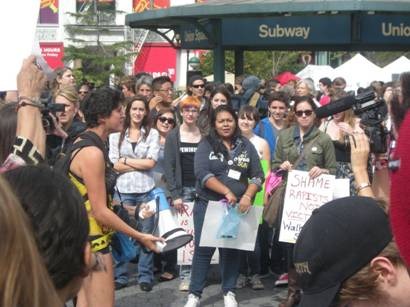
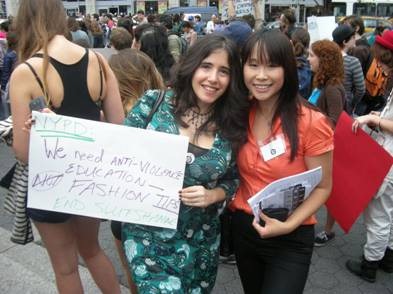
Pozner and me at SlutWalk NYC. I look deceptively calm here!
Her sign read: “NYPD: We need anti-violence education NOT
fashion tips. End Slut Shaming.”
Chiu: Why is it so tough to see good mainstream media coverage of activists’ events like anti-violence marches?
Pozner: We can talk about the reasons why there is bias in media coverage of social justice issues for hours, but here are some bullet points.
1. It is cheaper and often more effective to run sensational hea
dlines that scare, shock or shame. It is much more expensive to do actual reporting that does not rely on shock value. In the U.S., when six parent companies owned by rich, white men control the vast majority of everything we see in the media, it’s not surprising that the overwhelming coverage of violence against women, as well as other social justice causes, are problematic at best, and damning at worst.
2. Another reason for poor coverage of causes like sexual violence is that many stakeholders in the media don’t like to talk about the amount of sexism filled in the industry: such as in the use of sexual violence as entertainment in television, film and video games, and in advertising to sell everything from shoes to cars to burgers.
3. And lastly, the overarching reason is that feminism, like most social movements, poses a real potential threat to dominant power structures, whether it is legal, governmental or the media. These institutions are very set in their ways, and there has always been a backlash against the potential feminism holds to change the way the system works.
Chiu: Despite all these obstacles, what are some ways that activists can get their messages heard in the media, and hold media accountable for harmful coverage?
Pozner: Individually, we can write letters to the editor every time we see inaccurate or rape culture-supporting articles in media outlets that blame the victims and let the perpetrators off the hook. Activists often feel tired of sending letters but every editor I’ve spoken to say that their newsroom reads those letters and takes them seriously.
Information technologies also give individuals more ways than ever before to push back against sexism and rape culture in the media. You can use social media to call attention to problems you see in coverage and to also lay out good examples of media coverage, and to support independent media organizations.
Our power is maximized when we act collectively. On the collective level, organizations can really start to change the tone of media coverage if they create a media plan. Part of the plan should include monitoring how violence against women is covered in local or national media, and then to target those media outlets strategically—praising them for what they do right, and offering suggestions on how they could do to make improvements. If we understand the rules of game, then we are able to play the game in a way that’s more effective, and frame our events and causes in a way that will promote better media coverage.
Chiu: How can activists deliver their messages in a way that is more likely to attract a wide audience?
Pozner: Careful messaging is very important because of commonly held notions that feminists are fringe, angry and male bashing. To break from decades of age-old stereotypes, we really need to deliver our messages in unique, powerful and effective ways. That usually means telling engaging personal stories that connect to larger community struggles or policies that are backed up by facts and figures. It’s good to avoid jargon, to be accessible to people outside of the feminist community, and to engage people’s emotional and intellectual sides simultaneously.
Chiu: What resources would you suggest for activists to learn how to improve their media literacy to better resist against oppressive media representations?
Pozner: WIMN has some resources online, and we offer media trainings regularly.
The book, Spin Works: A Media Guidebook for Communicating Values and Shaping Opinions, is an activist-friendly guide to public relations.
I’ve written many articles for FAIR, a media watch group, when I was Women’s Desk editor there, and the archives are accessible here.
Bitch magazine has had some great pieces over years, and their anthology, BitchFest collects some of their best cultural and media criticism.
There are some classic, older books like Virgin or Vamp: How the Press Covers Sex Crimes, that provide detailed case studies. The old problems remain the same, but the solutions need to change with time.
More recently, feminist bloggers and writers Samhita Mukhopadhyay, Jessica Valenti and Jaclyn Friedman have published the following books that contain great pieces on rape culture, victim blaming and media criticism: Outdated, The Purity Myth, and Yes Means Yes!
Chiu: Thank you! And for resources focused on Canadian media, I’d recommend the Feminist Media Project and a new book by pioneering feminist journalist Michele Landsberg, Writing the Revolution. I also invite anyone interested in engaging in Canadian media criticism to join WAM! Vancouver’s listserv.
How Does She Resist: Resisting Media Representations to End Violence Against Girls and Women
Prevention of Violence Against Women Week April 15 – 21, 2012
Follow on Twitter #resistmedia