Jul 11, 2013 | Battered Women's Support Services, Indigenous Women, Media Advisory, Missing Murdered Indigenous Women and Girls
(Coast Salish Territory/ Vancouver, B.C.- July 10, 2013) The attached letter is from an informal coalition of 20 community and advocacy groups in response to the recent announcement by former Attorney General Shirley Bond that civil litigation by children of Robert Pickton’s victims may “constrain” its work in responding to the recommendations of the Missing Women Commission of Inquiry, and to the recent resignation of Honourable Steven Point as advocate for the recommendations. The coalition is seeking engagement with newly appointed Minister of Justice and Attorney General, Honourable Suzanne Anton.
By way of background, on April 2, 2012, fourteen groups sent an open letter to Commissioner Oppal advising that they would not be participating in the Policy Forums or Study Commissions aspects of the Missing Women Commission of Inquiry. Many of these groups, plus other supporters, have been meeting as an informal coalition since then to discuss how to move forward in supporting the children and families, and in pursuing justice for the missing and murdered girls and women.
For more information, please contact:
Aboriginal Front Door Society, Mona Woodward, (604) 697-5662
Atira Women’s Resource Society, Janice Abbott, (604) 331-1420
B.C. Civil Liberties Association, Micheal Vonn, (604) 250-6815
BC Native Women’s Association, Barbara Morin, (250) 461-6880
Battered Women’s Support Services, Angela Marie MacDougall
Butterflies in Spirit, Lorelei Williams, (778) 709-6498
Carrier Sekani Tribal Council, Tribal Chair Terry Teegee, (250) 640-3256
Downtown Eastside Women’s Centre, Alice Kendall, (604) 681-8480 ext. 233
Ending Violence Association British Columbia, Beverly Jacobs, (604) 633-2506 ext. 16
February 14th Women’s Memorial March Committee, Lisa Yellow-Quill, (604) 618-1061
Lookout Emergency Aid Society, Karen O’Shannacery, (604) 255-0340 ext. 12
PACE: Providing Alternatives Counselling & Education Society, Ellen Wiebe, ellenwiebe@gmail.com
PHS Community Services Society, Patrick Smith, (604) 779-6837
Pivot Legal Society, Doug King, (778) 898-6349
Union of B.C. Indian Chiefs, Grand Chief Stewart Phillip, (250) 490-5314
Union Gospel Mission, Genesa Greening, (604) 506-0845
West Coast LEAF, Laura Track, (604) 684-8772, ext.214
WISH Drop-in Centre Society, Kate Gibson, (604) 720-5517
Honourable Suzanne Anton
Minister of Justice and Attorney General
PO BOX 9044 STN PROV GOVT
Victoria BC, V8W 9E2
Via facsimile: 250 387-6411
July 10, 2013
Dear Attorney General:
Open Letter: Community and Advocacy Groups Strongly Object to Stalling by Province since Conclusion of Missing Women Commission of Inquiry and Set out Requirements for Participation
Congratulations on your appointment to Minister of Justice and Attorney General, we anticipate a strong working relationship with you to advance the critical file of missing and murdered women. We are a coalition of community and advocacy groups who were shut out of the Missing Women Commission of Inquiry (the “Inquiry”). We understand that your June 10 “Mandate Letter” from the Premier states that one of your priorities is to “consider implementation of the recommendations of the Missing Women Commission of Inquiry.” However, prior to your appointment and shortly after the election, your predecessor announced that civil litigation by children of Robert Pickton’s victims may constrain the government’s work in responding to the recommendations of the Missing Women Commission of Inquiry, and that Xwĕ lī qwĕl tĕl (the Honourable Steven Point) resigned as advocate for their implementation. We are frustrated and offended by the suggestion that civil litigation by families will constrain the government’s response or stall the work that needs to be done to deal with the ongoing tragedy of violence against women, particularly Indigenous women. If the government truly wishes to make changes in good faith and in the spirit of reconciliation, it should not constrain its actions out of fear that those actions may have an impact on litigation. Such a tactic is not a legal requirement – contrary to the inference that your predecessor appears to have made in her statement that litigation must take precedence over any other process. Rather, it is a defensive move that has already shaken the hope that there might be constructive action taken by the government to protect vulnerable women.
As you know, the undersigned groups were not funded to participate in the Inquiry, and did not participate in the Policy Forums or Study Commission aspects of the Inquiry. We refused to lend the credibility of our respective organizations’ names and expertise to the Inquiry, which could only be described as a deeply flawed and illegitimate process. For decades, family members of missing women, grassroots women’s organizations in the Downtown Eastside of Vancouver (DTES), community groups and Indigenous and public leaders, have incessantly called for a full public inquiry into the missing women of the DTES and the Highway of Tears. We were forced to withdraw due to denial of a just process, uneven funding for applicants granted standing, discrimination against women and Indigenous groups, and violations of international human rights standards. We were deeply troubled by the extremely narrow and restrictive terms of reference and the imposed tight timelines, and continued to demand that all applicants who were given standing be provincially funded, as recommended by Commissioner Oppal. The Commission lost all credibility among Indigenous, sex work, human rights and women’s organizations that work with and are comprised of the very women most affected by the issues this Inquiry was charged with investigating.
The litigation does not prevent the government from continuing essential work with impacted families and communities to create tangible solutions to the tragedy of violence against women that continues to unfold. Former Attorney General Shirley Bond’s statement that the work may be “constrained” unfairly places the blame for the government’s own inaction on the families involved in the litigation, who are seeking justice for the deaths of their loved ones. The families of the missing and murdered women must absolutely not be made into scapegoats for the government’s lack of progress.
Since the conclusion of the deeply flawed Inquiry, and the release of a 1500-page report by Commissioner Wally Oppal in December, 2012, the Province has been extremely slow in taking action implementing recommendations from the report, despite the glaring urgency for real and substantial change to be made on the ground in order to prevent further violence and to pursue justice for the missing and murdered women. We acknowledge that the immediate undertaking of the government to open the WISH Drop-In Centre over night with annualized funding of $750,000 was a critical and positive step; however, we cannot understand why, given the forced vulnerability to violence on the Highway of Tears, that the second immediate measure recommended by Commissioner Oppal to develop and implement an enhanced public transit system to provide a safer travel option connecting the Northern capital and Northern communities, particularly along Highway 16 (the Highway of Tears), was not implemented.
Members of the Coalition met with the Honourable Steven Point twice to discuss his role as “champion” to provide advice to the government as it implements the recommendations, and as Chair of a new Minister’s Advisory Committee on the Safety and Security of Vulnerable Women. Mr. Point indicated to us that he would be stepping down after getting the process up and running, with the recommendation that a woman should chair the committee. He did not state that this was related to any litigation, even though the coalition met with him on the morning of May 14, just days before his resignation was announced. We feel extremely betrayed by this sudden shift, which was made without any consultation or engagement with the families or with impacted community and advocacy groups. Despite our skepticism about the Commission and our previous exclusion, summarized above, we participated in these meetings with Mr. Point in good faith, with a number of our members considering how to engage constructively in that process. The government’s announcement has, once again, damaged the relationship between BC, the families of the victims (who spoke for themselves about their disappointment after the announcement), and stakeholder groups.
Recommendations Not Implemented: Upon review of the 63 formal recommendations in Commissioner Oppal’s report, which was released approximately six months ago, we are extremely concerned that the Province has begun work on only two of the recommendations, now apparently stalled out with the resignation of Mr. Point:
12.1 That Provincial Government appoint an independent advisor to serve as champion for the implementation of the Commission’s recommendations. This appointment should take effect within 12 weeks of release of the report.
12.2 That the independent advisor work collaboratively with representatives of Aboriginal communities, the DTES, and the victims’ families in the implementation process.
Given that Mr. Point was appointed in December 2012, we strongly object to the fact that none of the other recommendations have begun to be considered or implemented, and we are offended with the absence of justice for our missing and murdered women. Approximately six months after the release of the MWCI final report and recommendations, we ask whether the government thoroughly reviewed the report as committed on December 17.We call on the newly re-elected government – as a whole – to prioritize the issue of missing and murdered women, and to work with the families and community organizations to make real change. We know that the Premier has spoken of a strong commitment to government serving the needs of families. We expect the Premier and the government to understand that it is impossible to focus on creating jobs and building a strong economy without equally attending to the pursuit of justice for the most marginalized people and families in the Province.Necessary Conditions to Implement Recommendations: The Inquiry process was flawed from the beginning, and we were extremely concerned with, among other shortcomings: limitations of the terms of reference; no lawyers for organizations and community members who represent crucial perspectives; lack of witness protection; delayed, incomplete disclosure; impossible timelines; and limited witnesses. The failed Inquiry, far from assisting Indigenous women and women from the Downtown Eastside, ironically reinforced their marginalization. Gender and sexual violence against girls and women continues in Downtown Eastside Vancouver unabated. The Missing Women’s Commission of Inquiry missed an opportunity to respond to this critical social issue through recommending funding for a range of gender and sexual violence support services and gender and sexual violence prevention activities. We advise that if the Province of British Columbia is going to be successful in implementing the recommendations of the Inquiry:
• The Province must work collaboratively and directly with families and impacted community groups to implement recommendations and genuinely take action to make real change on the ground for vulnerable women, and not make unilateral decisions.
• We suggest a focus on key recommendations, determined in cooperation with the families and impacted community groups, and giving urgent priority to those which would direct and provide assistance to the families and to seeking justice for the missing and murdered women.
• There must be adequate funding from the Province to implement the recommendations.
• The proposed Minister’s Advisory Committee on the Safety and Security of Vulnerable Women, if established, must be large enough to allow for adequate representatives from the groups involved, and must include elder advisors as full members. The proposed Committee must allow the people most affected to appoint who sits on the Committee from their respective groups, rather than allowing the Minister with discretionary powers to make appointments. We are confident this will create a stronger and more effective committee.
• In addition to the fact that recommendations 12.1 and 12.2 are currently not even being implemented given the resignation of Mr. Point, the Province must take into consideration that the independent advisor would be most effective if it is a woman, given the extremely sensitive and gender-based nature of this work. Further, we object to the appointment of an independent advisor to serve as “champion” because we are concerned that this would mean the independent advisor would be bound to support all the recommendations even if s/he – or the Committee – did not agree with all of them, effectively taking away any independence.
• The Province must commit to a public, independent annual report on the situation of missing and murdered women in British Columbia, and on implementation of the Commissioner’s recommendations. We strongly urge you to ensure that the recommendations do not get put aside and ignored, as the majority of the recommendations did coming out of the Frank Paul Inquiry.
• In order to address the gaps and eliminate the critical and devastating issues of violence against Indigenous girls and women, intersecting and deeply rooted factors including colonialism, racism, and extreme conditions of poverty must be examined. We remind you that in Canada, Indigenous women are five times more likely than other women to die as a result of violence, and that this problem is a national and international crisis. We absolutely refuse to accept the racist notion concerning the normativity of violence that many Indigenous girls and women experience on a regular basis.
Coalition Committed to Pursuing a National Inquiry and International Investigation: In December 2011, the UN Committee on the Elimination of Discrimination against Women announced that it was initiating an investigation of Canada with respect to disappearances and murders of Indigenous women and girls. Given the failures of the British Columbian and Canadian governments to effectively address the human rights crisis of missing and murdered Indigenous women and girls, including the social and economic conditions that make Indigenous women and girls more vulnerable to violence in the first place, our organizations will dedicate what limited resources we can offer to working with the United Nations to facilitate their investigations and fact-finding processes, in order to ensure that Canada is held internationally accountable for these ongoing human rights violations.Canada has been criticized by the United Nations Committee on the Elimination of Discrimination against Women and, in 2012, by the UN Committee on the Elimination of Racial Discrimination because of the inadequacies in its law and practice respecting the prevention, investigation, prosecution and punishment of violence against women, particularly Aboriginal women. The high levels of violence experienced by Indigenous women, as well as the hundreds of missing and murdered Indigenous women across the country are evidence of Canada’s failure to meet its international legal obligations to respect, protect and fulfill the fundamental human rights of women. To date, Canada has not made an effective response to these serious and significant findings by expert human rights bodies.We remind you that the United Nations Declaration on the Rights of Indigenous Peoples clearly sets out a framework for states to effectively ensure the rights of Indigenous women:
Article 21(2): States shall take effective measures and, where appropriate, special measures to ensure continuing improvement of their economic and social conditions. Particular attention shall be paid to the rights and special needs of indigenous elders, women, youth, children and persons with disabilities.
Article 22(2): States shall take measures, in conjunction with indigenous peoples, to ensure that indigenous women and children enjoy the full protection and guarantees against all forms of violence and discrimination.
We, the undersigned groups, continue to strongly advocate for a national public inquiry into the hundreds of murders and disappearances of Indigenous women and girls in Canada , to address the service, socio-economic and human rights gaps, and make concrete and specific recommendations to end violence against Indigenous girls and women at a national level.Moving Forward
Although members of this coalition were shut out of the Inquiry process, we continue to meet regularly to discuss how to move forward in order to support the families, and to pursue justice for the missing and murdered women. We are not going anywhere, and we look forward to the opportunity to work with you on this important issue. We will be pursuing justice with or without you, and we certainly hope that you choose to work with us.Minister Anton, it is absolutely imperative that you work collaboratively with the families and impacted communities to make the issue of justice for the missing and murdered women one of your top priorities as Minister of Justice and Attorney General. Given the urgency of this issue, we request a meeting at your earliest convenience so that we can discuss how to move forward in addressing the violence against disadvantaged and marginalized women and girls in British Columbia. Please contact Don Bain, Executive Director at the Union of B.C. Indian Chiefs, to set up a meeting time (604) 684-0231.Yours truly,
Aboriginal Front Door Society
Amnesty International Canada
Atira Women’s Resource Society
B.C. Assembly of First Nations
B.C. Civil Liberties Association
BC Native Women’s Association
Battered Women’s Support Services
Butterflies in Spirit
Carrier Sekani Tribal Council
Downtown Eastside Women’s Centre
Ending Violence Association British Columbia
February 14th Women’s Memorial March Committee
Lookout Emergency Aid Society
Justice for Girls
PACE: Providing Alternatives Counselling & Education Society
PHS Community Services Society
Pivot Legal Society
Union of B.C. Indian Chiefs
Union Gospel Mission
West Coast LEAF
WISH Drop-In Centre Society

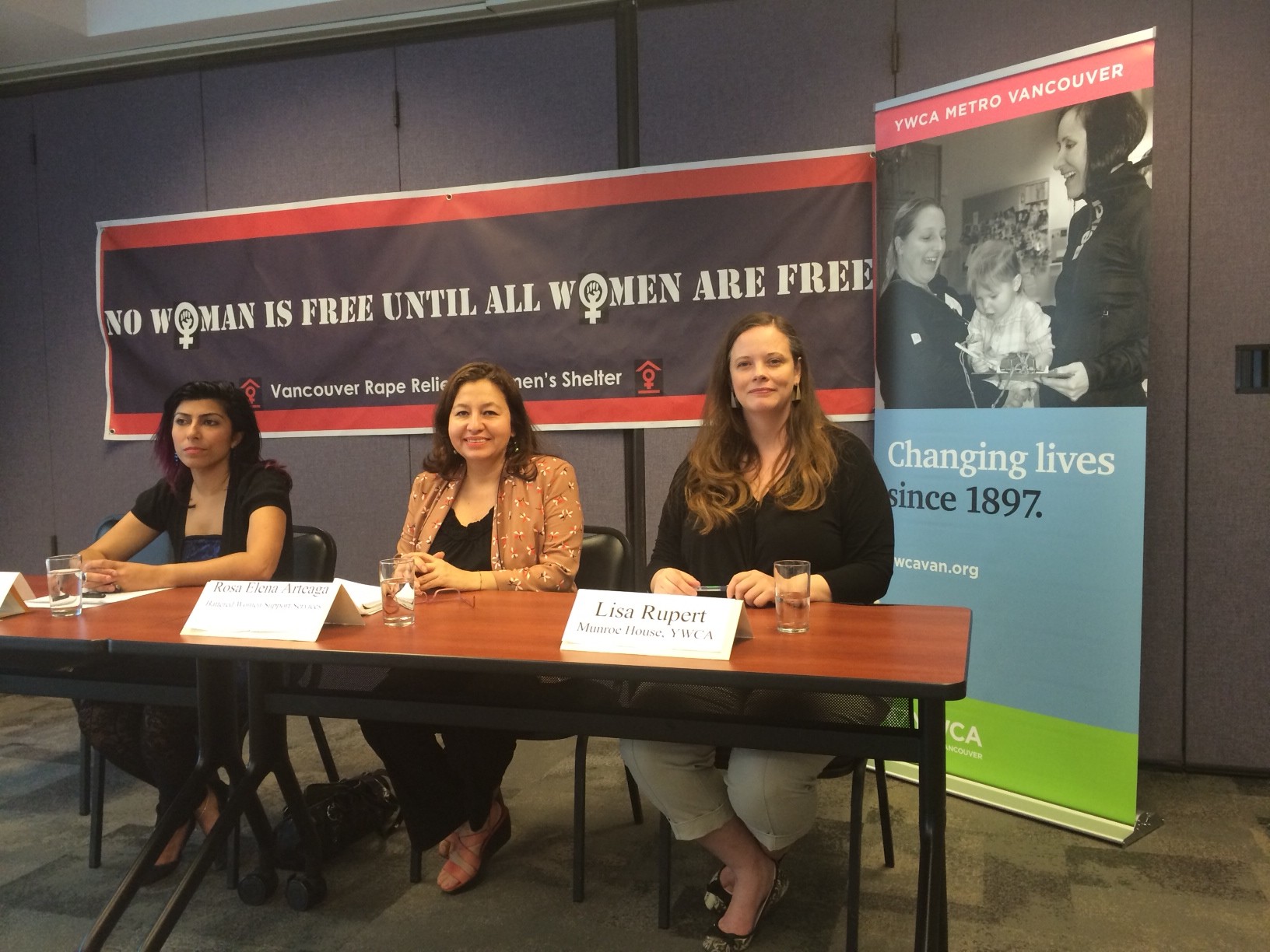 Daisy Kler, a front line-worker at Vancouver Rape Relief and Women’s Shelter notes that “At least in the first three cases, there was previous police involvement. This raises serious questions about police diligence in taking the appropriate measures to protect women from male violence.”