May 31, 2025 | Battered Women's Support Services
What Would It Look Like If Public Safety Was Designed With Survivors in Mind?
What would it look like if public safety was designed with survivors in mind?
We ask this not as a slogan—but as a serious political question.
Because the current conversation about “public safety” isn’t working for survivors. In fact, it rarely includes us at all.
Today, when the term public safety comes up, it usually means police. Prisons. Surveillance. It means calls to “crack down,” to end “catch and release,” to protect property, businesses, and public order.
But when we look at safety through the eyes of survivors, that lens doesn’t hold.
At BWSS, we work every day with women, girls, and gender-diverse people who have experienced violence in their homes, on the streets, in relationships, in institutions. We’ve seen how public safety systems were never designed with survivors in mind—and how easily they ignore violence until it spills out in ways too visible to deny.
“We’ve seen what happens when the violence that is ignored in private becomes the violence that erupts in public.”
The truth is, what politicians are now calling “catch and release” has always been the reality for survivors.
They report threats. They request safety plans. They ask for intervention.
And too often, the response is indifference.
Violent men are released. Protection orders are breached. Bail is granted. Risk is minimized.
And when another woman is killed, or a teenage girl is brutally attacked in a public park bathroom, everyone asks: How could this happen?
But survivors already told us.
“I called the police when he threatened to kill me. They said there was nothing they could do.”
“He was already known to them. He had a record. I still had to prove he was dangerous.”
We don’t need more punishment—we need more prevention.
We don’t need more surveillance—we need more response, support, and accountability when survivors come forward.
We don’t need tougher rhetoric—we need a broader definition of what safety really means.
That’s why we’re launching this campaign around a single, urgent question:
What would it look like if public safety was designed with survivors in mind?
We’re not here to offer a tidy answer. We’re here to listen.
To create space for the people who live the consequences of these failures every day to speak.
To imagine beyond what currently exists.
Because survivors already know what real safety feels like—and what its absence costs.
Maybe it looks like housing you can access without fear.
Maybe it looks like a legal system that doesn’t ask you to wait until it’s too late.
Maybe it looks like trauma-informed mental health care that doesn’t require a diagnosis.
Maybe it looks like public space where you aren’t forced to scan for exits every time you leave the house.
Maybe it’s something you’ve never experienced—but still deserve.
We believe the answers to this question already live in our communities.
We believe that public safety must be redefined—not just to include survivors, but to be built around us.
This campaign is your invitation.
To reflect. To speak. To imagine.
To respond with your vision of what safety could and should be.
What would it look like if public safety was designed with survivors in mind?
Tell us. Reflect. Share your vision. You can write, draw, speak, or respond however feels right to you.
Email us at EndingViolence@bwss.org
You can also share publicly using the hashtag #DesignedWithSurvivors and tagging @EndingViolence
Because safety should belong to all of us—and your voice matters
Tag us. Use the hashtag #DesignedWithSurvivors.
We are collecting and amplifying your responses—online, at community events, and through conversations that challenge the narrow frameworks dominating today’s debate.
Because until public safety includes those who have survived violence, it isn’t safety at all.
And until we expand the conversation, we’ll keep missing the point.
Let’s change that—together.
May 31, 2025 | Battered Women's Support Services
FOR IMMEDIATE RELEASE
May 30, 2025
“How Could This Happen…again?” BWSS Responds to Brutal Assault of Teen Girl in Vancouver and Calls for Urgent Action
Vancouver, BC – A 14-year-old girl was brutally assaulted in a public bathroom in the middle of the day. She was attacked by a man with a history of violence—known to police, armed, and moving through the city with no apparent oversight. This after several high profile assaults on women in Vancouver, BC.
This is not just a tragedy. It is a failure.
Battered Women’s Support Services (BWSS) is grieving with the survivor and her family, and demanding urgent action from every level of government. The organization says this case reflects what happens when we treat gender-based violence as an afterthought instead of a public safety emergency.
“We ask ourselves, ‘How could this happen?’ But the truth is, it keeps happening—because we refuse to take gender-based violence seriously,” said Angela Marie MacDougall, Executive Director of BWSS. “This wasn’t random. It was predictable. And it was preventable.”
A System That Lets Survivors Down—Over and Over Again
The suspect, 62-year-old John Frederick Field of Surrey, now faces multiple charges including sexual assault with a weapon against a minor, forcible confinement, robbery, and assault. This follows what police have described as a violent spree across Vancouver on May 29.
Rejecting “Catch and Release” Myths, Demanding Real Reform
While political rhetoric often blames “catch and release” policies for public safety failures, BWSS urges the public to look deeper.
“This isn’t only about bail reform—it’s about the failure to treat male violence against women and girls as high-risk behaviour,” said MacDougall. “When gender is left out of risk management, survivors are left out of safety planning.”
This case is emblematic of how public safety systems fail survivors, not because offenders are “caught and released,” but because known violent actors are not managed through a gender-based violence lens.
Systemic Gaps Include:
- Lack of mandated, evidence-based risk assessment tools especially for repeat or sexualized violence and lack of applying tool in decisions about releasing men back into the public.
- Failure to track coercive control, violence against women, or escalating threats as high-risk indicators.
- No consistent integration of GBV prevention in public safety or justice strategies at municipal, provincial, or federal levels.
While media headlines focus on the arrest, BWSS urges the public to focus on what led up to it:
- Why was a known violent offender free and unsupervised?
- Why are evidence-based risk assessment tools not mandated in cases involving sexual or gender-based violence?
- Why, after years of reports, plans, and promises, are women and girls still left unprotected?
Statistics Canada reports that 57% of sexual assaults are never reported, and 43% of victims believe nothing will change if they come forward. “For most survivors, the system isn’t just broken—it never worked to begin with,” said MacDougall.
The Plans Exist. The Action Does Not.
Both the federal National Action Plan to End Gender-Based Violence and BC’s Safe and Supported Action Plan were meant to change this. But today, those plans remain largely unfunded, piecemeal, and detached from real-time public safety planning.
“A 14-year-old was assaulted in a city bathroom. If our national and provincial plans don’t prevent that, they’re not working. They need to be more than documents—they need to be lifelines,” MacDougall said.
What Needs to Happen Now
BWSS is calling for bold and immediate steps, including:
- Declare gender-based violence a public safety emergency at all levels of government.
- Fully implement and expanding funding both the National and BC Action Plans with clear timelines, targets, and accountability.
- Mandate gender-based violence and violence against women risk assessments for all violent and sexual offenders.
- Invest in trauma and violence-informed housing, mental health, and violence prevention programs that actually reach survivors and communities.
- Convene a public safety roundtable on gender-based violence, including survivors, Indigenous leadership, and frontline organizations.
A Message for Elected Officials
“If this story makes you angry, good. It should. But don’t let it end there. Do something. Fund the work. Listen to survivors. Fix the systems that failed this girl—and that fail so many others every day.”
BWSS will meet with Mayor Ken Sim on Monday to press for urgent policy and funding action. The organization is calling on all levels of government to act—not with more statements, but with real investment, real oversight, and real prevention.
May 7, 2025 | Battered Women's Support Services
For many mothers, home isn’t always a safe place. Recently, we told you about Jade and shared her story as a mother who escaped years of abuse to protect her two sons, only to experience post-separation abuse after she left him.
Jade and her children survived because people like you believed in her, so she could stand in her power and continue to heal.
Mothers who navigate violence by their husbands, partners, and children’s fathers, while raising children, show immeasurable strength. You may be unable to fix it, but you can stand beside her. Here’s how to support a mother experiencing violence:
- Believe her – If she opens up, it’s a big step. Listen without judgment. Your belief can offer the trust she’s been denied elsewhere.
- Offer practical help – A ride. Childcare. A safe spot to rest or make a call. These small acts of care can open real pathways to safety.
- Know the resources – Have local crisis lines, shelters, and advocacy services in mind—so when she’s ready, you can guide her toward support, not pressure.
- Respect her privacy – Her story isn’t yours to tell. Never share without her consent. Her safety and dignity come first, always.
- Remind her she’s not alone – Violence isolates. Your steady, compassionate presence can be a lifeline—something to hold onto when everything else feels unsafe.
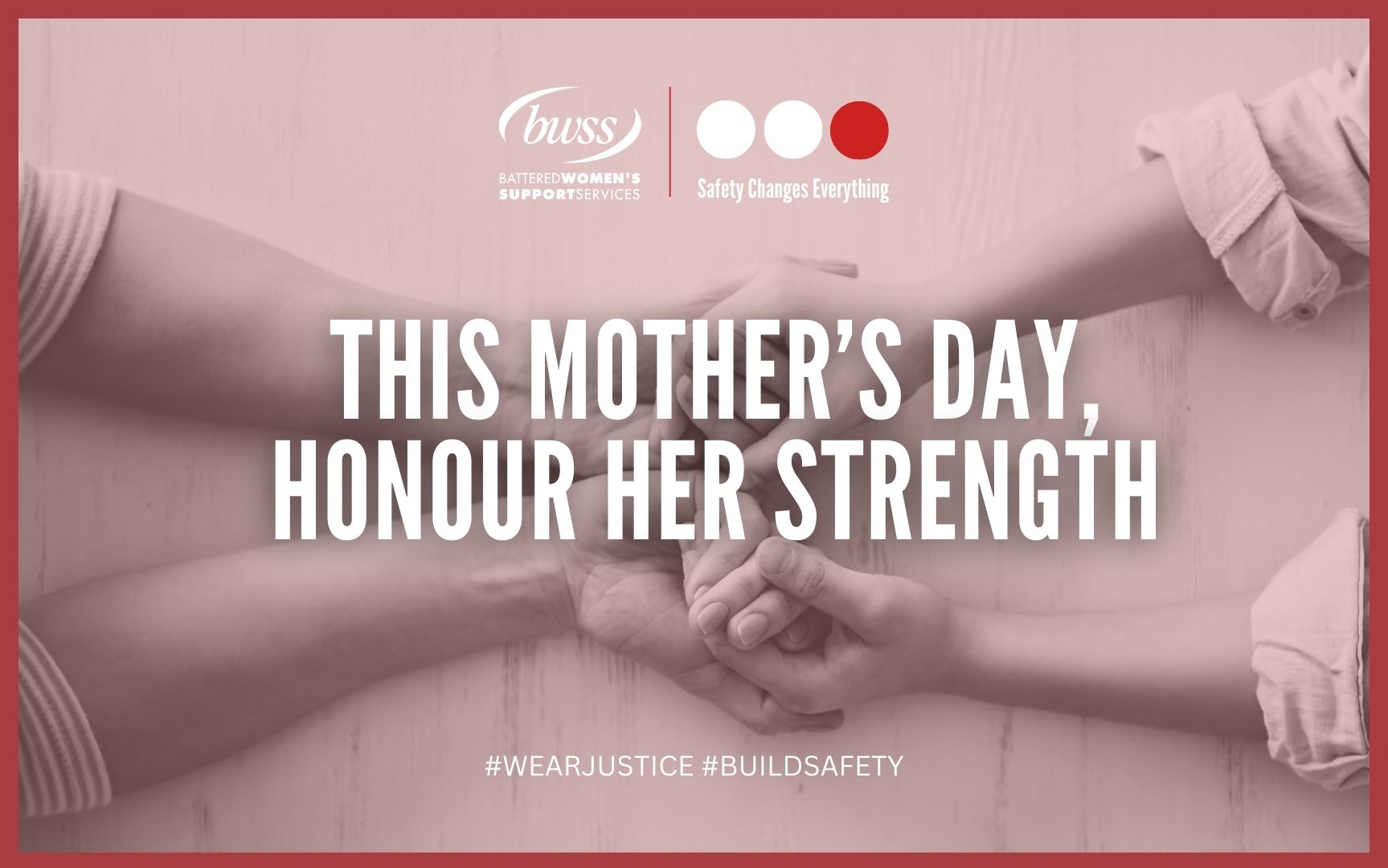
This Mother’s Day, honour a mother’s resilience by standing with her. Support is powerful. Let her know you are here.
May 7, 2025 | Battered Women's Support Services
Locker Room, Courtroom, Culture: Why We’re Still Not Asking the Right Questions About Sport and Sexual Violence
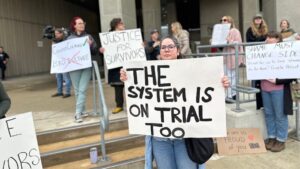
PHOTO: CBC source: https://www.cbc.ca/news/canada/london/livestory/recap-in-gruelling-cross-examination-woman-in-world-juniors-sex-assault-trial-denies-wanting-wild-night-9.6749607
What’s happening in a London, Ontario courtroom is about more than guilt or innocence. It’s about who we believe, who we protect, and what kind of country we are becoming.
Five former members of Canada’s 2018 World Junior hockey team—once celebrated as national heroes—are on trial for the alleged gang sexual assault of a young woman, known in court as E.M., in a hotel room following a Hockey Canada gala. Her account, brought forward with extraordinary bravery, is being examined under intense scrutiny. It is a story she has had to repeat and defend again and again—first to police, then to the public, now to a courtroom.
But this trial is not only about one night or five individuals. It is a national flashpoint. It is about the culture that raised them, the institutions that protected them, and the silence that made it possible. It is about power—who holds it, who it harms, and who it shields. It is about gender, justice, and the very foundation of Canadian sport.
We believe E.M. Not because she fits some perfect script of victimhood—but because what she describes is real, common, and systematically ignored.
We believe her because we’ve heard this story before—from women and girls across this country. The details shift, but the power dynamics are familiar: isolation, coercion, disbelief. A system that rewards silence. A courtroom that penalizes truth-telling. A public more ready to mourn a sport’s reputation than to confront its violence.
We are done pretending this is rare.
We are done pretending this is just about five men.
And we are done pretending this is just about hockey.
Because what’s on trial is not only a group of individuals. What’s on trial is a culture of entitlement, aggression, and male bonding that saturates competitive sport—amateur and professional alike.
And still, even now, we are not asking the deeper questions.
Why are we not interrogating the culture of sex and sexual violence in male sport?
- Why do group sexual assaults happen over and over again in sports teams—from high school locker rooms to NHL draft classes?
- Why is male team culture so often built on the degradation or objectification of women and girls?
- Why are coaches, executives, and governing bodies allowed to call it “horseplay” or “a lapse in judgment” rather than what it is—organized performances of violent masculinity?
- Why is sex used as proof of status, and silence used as proof of loyalty?
Let’s be clear: this is not about misunderstanding consent.
It’s about how male athletes are groomed by the culture around them to believe that consent isn’t even part of the story. In this version of masculinity—built and reinforced by coaches, peers, fans, and sponsors—sex isn’t intimacy. It’s a team sport. It’s conquest. It’s social currency. And when violence happens, it’s reframed as mistake, miscommunication, or moral ambiguity—anything but what it actually is.
And when survivors come forward?
They’re asked: Why didn’t you leave?
Why didn’t you say no?
Why are you coming forward now?
Why are you ruining these young men’s lives?
Rarely—almost never—do we ask:
Who taught these boys that women’s bodies are a place to bond?
Who told them that team unity is proven through silence about violence?
Who benefits when we see sports as sacred—but survivors as disposable?
This isn’t just about locker rooms. It’s about every institution that protects them – the presidents, the recording artists, the movie moguls, the financiers, and the hockey players.
Hockey Canada quietly paid sexual assault settlements with registration fees collected from parents across the country. Universities regularly conceal assaults by athletes to protect recruitment and funding. Entire leagues close ranks when someone breaks the code of silence.
These are not failures of oversight. They are the intended consequences of institutions that prize loyalty over justice, and brand protection over survivor safety.
We Believe E.M.—And We Know She’s Not the Only One
E.M. has described, in devastating detail, what happened to her. She has withstood days of cross-examination. She has been asked to defend her pain, her memory, and her humanity in a courtroom that was never built for her.
She is not just a witness. She is a truth-teller in a system designed to dismantle the truth.
And still—she spoke. She continues to speak.
That is courage.
That is resistance.
That is why we believe her.
But belief is not enough.
We must demand better from the sports systems that shape masculinity.
We must demand better from the justice systems that interrogate survivors instead of accountability.
We must demand better from each other.
Because this isn’t just about one case, one team, one woman.
It’s about what kind of society we are—and what we’re willing to become.
We believe E.M.
We believe survivors.
We refuse to stay silent.
And we’re not done asking questions.
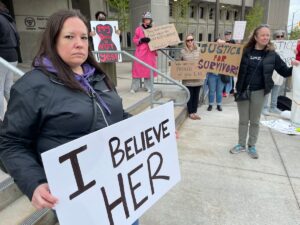
Jennifer Dunn, executive director of the London Abused Women’s Centre, outside London’s Ontario Superior Court, where five members of the winning 2018 world junior hockey team are on trial for sexual assault.
ROBYN DOOLITTLE/THE GLOBE AND MAIL
May 2, 2025 | Battered Women's Support Services
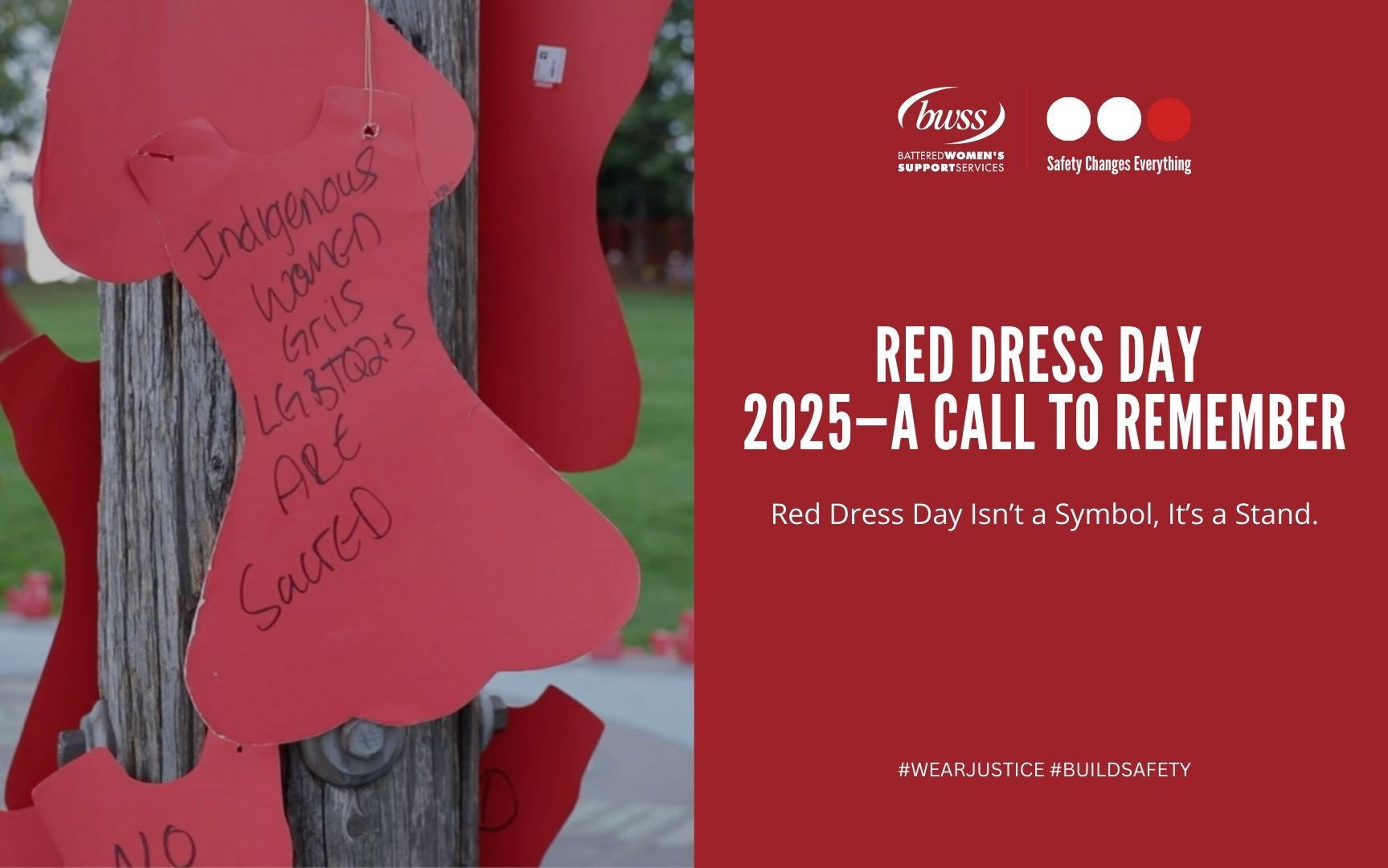
On May 5, red dresses hang in silence—marking the absence of Indigenous women, girls, and Two-Spirit
people who should still be with us. But we cannot let these dresses remain symbols.
They speak to an ongoing crisis—misogynist, racist, and economic violence—rooted in colonialism and
sustained by institutions that were never meant to protect us.
Indigenous women are being disappeared and killed by state violence, by men’s violence, and by the
cumulative impact of systems built on our disposability.
They are failed repeatedly by:
- Police, who ignore missing persons, mishandle cases, and treat Indigenous deaths with indifference. Noelle O’Soup’s death is one of too many.
- Child welfare, where newborn Indigenous babies are taken from their mothers, severing family bonds and repeating the trauma of residential schools.
- Group homes, often co-ed, where Indigenous girls are warehoused without safety or support, and left vulnerable to abuse, trafficking, and disappearance.
- Workplaces, where Indigenous women face sexual harassment and retaliation for speaking out.
- Homes, where women are trapped in violent relationships without access to housing, income, or safety.
- Courts and social services, which blame Indigenous survivors, denying support, or criminalize Indigenous women and girls for trying to survive.
This is not a series of isolated incidents—it is a pattern of systemic targeting starting through the making of
Canada as a nation.
The 231 Calls for Justice from the National Inquiry remain largely ignored. We are now without a
federal Minister for Women and Gender Equality, even as the crisis deepens. Indigenous women and girls
remain over-policed, under-protected, and shut out of the systems that claim to serve them.
At BWSS, we are not waiting for change—we are aligning with Indigenous Women to create it.
Through our Indigenous Women’s Program, we support women and Two-Spirit people navigating violence,
poverty, grief, and survival.
With the leadership of our Elder, the commitment of our staff and volunteers, and the presence of
the Wildflower Women of Turtle Island Drum Group, we continue this work in community, on the frontlines,
and in ceremony.
We don’t mark this day with symbols alone.
We show up because we have to.
Because lives are still being lost.
Because the systems causing this violence are still in place.
And because Indigenous women, girls, and Two-Spirit people deserve more than remembrance—they
deserve safety, justice, and a future.
Red Dress Day isn’t a gesture.
It’s a line we hold.
And we’re holding it—together, in community, with clarity and purpose.