Violence Against Women as a Psychiatric Disorder

The View of the Impact of Violence Against Women as a Psychiatric Disorder is a Choice that Furthers the Violation and Oppression of Women Trauma Survivors

by Samantha Kearney, BWSS Manager of Retail Services and Programs

I wrote this article to share what I witnessed,  heard, and what I believe based on my long-term counseling work with women who have experienced a multitude of violences and horrors at the hands of others. I heard countless women who shared with me their experiences within the helping systems such as psychiatry how they were silenced and disempowered.

I worked with women who shared that they have been in the psychiatric system for 20, 10, 5 years without ever talking about the violence they experienced in their lives. I  worked with women who struggle to understand the labels that have been thrown upon them – “manic depressive”,“schizophrenic”, “bipolar”. I worked with women who are so heavily medicated by anti-psychotic drugs who tell me they want to feel again. I asked women who have been in therapy for most of their lives and have not shared their history of abuse why that is…I get the responses, “My therapist doesn’t work with abuse”, “I was told it would be too much for me to handle if I talked about it”, “I was told not to share my abuse in the group… that it is not the place”. When I ask women about their understanding and meaning of the diagnoses put upon them, many reply that they are confused and have no understanding of those labels. When I hear their histories most often abuse precedes the manifestation of the “psychiatric symptoms”. When I ask women if their “symptoms”/”diagnoses” were ever linked to the trauma they experienced, many reply no. When I offer them information about the common reactions of abuse and trauma, such as intense emotions, swings in moods, depression, anxiety, panic attacks, intense fear, high vigilance, and so forth, many ask why this information was not shared with them by their doctor, therapist, psychiatrist and many feel a huge sense of relief, validation, and normalization.

Now, it is true that when we open and explore our “boxes of trauma”, it can be overwhelming and it can throw us for a spin that may compromise our safety (e.g., physical, emotional, social, spiritual). Being abused by others who are suppose to love and take care of us impacts our whole being and hurts us to our very core. So yes, when we open our “trauma box” and begin to share, we need to do so in a safe way (e.g., connected to what we are sharing and how much), with a safe person (e.g., one who will not judge, criticize, or hurt us), in a safe place, and have a sense of how we are going to take care of our selves afterwards (e.g., safety plans for our emotions and body). “Safety” is an umbrella term that signifies various elements such as reducing self-injurious behaviours, establishing physical safety from an abusive partner, reducing suicidality, gaining control of ways of coping such as dissociation/ disconnecting from oneself and the present. It is important before exploring past abuse, women have a level of safety in their present life. This does not mean women need to be shut down and silenced when they share a bit of their past. In our world today, complete safety for a woman is not attainable right now.
trauma

Women today continue to live and navigate in a world full of oppressive forces to keep them down and disempowered. “Simply living in the body of an oppressed person is traumatic and exhausting” (Women Making Waves, Volume 18, Issue 3, 2007). Women sharing a word or two or even a past incident of abuse, the listener can listen to it and does not need to jump to shut her down. Listening and grounding her sharing in the present and within the container of the counselling relationship and room can provide the necessary safety. Exploration of past traumatic material is critically important because it is through directly processing the trauma memories that they no longer have such an emotional hold and power over the woman.

So I hope we, listeners and helpers, do not assume and judge a woman’s safety by the label and diagnose she has. I hope we assess with the woman herself what safety is, what safety she would need to do trauma based counselling, and how we can best support her in doing that work. I do not want our, ‘helpers’, judgements and own fears to silence women that would only be furthering and perpetuating the oppression women trauma survivors experience. We, helpers, need to remember that it was and is that woman herself who wants to share her pain and wounds of trauma that has been the one who has lived, managed, and survived those horrors. It is that woman who holds within her the strength, the courage, and the tools to overcome abuse. We, helpers, need to see that and need to work and build upon those strengths rather than seeing the woman as some sort of fragile being.

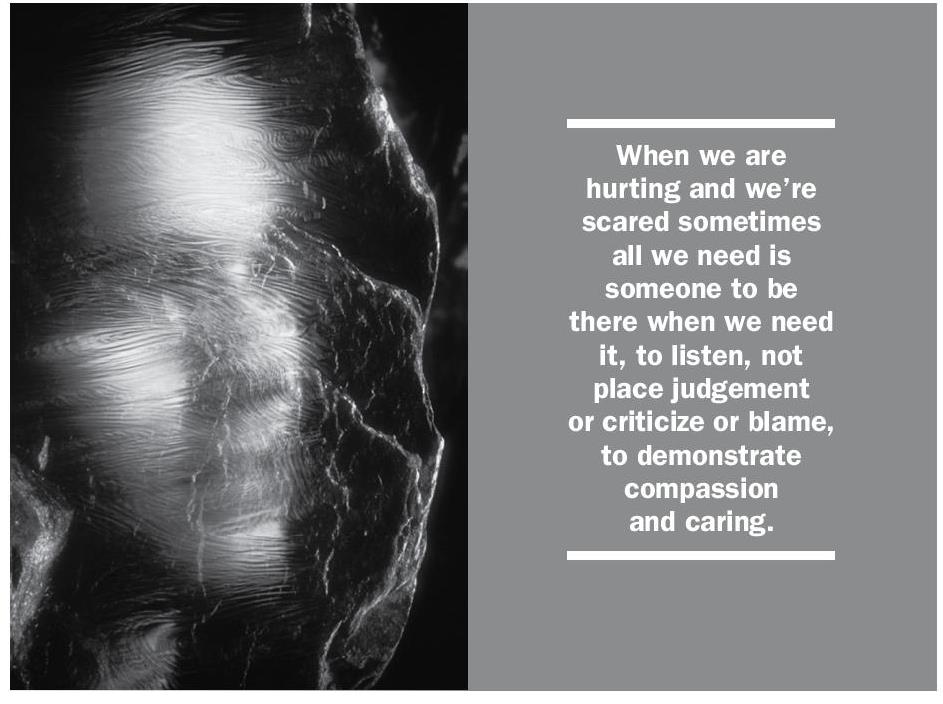
As stated in our past newsletter article (Women Making Waves, Vol.18, Issue 3, 2007), “The work we do is complex for sure, it is informed by trauma theory, addiction theory, attachment theory, anti-oppression analysis, family systems theory…the work of the researchers and academics…at the end of the day it is very simple, really…When we are hurting and we’re scared sometimes all we need is someone to be there when we need it, to listen, not place judgement or criticize or blame, to demonstrate compassion and caring. And that is what we are all about at BWSS…”.

If you want information about interpersonal trauma/ abuse and its impact, two useful resources you can check out are Judith Herman, Trauma & Recovery, and Charlotte Kasl who looks both at trauma and addiction.

If you are wanting information and support regarding the trauma you have experienced, please check out our Healing from Trauma through Empowerment Groups and our Stopping the Violence Counselling Program on our website  and/or call our Intake & Crisis line at 604-687-1867. All our services are free and confidential.

Last year, Battered Women’s Support Services responded to over 10,000 crisis calls from women and girls to get help and end violence. We could not provide this essential support without your contribution.


images

Awareness, Empowerment and Action

by Elissa Bell

I contacted BWSS in October 2012 on the advice of an alcohol and drugs counsellor.  I had suddenly become overwhelmed by trauma, intrusive thoughts and I knew I needed help. When I called BWSS, they ensured me they could help but I would need to be put on a waiting list. Six months later, I started a psycho-educational group with BWSS called Awareness, Action and Empowerment. I have since been in two trauma groups and a new Narrative group that is absolutely amazing!

I had never been able to feel for myself, or see anything as “abusive” if it happened to me. Here, at BWSS, that belief is being challenged. As I opened my heart to feel for the women in group, and cried with them, and felt angry for them, I began to see myself differently. This insight is now leading me to have some compassion for myself as well.

WOMAN-EMPOWERED-ON-TOP-OF-THE-WORLD

I come from a place that having heard so often that “it WAS my fault and didn’t deserve to live”.  I believed it at 8 when I first contemplated taking my own life.  For the next 7 years, family life just got worse. So at 15, I left home and thus began my goal of trying to get away from myself by partaking in many addictions – all just to get away from the pain and hurt of: sexual molestations; sexual assaults; incest; battery; bullying; group beatings; and spousal abuse.  At 49 years old, I had not dealt with any of them. Today, I am a year into working on the physical traumas, I have a great support network set up, I am coming up to 12th years free from substance abuse, 8 years free from suicidal ideation, 10 years from being in a relationship and, I am a non-smoker!!! 4 ½ years now.

I am getting so much help from these women and am so grateful. What I see within myself is a new way of questioning, of challenging the old stories/believes. Who put them there? How are they affecting me? Do I want to take responsibility and do something different? And, because of the supporting, caring environment with BWSS, I plan on sticking around BWSS as long as they’ll have me.

I Love Me Written inside a Heart Drawn in SandI would want other women to know that it is worth the pain of digging in and finding our truths. It is permitted for us to share what we’ve been told to keep secret. There are people you don’t know yet, that you can help by telling your story and if you can’t tell your story yet, there is so much to gain of giving our time to listen to and validate another woman’s story. There is help. Yes!!! It is hard to ask for and harder still show up to get it, but it is only by doing this, by risking and taking chances that we can change. I don’t like what I’m going through, I cry, make weird honking noises, use my sleeve at times to wipe my nose and the tears away – but I’m ok with that today!!! I can feel for me now, a little, when I never could before.


Last year, Battered Women’s Support Services responded to over 10,000 crisis calls from women and girls to get help and end violence. We could not provide this essential support without your contribution.

images

The Truth about the “Truth and Reconciliation Process”

by Terriea Harris, BWSS Indigenous Women’s Outreach Counsellor

truth and reconciliation

She was taken by Indian Agents from her community and put on a bus towards a destination unknown. Upon arrival, her hair was cut, her traditional clothes changed to a generic uniform, she is forbidden to speak her language, sing her songs or deal with the abuse by the hands of priest sand nuns.  As she recounts  her story, a camera shines its glaringly bright lights, while another media camera weaves in and out amongst the witnesses, zooming in for a close ups of reactions to the horrific details she shares.  She gets to the part where she speaks of the ongoing impact of the abuse she endured and breaks down, crying uncontrollably.  I cannot hold in my tears any longer, watching an elder’s body physically collapse to the point where she needs to be held up by supporters is too much too bear.  A woman comes over and asks for my tissue with my tears in it; the tissues are to be burned in the sacred fire. The tears keep flowing and I acknowledge that my sadness is only secondary to my anger.

truth

As some have argued, it should not be the responsibility of survivors to educate the rest of society of the institutionalized abuse and neglect they experienced because of racist, colonial, governmental policies executed by the church. While, the Indigenous Women’s Program at BWSS was present at the Truth and Reconciliation events held at the Pacific National Exhibition, it was not without reservation as to how the “retelling”- done in a way that more resembled “reliving” of the traumatic experience- could be re-victimizing for residential school survivors.

walk-for-reconciliation-0130922photo credit: CBC

Being mindful of the potential impact for re-victimization, the Indigenous Women’s Program (IWP) was present throughout the events to support.  We integrated traditional healing modalities such as smudging with the opportunity for women survivors to connect one-on-one throughout the 4 days.  Women that access the IWP program at BWSS, as well as, women that access BWSS’ Women’s Safety and Outreach Program expressed gratitude to be able to smudge or connect whenever needed.

BZt9vfeCEAARxIG

As the Indigenous Women’s Outreach Counsellor, part of my work is to connect with women from the Downtown Eastside (DTES) Community.  Indigenous women are overrepresented in the community. When we analyze Indigenous Women’s experience in the context of the collective trauma experienced as a result of Colonization and its ongoing racist power over mandate, we have a population of women and girls that are constantly being “overlooked” thereby, making them vulnerable to predators.  I believe this is why some of the women that I connect with shared that they found the truth and reconciliation process to be a positive experience. .  For 4 days, during The Truth and Reconciliation, women did not have to justify coping with substances or justify the reasons why she engages in survival sex work or be asked about the pattern of abusive relationships.

Indigenous women and girls of the DTES community experience violence and abuse at disproportionate rates.  When women of the community engage with our Women’s Safety and Outreach Program as to what their needs are, violence is too often viewed as “the norm”, therefore, support around her experience of violence is minimized in favour of getting her basic needs met such as housing and food. During the TRC, the spotlight was on her experience of racist Colonial practices of the residential school system and the impact it has on her today. She was given space to feel as though she would not be judged or blamed for her experience, rather her experience could potentially be understood and facilitate a dialogue within the context of Colonial practices.

TRC_3

             This space to be “listened to” and to “not be judged” is of a high priority for all the programming we engage in at BWSS, but is fundamental to the Women’s Safety and Outreach Program. In this program, we engage with women where they are at- literally and figuratively.  We recognize the many intersecting oppressions that women of the community are navigating. We provide services that are low barrier and survivor-centric. During the Truth and Reconciliation, the IWP collaborated with The Women’s Safety and Outreach Program (WSAOP), to ensure that support services were available both day and evening. Some women shared that they needed to be in nature, and the WSAOP accompanied them to Stanley Park where they could have time to reflect on the day’s events.


Last year, Battered Women’s Support Services responded to over 10,000 crisis calls from women and girls to get help and end violence. We could not provide this essential support without your contribution.
images

What Can I Do To Help My Friend?

20131129-105308.jpg

When our friend, family member, loved one is living with abuse by an intimate partner, we have a key role in supporting their journey.

You may be the only person that they can trust.  Please read on for tips and tools and become an empowered bystander with the knowledge to help a friend.

Violence in an intimate relationship is a systematic pattern of domination, where the abuser uses abusive tactics designed to maintain power and control over the woman.  The Power and Control Wheel was developed by Domestic Violence Intervention Program based in Duluth, Minnesota.  The P and C Wheel provides a good illustration of the tactics used by an abuser.

Remember:  You may be the only person your friend can trust.  Be attentive, believe what she says, tell her you care, and show her you are willing to help.

•    Reassure your friend that she does not cause the abuse.  An abuser learned to use violence as a way of expressing anger or frustration long before he/she met your friend.
•    Physical safety is the first priority.  Women frequently minimize the violence because abuse usually gets worse over time.  Ignoring the abuse is dangerous.  Explain this to your friend and help her to make an emergency safety plan by obtaining transition house phone numbers and considering police and legal protection.
•    Tell your friend she is not alone.  Abuse happens to many women, of all income and educational levels, in all social classes, in all religious and ethnic groups.
•    If she is not ready at this point to make major changes in her life, do not take your friendship away from your friend.  Your support may be what will make it possible for her to act at a later date.
•    Give your friend BWSS’s brochures, website link, which have information and resources of help for women.
•    Help your friend with her self-esteem.  Tell her what you admire about her; why you  value her as a friend; what are her strengths and special qualities.
•    Support her emotions:  fear, anger, hope, grief in the loss of her relationships, etc.
•    Help with children:  they need support for their feelings, to know the reality of what is going on, to know they are not to blame.

Be supportive and willing to listen

•    Let your friend know that you believe what she has told you – chances are, the situation is worse than she is letting on.
•    Encourage, but do not pressure your friend to talk about the violence.  Allow her to say as much or as little as she wants in her own words.
•    Offer to accompany her to the police, transition house, or any other place she is frightened to approach for help.  Your presence will help her to be strong and will show her that she is not alone.
•    No matter how tempting it is to bad-mouth her partner, stop yourself and try to focus on the abuse as the problem.  Most women love their partners and want the violence to stop, but they want the relationship to continue.

Allow your friend to make her own decisions

Remember:  You may be the only person that can see your friend through a life without violence.  Don’t give up on her – just because the decisions she makes are different from the ones you might make doesn’t mean she doesn’t want or need your support.  If she is not ready to leave at this time, please read p. 1 of this brochure.

Men/women who use violence do so as a way of controlling their partners.  A woman who has been assaulted may come to believe that she can have no control over her life and that her ability to make decisions is flawed.  To help her feel more confident and regain control over her life:

•    Let her know that there are no simple solutions but that change is possible.  The first step is to look after her safety.
•    Point out different options available to your friend, and help her to evaluate each one.  Your role as a friend is to support, not rescue.
•    Allow her to decide which option is best for her.  If you strongly disagree, remember that it’s her life, not yours.
•    Let her know that you’ll stand by her no matter what she decides.

Help make a safety plan

Remember:  Assaults rarely occur only once.  They usually get worse and more frequent with time.  Helping to develop a safety plan may be the best way to help your friend protect herself from further harm.  And if she doesn’t use the plan this time, she may next time, or the time after that.

A safety plan is a plan of action for when an assault occurs, or is about to occur.  To help your friend develop a plan which will work for her, the following information is needed:

•    When do the assaults usually occur?  Are they predictable?
•    What does her partner do or say before he/she assaults her?
•    Where can she go before an assault occurs to keep her and her children safe?  Is there an understanding friend or relative that can provide her shelter?
•    Does the presence of a third person reduce the chance that her partner will assault her?  If so, can she invite someone into her home over-night?
•    If she can’t get out before an assault, how can she get help afterwards? Where can she go, who can she call, and how can she get herself to a safe place?

You can get more information about safety planning by calling the BWSS intake/crisis line or a transition house/crisis line in your area.  The important thing is to help her develop a plan which goes in logical order from the time the assault occurs (or is about to occur) until she reaches safety.

If you are going to help me…

Help me to help myself

1.    Please be patient while I decide if I can trust you.

2.    Let me tell my story, the whole story in my own way.

3.    Please accept that whatever I have done, whatever I may do is the best I have to offer and seemed right at the time.

4.    I am not “a person.”  I am this person, unique and special.

5.    Don’t judge me as right or wrong, bad or good.  I am what I am and that’s all I’ve got.

6.    Don’t assume that your knowledge about me is more accurate than mine.  You only know what I have told you.  That’s only part of me.

7.    Don’t ever think that you know what I should do.  You don’t.  I may be confused, but I am still the expert about me.

8.    Don’t place me in a position of living up to your expectations.  I have enough trouble with mine.

9.    Please hear my feelings, not just my words.  Accept all of them.  If you can’t, how can I?

10.    Don’t save me or try to “fix” my situation.  I can do it myself.  I knew enough to ask for help, didn’t I?

photo (1)

Increase your knowledge

Remember:

The better informed you are, the better able you will be to help her.

•    Find out more about the issue of violence against women by contacting a transition house or BWSS.  These agencies can also talk with you in confidence about your friend’s situation and provide some helpful information.
•    Make a list of phone numbers of agencies and individuals who can offer services to your friend.  Call BWSS for more information about these services.

Taking care of yourself

Remember:

There are no simple solutions for your friend.  If you have a friend who is hurting, don’t ignore the violence.  You may be the one link she has to a world without violence.

Helping a friend who is in an abusive relationship is often stressful and can be dangerous.  You need to look after your own physical and emotional well-being.

•    Don’t confront your friend’s partner about the violence.  The partner will likely make it even more difficult for you to see your friend and could become violent towards you.

•    Talk with resource persons about your feelings, fears, frustrations, and reactions to the abuse.  You can do this without giving away your friend’s name or betraying her confidence in any way.

* Some of the material in this publication is borrowed from an Education Wife Assault (Toronto) handout, and a Yukon Public Education Association brochure.

Here is how you contribution help end violence against girls and women.

images

Take Back Your Power! Planning For Safety in Abusive Relationships

outhewindowViolence against women continues as an epidemic. Planning for safety can be one way women can take back power in abusive relationships.  One in three women, in their lifetime, experience abuse including emotional, physical and/or sexual violence in an intimate relationship. The abusive partner is completely responsible for their behaviour and for ceasing the use of violence and abuse.

If you’re in an abusive relationship, planning for safety can help you evaluate, define options and opportunities for liberation and freedom. The risk of lethal violence increases during or just after a woman has left an abusive partner, therefore planning for safety is critical.

Take Back Your Power!

“Just as abusers continually shift their tactics of power and control, your safety plan is an adaptable tool to help keep you safe in your ever-changing situation.[1]

Safety is always at the centre of our work at Battered Women’s Support Services. You may call BWSS Crisis & Intake Line at 604-687-1867 or toll free at 1-855-687-1868 for support and information.

If you are in an abusive relationship, remember that reading or researching online may also present risks, you can log off the page quickly by clicking the EXIT button on the of the page.

224309_10151586997154375_276146488_n

The following steps represent my plan for increasing my safety and preparing in advance for the possibility for further violence. Although I do not have control over my partner’s violence,I do have a choice about how to respond to him/her and how to best get myself and my children to safety.

PERSONALIZED SAFETY PLAN

Safety during a violent incident. Women cannot always avoid violent incidents. In order to increase safety, women may use a variety of strategies. I can use some or all of the following strategies:

A. If I decide to leave, I will _________________________________. (Practice how to get out safely.

What doors, windows, elevators, stairwells, or fire escapes would I use?)

B. I can keep my purse and car keys ready and put them _______________________ (place) in order to

leave quickly.

C. I can tell _________________________________ about the violence and request they call the police

if they hear suspicious noises coming from my house.

D. I can teach my children how to use the telephone to contact the police and the fire department.

(Be careful about placing responsibility on children.)

E. I will use _________________ as my code word with my children or my friends so they can call for help.

F. If I have to leave my home, I will go _________________________. (Decide this even if I do not think there

will be a next time.) If I cannot go to the location above, then I can go to ______________________________ or ________________________________.

G. When I expect we are going to have an argument, I will try to move to a space that has fewer risks, such as __________________________. (Try to avoid arguments in the bathroom, garage, kitchens, near weapons, or

in rooms without access to an outside door.)

H. I will use my judgment and intuition. If the situation is very serious, I can give my partner what he/she wants to

calm him/her down. I have to protect myself until I/we are out of danger.

Safety when preparing to leave. Risk of harm and violence often escalates when a woman decides to leave

an abusive relationship. I can use some or all of the following strategies:

A. I will leave money and an extra set of keys with ___________________________ so I can leave quickly.

B. I will keep copies of important documents or keys at __________________________________.

C. To increase my independence, I will open an individual savings account by _______________________ (date), or

I will find a safe place to hide cash.

D. Other things I can do to increase my independence include: _____________________________________________________________

E. Battered Women’s Support Services number is 604-687-1867. I can seek a transition house by calling Victim Link 1-800-563-0808. I will call ahead of time to find out the procedure for admission to the transition house.

F. I will check with ____________________________________ and ________________________ to see who would be able to let me stay with them or lend me some money.

G. I can leave extra clothes with _________________________________.

H. I will sit down and review my safety plan every ______________________ (no more than six weeks) in order to plan the safest way to leave the residence. _____________________________ (an advocate or friend) has agreed to help me review this plan.

I. I will rehearse my escape plan and, as appropriate, practice it with my children.

J.  If and/when I leave I will take all my children with me.

Safety in my own residence. There are many things that a woman can do to increase her safety; these measures can be added step by step. Safety measures I can use include:

A. I can change the locks on my doors and windows as soon as possible.

B. I can replace wooden doors with steel/metal doors.

C. I can install security systems including additional locks, window bars (not generally recommended due to fire escape hazards), poles to wedge against doors, an electronic system, etc.

D. I can purchase rope ladders (“fire ladders” are available from hardware and discount stores) to be used for escape from second floor windows.

E. I can install smoke detectors and purchase fire extinguishers for each floor in my house/apartment.

F. I can install an outside lighting system that lights up when a person is coming close to my house (motion detectors).

G. I will teach my children how to use the telephone to make a collect call to me and to ________________ (friend/family/other) in the event that my partner takes the children.

H. I will tell people who take care of my children which people have permission to pick up my children and that my partner is not permitted to do so. Some will require a court order. The people I will inform about pick -up include:

____ (school),____ (day care staff),____ (babysitter),____ (teacher), and____ (others such as neighbors).

Safety with a Protective Order. I recognize that I may need to ask the police and the courts to enforce my Protective Order. The following are some steps that I can take to help the enforcement of my Protective Order:

A. I will keep my Protective Order (and/or probation orders or other such legal documents) __________________________________ (location). (Always keep it on or near my person. If I change purses that is the first thing that should go in it.)

B. The telephone number for the Crown Counsel and local law enforcement agency is _______________.

C. I can call Battered Women’s Support Services if I am not sure about protection orders, or if I have some problems with my Protective Order. The number to call is 604-687-1867.

D. I will inform my employer, my closest friend, and _____________________________ (other) that I have a Protective Order in effect. (I may give them copies, too.)

E. If my partner violates the Protective Order, I can call the police and report a violation, contact the Crown Counsel, and/or call my advocate. (Make sure it gets documented!!!)

If the police do not help, I can contact my advocate or Watch Commander at the Police Department to file a complaint.  My advocate’s name is ______________________ and phone number is _________________. The Crown Counsel’s name is ____________________and phone number is ____________________.

Safety on the job and in public. Each woman must decide if and when she will tell others that her partner has battered her and that she may be at continued risk. Friends, family, and coworkers can help to protect women. Each woman should consider carefully which people to invite to help secure her safety. I might do any or all of the following:

A. I can inform my boss, the security supervisor, and ______________________________ (other) at work of my situation.

B. I can ask _____________________________ to help screen my telephone calls at work.

C. When leaving work, I can __________________ _____________________________.

D. When driving home, if problems occur, I can_____________________________________________.

E. If I use public transit, I can ____________ _____________________________.

F. I can use different grocery stores and shopping malls to conduct my business and shop at hours that are different from those hours in which I shopped when I resided with my battering partner.

G. I will always remember to be careful and watchful of my surroundings.

Safety and drug or alcohol use. The use of any alcohol or other drugs can reduce a woman’s awareness and ability to act quickly to protect herself. Furthermore, the use of alcohol or other drugs by the batterer may give him/her an excuse to use violence. Therefore, in the context of drug or alcohol use, a woman needs to make specific safety plans. If drug or alcohol use has occurred in my relationship, I can enhance my safety by doing some or all of the following:

A. If I am going to use, I can do so in a safe place and with people who understand the risk of violence and are committed to my safety.

B. I can also _________________________________________________.

C. If my partner is using, I can _____________________________.

D. To safeguard my children, I might ________________________________________ and _____________________________________.

Safety and my emotional health. The experience of violence is usually exhausting and emotionally draining. The process of building a new life for myself takes MUCH COURAGE AND INCREDIBLE ENERGY. To conserve my emotional energy and resources and to avoid hard emotional times, I can do some of the following:

A. If I feel down and ready to return to a potentially abusive situation, I can

______________________________________ and  ___________________________________.

B. When I have to communicate with my partner in person or by telephone, I can ________________________________ and ___________________________________.

C. I can try to use “I can …” statements with myself and to be assertive with others.

D. I can tell myself “__________________________________________” whenever I feel others are trying to control me.

E. I can read ___________________________________________ to help me feel stronger.

F. I can call ____________________________________, __________________________________, and _____________________________ as other resources to be of support to me.

G. Other things I can do to help myself feel stronger are ______________________________________ and _______________________________________.

H. I can take care of myself by _____________________________________________________.

I. I can attend workshops and support groups at Battered Women’s Support Services or _______________________________________, or ____________________________________ to gain support and strengthen my relationships with other people.

Items to take when leaving. When I leave, I should take:

Identification for myself such as birth certificate, immigration documentation, passport

Children’s birth certificates, passports

Social Insurance cards, medical records (all family members)

School and vaccination records, insurance papers

Driver’s license and vehicle registration

Money Marriage/divorce certificates

Cheque book, ATM card, address book

Credit cards, picture IDs

Keys: House, car, office

Medications

Children’s favorite toys and/or blankets, items of special sentimental value

You can download Personalized Safety Plan here.

Last year, Battered Women’s Support Services responded to over 10,000 crisis calls from women and girls to get help and end violence. We could not provide this essential support without your contribution. images


[1] The Missouri Coalition against Domestic Violence, A Framework For Understanding the Nature and Dynamics of Domestic Violence

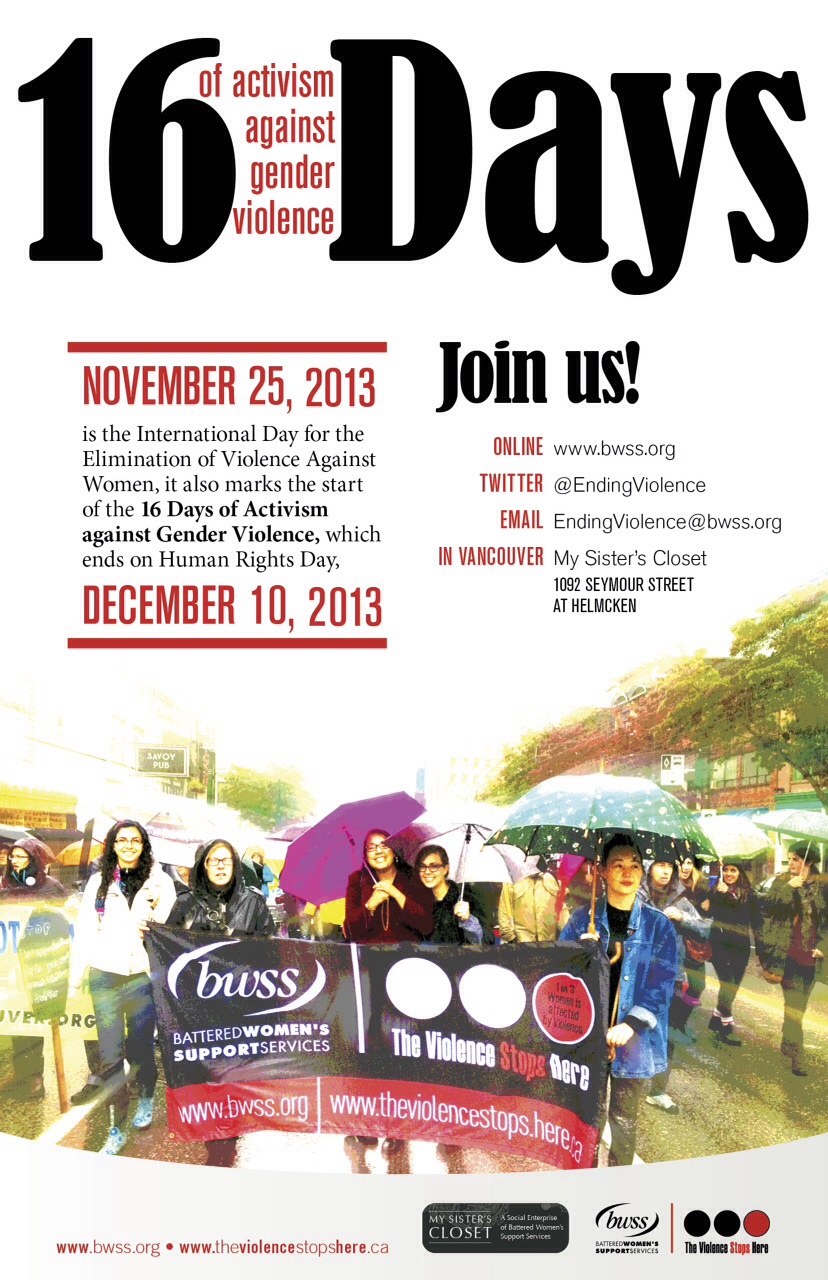
16 Days of Activism Against Gender Violence

16 Days of Activism Against Gender Violence

November 25th is the International Day for the Elimination of Violence Against Women, it also marks the start of the 16 Days of Activism against Gender Violence, which ends on Human Rights Day.

Join us!

November 25, 2013 to December 10, 2013

Online via our Ending Violence Blog: bwss.org

Twitter: @EndingViolence

Email: EndingViolence@bwss.org

In Vancouver: My Sister’s Closet

1092 Seymour Street Vancouver, BC,

Coast Salish Territory

16 Days of Activism Against Gender Violence